
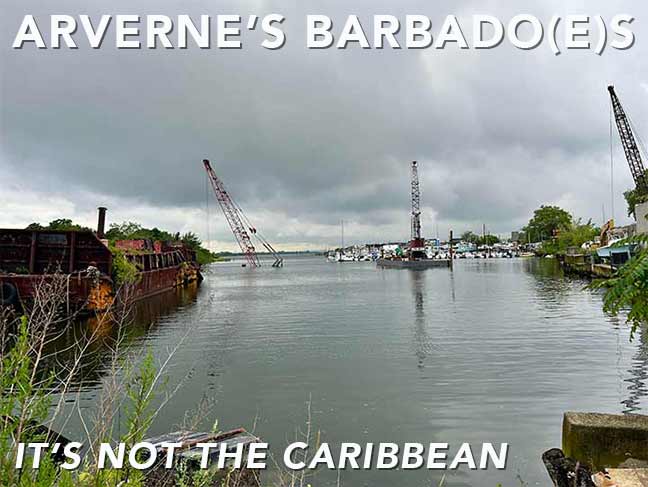


New York is filled with Dutch names resulting from its history. On the Rockaway peninsula, Amstel Boulevard takes its name from Amsterdam’s namesake river. Running for five blocks, it can hardly be called a boulevard, but its name hints at ambitious plans that were never realized.
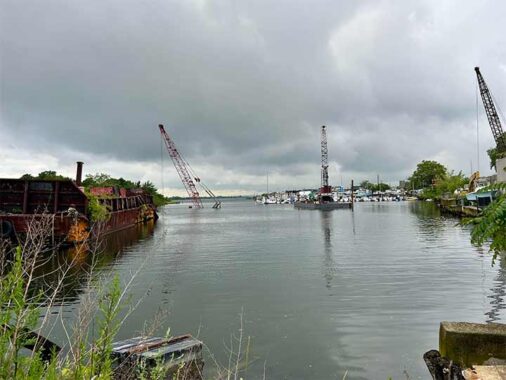
Following the death of Arverne’s namesake developer Remington Vernam, attorney Louis J. Somerville took over the real estate business here. He also left his name on the map, with Somerville as the designation for the blocks on the peninsula’s bay side in the Beach 70s. This section of Arverne is a mix of industrial and residential. At Vernam Basin, an abandoned barge and crane slowly sink into the channel, unintentional monuments of a working waterfront.
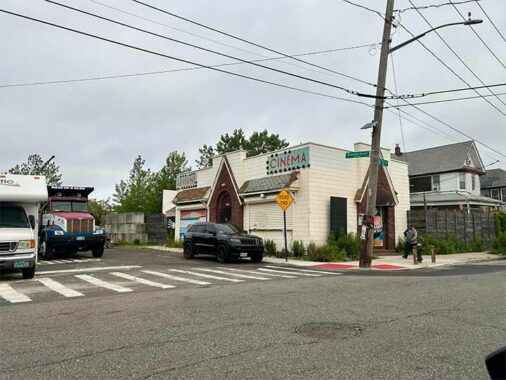
A couple of blocks from Somerville Basin is a creative venue, the peninsula’s sole movie theater, Arverne Cinema which hosts the nonprofit Rockaway Film Festival. The site has two screens, indoor and outdoor in addition to screenings at other locations on the peninsula. Prior to Arverne Cinema’s founding in 2018, the last commercial movie theater in the Rockaways closed in 1996. The Wave has a detailed essay on other nearby former theaters.
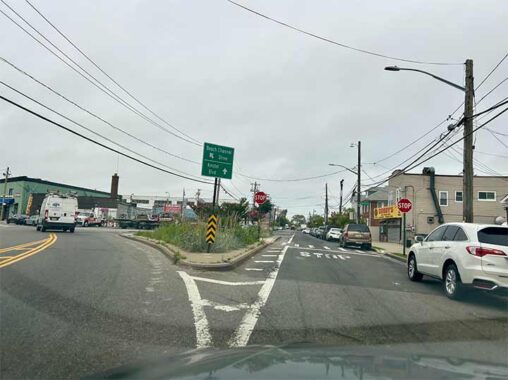
The unrealized element proposed by Somerville was a canal on Amstel Boulevard that appears on maps from the turn of the 20th century. Rather than naming this road after Venice, Somerville had it named for another city famous for canals. Don’t assume that Amstel has any relation to Holland, the neighborhood near Beach 90th Street. Like the Holland Tunnel in Manhattan, it’s named for a person, not the country. Michael P. Holland was a developer in this section of the Rockaways.
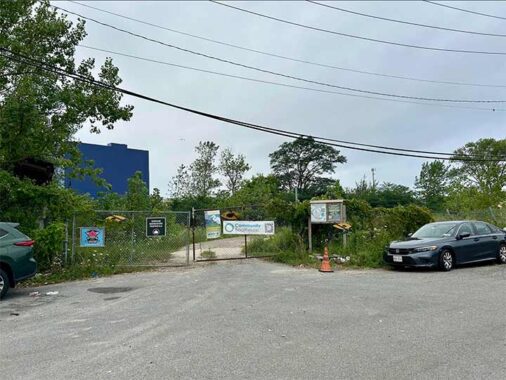
Amstel Boulevard runs through an industrial section of Arverne, where cars are repaired and boats are stored. At its western tip is Vernam Barbadoes Peninsula. Previously a storage area for boats, it was designated as parkland with the nonprofit Community Boathouse storing its vessels here. The peninsula is mostly parkland, with a smaller parcel used by a construction equipment company. In 1988, the city commissioned a historical survey of Vernam Barbadoes, noting its 20th century transformation from residential to industrial.
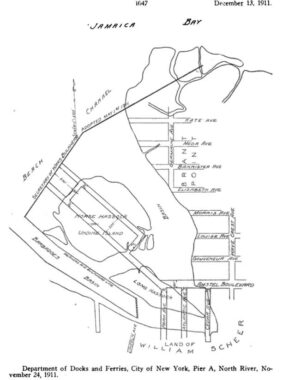
This knob of land has a long history as a long-forgotten island that was fused to the Rockaway peninsula. In 1911, it appeared in a petition submitted to the city by property owners William and his son Robert Scheer, (pages 1042 to 1052) seeking to determine the high water line here as the city was mapping out bulkhead and pierhead lines around Jamaica Bay.
Their letter noted the past ownership of Horse Hassock, also known as Undine Island, starting with colonial governor Thomas Dongan’s assigning of title of this marshland to John Palmer, which then passed through a series of owners leading to the Scheer brothers. The petition contained a map of their two islands with Amstel Boulevard mapped to run on top of them. Prior to the city’s expansion in 1898, William Scheer served as mayor of the village of Arverne.
According to Rockaway Wave, Scheer was a diamond merchant who also made his money in its carbon relative coal, running the Black Diamond Coal Company, which had its dock at the head of Vernam Basin. Its neighbors included lumber yards, an ice house, boat repair shops, and other coal companies. By the mid-20th century, the peninsula was under the jurisdiction of the Port Authority of New York and New Jersey before its transfer to the Parks Department.
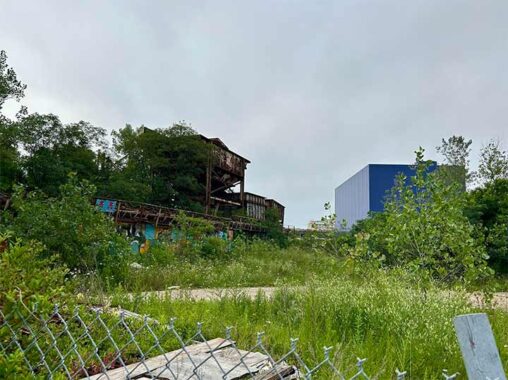
Similar to Concrete Plant Park in the Bronx, Vernam Barbadoes Peninsula has industrial ruins left by concrete companies who relied on the docks here for their materials.
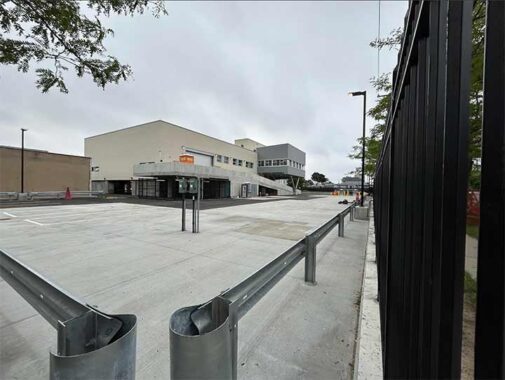
At Beach 75th Street, the Parks Department built its Rockaways operations center, which stands high above a parking lot, safe from a 100-year flood. It replaced a small garage that stood here until 2025. Fitting with the agency’s mission, this parcel of parkland isn’t a park but the building was designed with sustainability standards to minimize its environmental impact. This is where all Parks staff on the peninsula are assigned their roles.
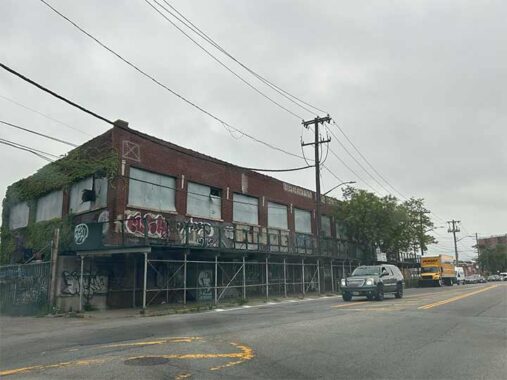
The Brooklyn Day Camp at Beach 75th Street and Beach Channel Drive operated here until 1981, its name visible on the vacant building facing the elevated tracks. It had a sizable property that extended back to the peninsula. Among the distinguished alumni of this camp are historians Ellen Levitt and Alyssa Loorya.
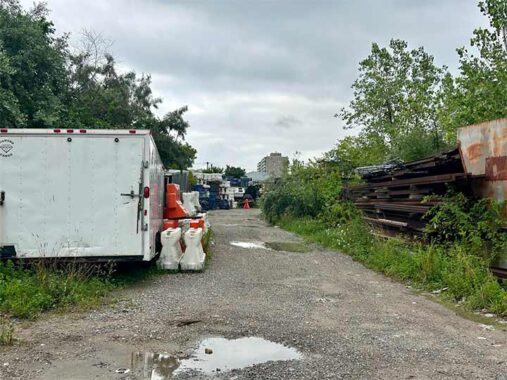
Where children played tennis and swam in the outdoor pool, construction materials are stored as nature tries to reclaim the property. In my effort to document the peninsula’s misspelled connection to the Caribbean island country, I found nothing in the newspaper articles, books, and historical reports. If you’ve found the answer, put it in the comments section.
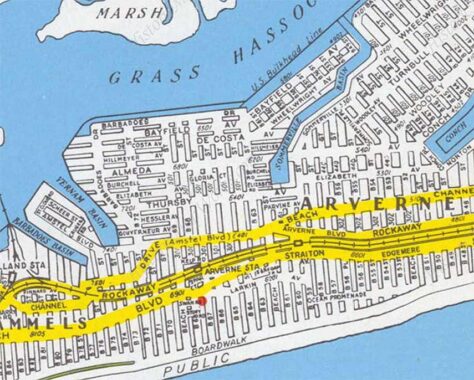
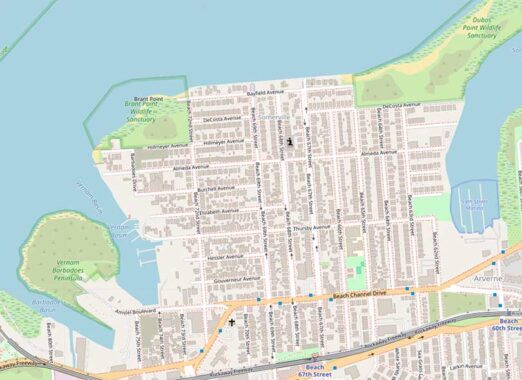
Compare the (hoped for by developers) Arverne street layout in 1949 (Hagstrom) with the reality of today’s (Open Street Map)
In the 1949 map you can see that developers once hoped to make Barbadoes Drive a waterside boulevard along Vernam Basin and Grass Hassock Channel: but only two blocks between Burchall and Hillmeyer Avenues were ever built. The street has seen some development in recent years, as it was formerly home to grassy lots and industrial lots.
Sergey Kadinsky is the author of Hidden Waters of New York City: A History and Guide to 101 Forgotten Lakes, Ponds, Creeks, and Streams in the Five Boroughs (2016, Countryman Press), adjunct history professor at Touro University and the webmaster of Hidden Waters Blog.
Check out the ForgottenBook. As always, “comment…as you see fit.” I earn a small payment when you click on any ad on the site.
4 comments
Brooklyn Day Camp, aka BDC, was a huge day camp that had really impressive facilities, including a large swimming pool, several sports fields, two mini golf courses, boating, arts n crafts, a pinball arcade, a movie house, basketball courts and so much more.
At age 7 my first day at a day camp in Connecticut was ruined when I looked out the bus window and saw a small stone monument that read “Bound.” I thought it was the grave of a dog named Bound and was miserable all day.
That evening my dad had the unenviable task of explaining land surveying in terms a 7 year old could understand.
Barbadoes was the way Barbados was spelled in many older English documents – there are hundreds of newspaper articles spelling the island that way in the 1800’s. On the NYC Parks site it indicates “The name Barbadoes is a corruption of “Barbados,” the Caribbean Island. Several Dutch settlements around colonial-era New York were named New Barbadoes. The corruption of course was an accepted one at the time, not something we should “blame” on the land owner. Still searching for an explicit statement from that time period..
The barges and cranes belonged to Tony Rivara, owner of Pile Foundations Construction Company Inc. Tony was notorious for sinking and abandoning barges all over NY Harbor and surrounding waters.
https://extapps.dec.ny.gov/docs/legal_protection_pdf/pilefoundationo.pdf
https://www.nytimes.com/2008/08/05/nyregion/05barges.html