
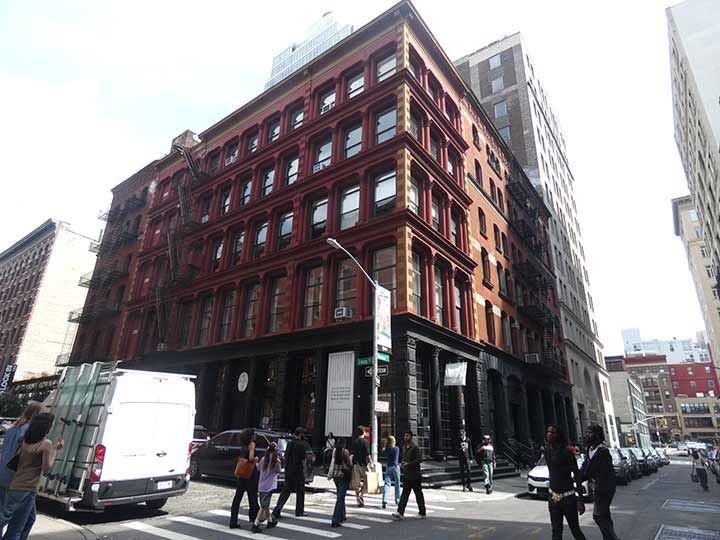

CROSBY Street is one of those NYC streets that traditionally had been somewhat overlooked, since it’s wedged between main N-S thoroughfares Broadway and Lafayette Street between Howard and Bleecker Streets. It has had a checkered history that saw only one-half of it given landmark protection. That, though, has been changed as the Soho Cast-Iron Historic District Extension has covered its east side since 2010. In recent years, like the rest of Soho, it has become home to a number of high-end residences; homeowners here appreciated its relative quiet. At 126, its northern end near East Houston Street you will find the Housing Works Used Book Café, where all profits go a nonprofit offering housing, health care, job placement and other services for homeless suffering with HIV and AIDS.
Up until recently I had found Crosby one of SoHo’s quietest streets, but especially in recent years, things have gotten very busy as high-end retailers have taken up a great deal of space. Sidewalk free space is now at a premium on weekends given the new trend of lining up for blocks for small retailers and restaurants with limited seating or small floor space. Scenesters also want … to be seen on line … in social media such as instagram and tiktok. I walked Crosby’s full length, will eventually make its way to an FNY post, but I thought I’d get the jump on things with something that perplexes me at #1 Crosby, on the corner of #28 Howard. This corner appears in Scorsese’s “After Hours” in which anything that can go wrong does, for Griffin Dunne’s office jockey.
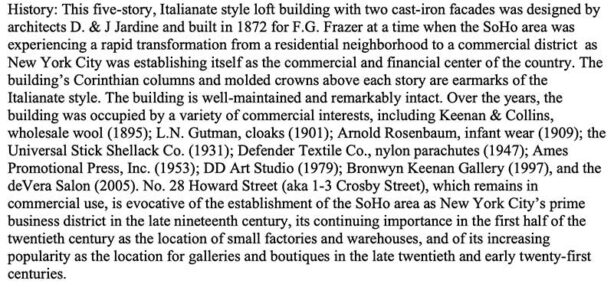
^ The LPC report lined above gives a detailed description and history. I’ll spare you the architecture-ese in the description, but here’s the history. The description, though, leaves out one element I found perplexing.
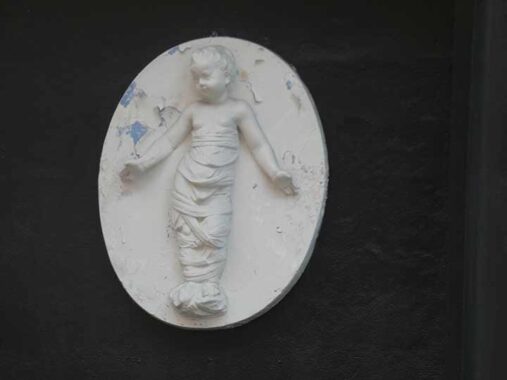
These’s this cameo, or bas-relief, probably executed in marble, on the Crosby Street side, with a loosly-wrapped or swaddled baby, but with free arms; usually swaddling is done with both arms and legs. I’m not a scholar of Victorian-era symbolism; the most famed swaddled baby I know of is the Christ child, so this may be a depiction. The LPC description does not include an ecclesiastical use of the building. The Rosenbaum “infant wear” in 1909 is a possible clue.
Any ideas? Comments are open.
Check out the ForgottenBook (HarperCollins, 2006), as well as Forgotten Queens (Arcadia, 2013). I also have a chapter in the anthology “New York Calling: From Blackout to Bloomberg” (Reaktion, 2007). As always, “comment…as you see fit.” I earn a small payment when you click on any ad on the site.
9/15/26