
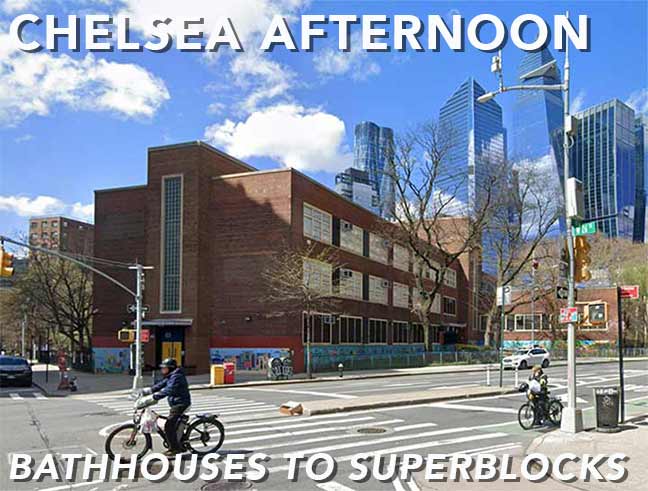


Having documented a long-demolished bathhouse across the street from John Jay Park on the Upper East Side, I learned that it had a Beaux Arts counterpart on the west side in Chelsea that was demolished in the 1960s with another four decades until its replacement was built three blocks to the south.
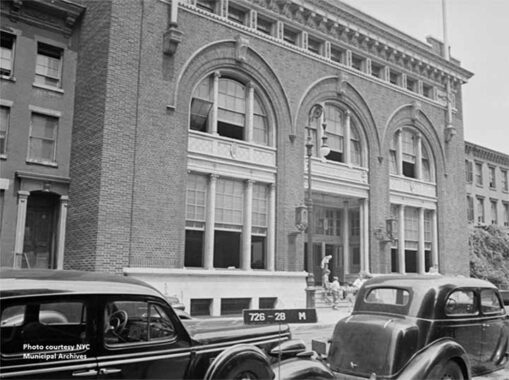
The original Chelsea Recreation Center stood at 407 West 28th Street, a crowded neighborhood of tenements, railyards, and factories in the early 20th century. It was among a dozen public baths built around the city to promote hygiene as many apartments did not have showers or bathtubs.
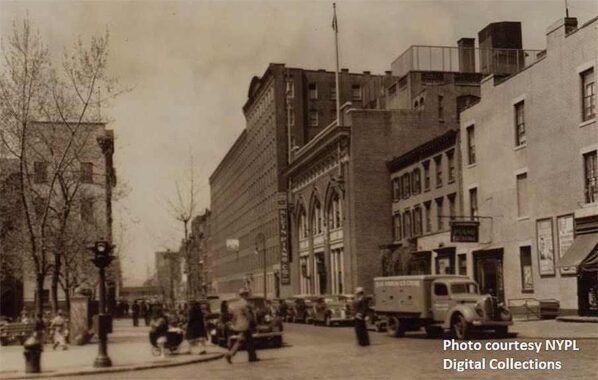
In turn, residents of Chelsea looked across the street and demanded a public park as the west side had no parks on the stretch between DeWitt Clinton Park and St. John’s Park in Tribeca. The block contained a coal yard, tenements, and Public School 33.
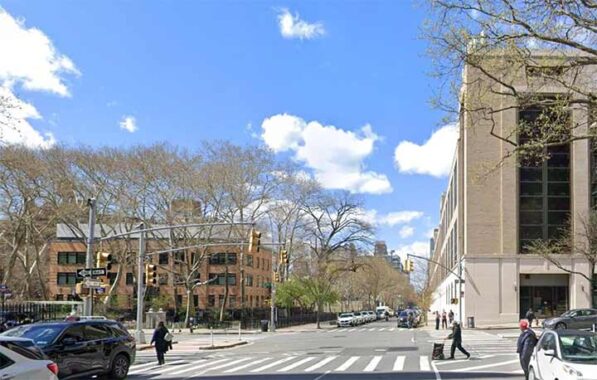
The same view today shows the Morgan South postal facility taking up the full block on the north side of W. 28th Street, with Chelsea Park donig the same on the south side. The corner gateposts sponsored by the local Tammany club were moved inside the park. The health clinic in the park has an Art Deco design with horizontal brick stripes around its facade. Closer to Seventh Avenue, 28th Street hosts the Flower District, which Kevin visited in 2007.
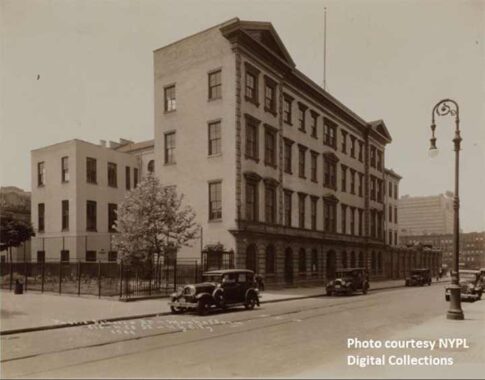
This school was built in the 1850s, when Manhattan was divided into wards. Its design resembled other mid-19th century schools that I’ve documented, Grammar School No. 55 at Chelsea Green, Primary School 14 near the site of Alfred E. Smith Playground, and Ward School No. 47 at Union Court. The former Ward School 48 also represents the Italianate style of school architect Thomas R. Jackson.
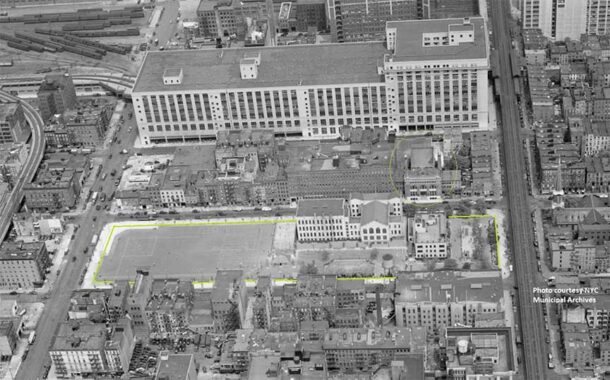
In this 1941 aerial survey by the city, Chelsea Park enveloped the old school, which was later demolished and relocated a block to the south at 291 Ninth Avenue. The old Chelsea public bath is circled across the street from the park. Also visible here is the landmarked Church of the Holy Apostles, which was completed in 1846. The city’s oldest elevated rail line appears atop Ninth Avenue, but its last train ran on June 11, 1940. It was demolished in favor of the Eighth Avenue subway line that served as its replacement. To the south of the park, blocks of tenements and factories would be demolished in 1945 for the NYCHA Elliott-Chelsea Houses.
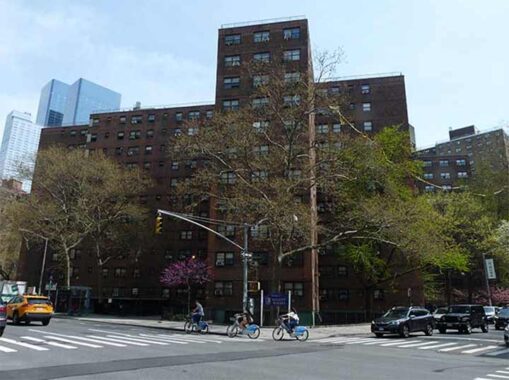
The namesake of this housing project is Dr. John Lovejoy Elliott, who founded Hudson Guild, a settlement house serving the low-income population of this neighborhood. Its first building opened in 1910 at 436 W. 27th Street, which is within the footprint of these apartments. As a result of their construction, this nonprofit moved to its present address, 441 W. 26th Street. Hudson Guild was created during the settlement house movement, a contemporary of the Henry Street Settlement, East Side House, and Grand Street Settlement, among others.
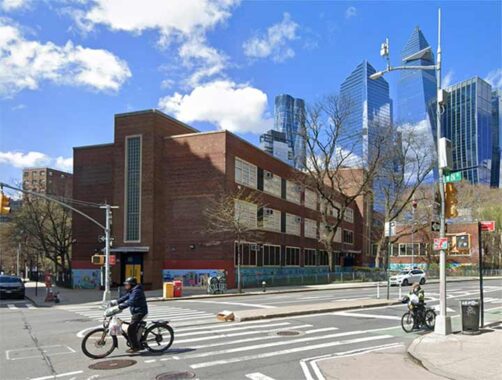
Architectural critic Lewis Mumford described this superblock in a 1952 New Yorker column. The public bathhouse was in his view, “gaudy terra-cotta. The old P.S. 33 was a “grim and toothless ghost.” As for the Elliott Houses, he called them “one of the most overcrowded and dismal examples of public housing in the city, though I hasten to add, a paradise compared to the tenements they replaced.” But he offered praise for architect Eric Kebbon in his design of the new P.S. 33 on the NYCHA superblock.
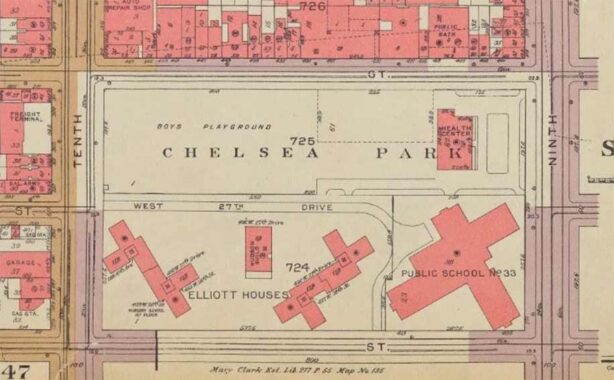


Behind the school, W. 27th Street appears as a driveway that curves towards W. 26th Street, with signs indicating this segment as W. 27th Drive, an anomaly resembling 49th Road in Brooklyn. The curve in W. 27th Street appears on the 1955 Bromley atlas, where it is labeled as a “Drive.”
From 1938 to 1952, he designed more than 100 public schools across the city, including Forest Hills High School, Fort Hamilton High School, Midwood High School, and Joan of Arc Middle School, among others. His portfolio also includes post offices, which include branches in Far Rockaway, Chelsea, and Lenox Hill. My friend Michael Perlman notes that Kebbon also designed Stephen A. Halsey JHS 157 in Rego Park, his alma mater.
The wings of P.S. 33 stand diagonal to the street grid as do the six towers of the NYCHA project. Considering the value of the land on which they stand, this housing project is slated for redevelopment in favor of mixed-income towers that will line up with the street grid.
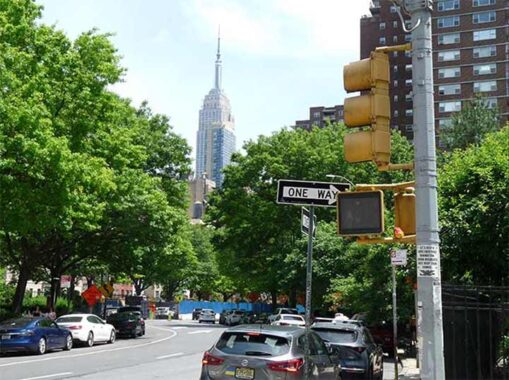
Across Ninth Avenue from the school and behind the historic Episcopal church, the Penn South co-op takes up six blocks with its own set of towers-in-the-park. Kevin walked here in 2024 during his survey of 28th Street, which curves around these apartments. This union-sponsored development was built as a slum-clearance project. Along with the Church of the Holy Apostles, Kevin noted two more churches that were preserved during the construction of Penn South, Saint Columba church and school on W. 25th Street that stood until 2026, and the historic but not landmarked Manor Community Church which he documented in his survey of W. 26th Street in 2020. Next to it is Penn South Playground, a public park built in tandem with these apartments, which also have their own private playgrounds.
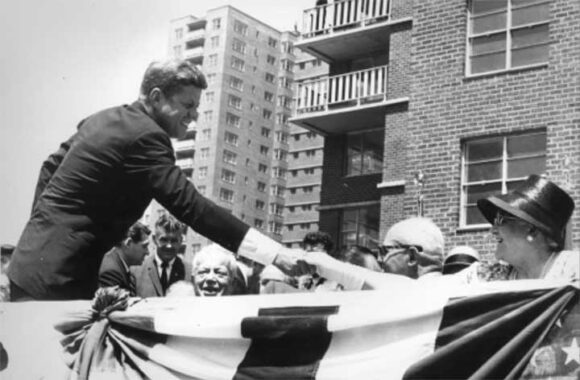
Master builder Robert Moses regarded the blocks composing Penn South, Elliott Houses, and Fulton Houses as slums in need of urban renewal, but with the destruction of the buildings here, so much history was lost. The dedication of these apartments in 1962 was attended by President Kennedy, Gov. Nelson Rockefeller, Mayor Robert Wagner, Robert Moses, Eleanor Roosevelt, and labor leaders George Meany and David Dubinsky. Penn South is among a handful of co-ops in the city built by organized labor for its members, living on as affordable housing in an increasingly expensive city. As a newlywed, I lived in IBEW-sponsored Electchester, which gave me time to save money for a house.
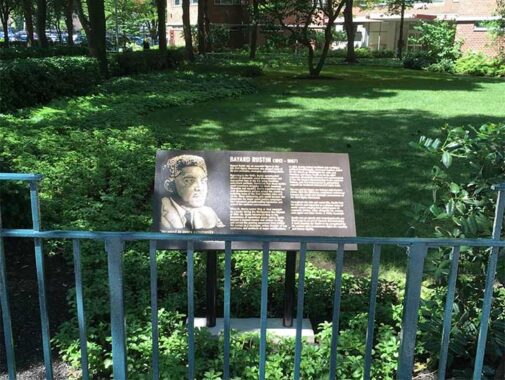
Among the notable residents of Penn South was Bayard Rustin, a key figure in the nonviolent approach towards civil rights and organizer of the 1963 march on Washington. A plaque installed in front of his apartment building tells the story.
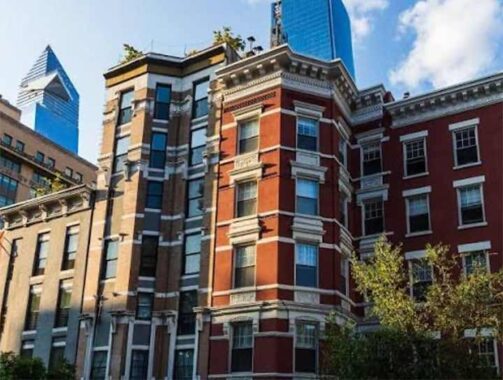
An example of what was saved from the wrecking ball stands across W. 29th Street from Penn South, the landmarked Lamartine Place rowhouses. If therse buildings could talk, they would speak of the abolitionists, 1863 anti-draft riots, Northern Irish Orangemen followed by Franch then Irish immigrants, among other chapers in their long history.
A block to the north is another landmark, Lithuanian Alliance at 307 W. 30th Street, a center for advocacy and support for immigrants and descendants from this Baltic country. Lithuanian New Yorkers also had a church by the Holland Tunnel entrance that stood until 2007, and the Church of Transfiguaration in Maspeth that has a traditional roadside shrine.
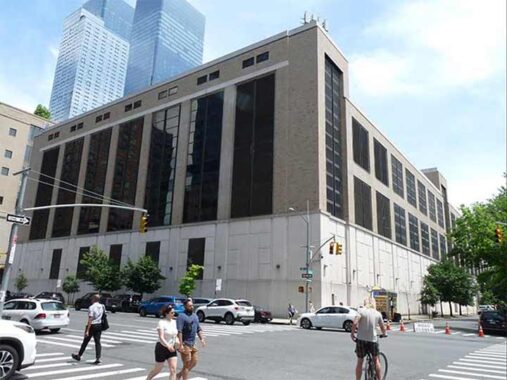
The old Chelsea bathhouse was demolished in the 1960s for the block-long expansion of the Morgan postal complex. While its prewar twin Morgan North was converted to an office building with a green rooftop, Morgan South remains a postal facility, fused to its twin by a bridge wide enough to make W. 29th Street a tunnel between Ninth and Tenth avenues. On the subject of tunnels, the Morgan facility is connected to the nearby historic Farley Post Office with a block-long secret tunnel below Ninth Avenue. LTV Squad visited it in 2006.
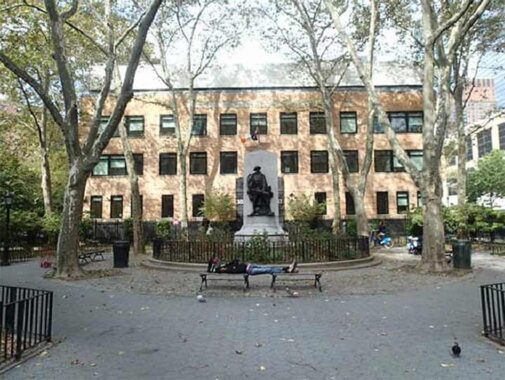
Inside Chelsea Park is a city-run health clinic that opened in 1937, one of a dozen built during the New Deal to provide for the needs of New Yorkers in the midst of an economic depression. A health center in a verdant park was an ideal setting at a time when this city was heavily industrial with fewer parks than it has today. The doughboy monument in front of it honors local soldiers and sailors who fought in the World War. When this monument was dedicated in 1921, nobody here expected that there would be another world war within two decades.
The park contains memorial gateposts sponsored by the local Tammany club in 1926, when that organization held sway over the city’s politicians. Much of its strength came from Irish immigrant voters who benefited from patronage positions offered by Tammany Hall.
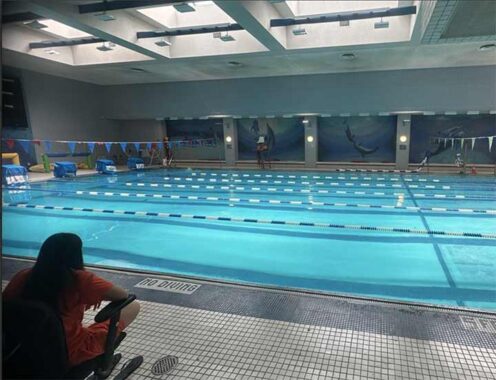
With the demolition of the old Chelsea bathhouse, the city promised a replacement and chose 430 W. 25th Street as the site. The fiscal crisis of the 1970s delayed its completion for a generation. The present Chelsea Recreation Center greatly exceeds the amenities of its predecessor, with its 25-yard indoor pool, gym, basketball courts, classrooms, and the dolphins mosaic based on the works of photographer Tsuneo Nakamura. The exterior isn’t as ornate as the original bathhouse, but with more than 56,000 square feet, it is one of the largest recreation centers in the city.
Sergey Kadinsky is the author of Hidden Waters of New York City: A History and Guide to 101 Forgotten Lakes, Ponds, Creeks, and Streams in the Five Boroughs (2016, Countryman Press), adjunct history professor at Touro University and the webmaster of Hidden Waters Blog.
Check out the ForgottenBook (HarperCollins, 2006), as well as Forgotten Queens (Arcadia, 2013). I also have a chapter in the anthology “New York Calling: From Blackout to Bloomberg” (Reaktion, 2007). As always, “comment…as you see fit.” I earn a small payment when you click on any ad on the site.
9/14/26