
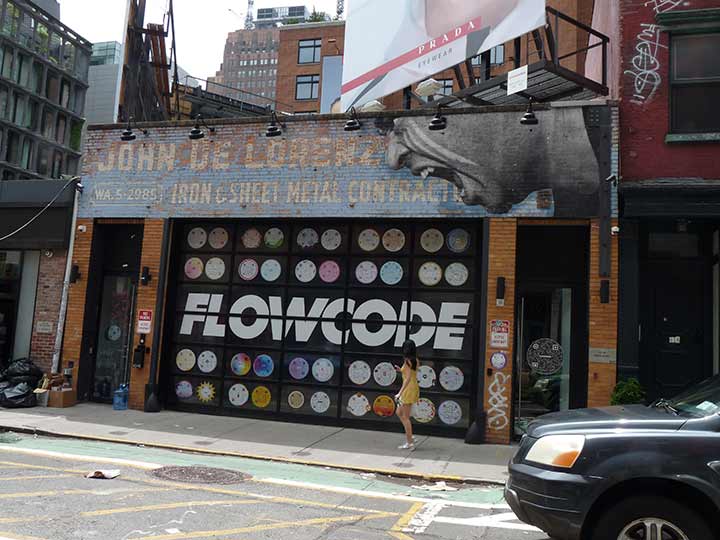

Is the blue and white painted sign for De Lorenzo & Bro. Iron & Sheet Metal Contractor at #43-45 Grand Street, just east of 6th Avenue, gone for good? I hope not. When I viewed it last in 2022, it had been partially obscured by painted ads for Flowcode (shown here) but a year earlier, I saw it in all its glory. In the alphanumeric phone number, WA stands for WAlker. What’s Flowcode? Let wikipedia explain it: “Flowcode is dedicated to simplifying complex functionality such as Bluetooth, Mobile Phones Communications, USB communications etc. by using pre-developed dedicated open source component libraries of functions. This is achieved by dragging virtual representations of hardware onto a visual panel, providing access to associated libraries. Flowcode is therefore ideal for speeding up software development times and allowing those with little programming experience to get started and help with projects. This makes it appropriate for the formal teaching of principles of programming. microcontrollers.” Yeah, I don’t understand it either!
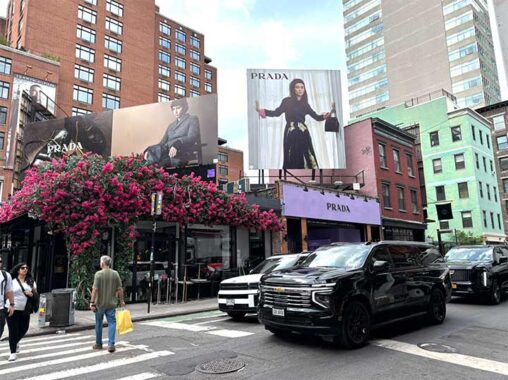
Unfortunately on a recent passby on Grand in September 2026, I saw that the painted sign was completely obscured by a sign advertising a pop up Prada store (this one selling fragrances) that had young women lined up for several blocks on Grand Street’s narrow sidewalks. In fact I counted five or six long lines for various venues in SoHo. Jockeying for sidewalk room, I am almost tempted to agree with activists wishing to create “open streets” (i.e. not heavy motor vehicles) in SoHo, though who knows how deliveries would be made if they got their way.
Who were DeLorenzo & Bro? The family operated their ironworks business in SoHo for over a century, 1903-2008, first on Thompson Street and then on Grand. Creatives often precede the upper classes in developing neighborhoods, and artists and artisans working with metal often employed De Lorenzo. According to the NY Times, “Over the decades, they built custom metalworks for high-profile clients, including a terrace enclosure for Paul Newman, metal baseboards for the 1976 Olympics fencing team, and raw materials for actor and artist Fred Gwynne.” Though the building was sold in 2008, the painted sign remains, when advertisers aren’t having their way with it.
Check out the ForgottenBook (HarperCollins, 2006), as well as Forgotten Queens (Arcadia, 2013). I also have a chapter in the anthology “New York Calling: From Blackout to Bloomberg” (Reaktion, 2007). As always, “comment…as you see fit.” I earn a small payment when you click on any ad on the site.
9/17/26