
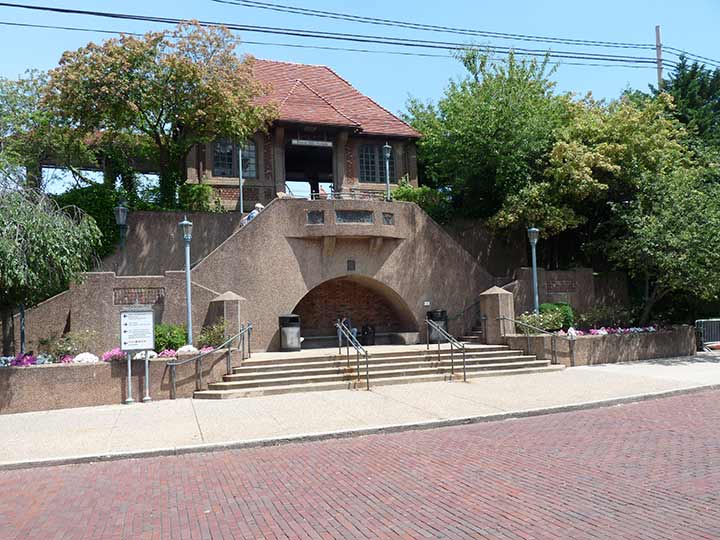

WITH its distinctive Tudor-style ticket offices with shaped and cut glass and unique luminaires, Forest Hills station’s position overlooking Burns Street seems perfect to give a speech, and that’s exactly what former President Teddy Roosevelt did here in 1917. The station’s design goes back to 1911 and, as it was built in tandem with Forest Hills Gardens, it was always meant to be the perfect complement to the neighborhood. It continues to be directly connected to the development via ornamental walkways.
Here’s Teddy Roosevelt at Forest Hills in 1917, though there was no sound recording at that time. That year, US troops were mustering to travel to Europe to aid the WWI effort.
The Forest Hills station’s lighting and signage are marvelously detailed, from the station lamps to the stylized “FH” on the wrought iron signposts. Signs are printed using the classic Goudy typefont. For rail architecture buffs, the Forest Hills station is a destination in itself. The design is English tudor accented with red brick, red tile windows, casement-style windows and benches and platform lighting unique to the station. Some of these highlights were installed after a late-1990s renovation. The station is not a major one and many trains deadhead run past it. If the LIRR put this much effort into stations such as East New York, well, that’d be a way to run a railroad.
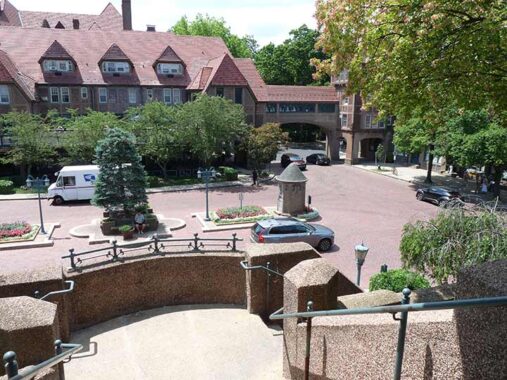
When looking out at Forest Hills Gardens from the railroad platform, I’m reminded of the cult 1960s TV show The Prisoner, in which Patrick McGoohan (who was born in Astoria) plays a secret agent who is spirited off to a mysterious location, known as “The Village,” where village masters attempt to extract information from him by whatever means necessary. The show was filmed in the northern Welsh village of Portmeirion, built as one of the world’s first theme parks by Sir Clough Williams-Ellis in the 1920s. Images from Retroweb’s Prisoner page.
Check out the ForgottenBook (HarperCollins, 2006), as well as Forgotten Queens (Arcadia, 2013). I also have a chapter in the anthology “New York Calling: From Blackout to Bloomberg” (Reaktion, 2007). As always, “comment…as you see fit.” I earn a small payment when you click on any ad on the site.
10/14/26
4 comments
May I take the liberty of adding some information about the Forest Hills LIRR station. True, today it is not a major station, mostly because the IND subway is a block away. However, it inaccurate to say “many trains deadhead past it.” It’s more accurate to say that “many trains travel through Forest Hills without stopping, the majority carrying passengers. Some are empty, or deadhead trains.”
Deadhead refers to an empty train not making regular stops and travelling between its previous terminal and a yard facility, or between its previous terminal and another station where it will turn for a passenger-carrying, or revenue, train. Deadhead trains are not shown in public timetables but are important to the overall railroad because they reposition train equipment. Deadhead trains do not carry passengers and are most common in the rush hours in the opposite direction of peak travel. That is, in the morning some trains may travel empty from Manhattan to a yard facility in the Jamaica vicinity, or to a terminal station where the train will turn for a return trip to Manhattan – for example Long Beach or Far Rockaway. The opposite happens between 3 and 6 pm as trains are needed to cover PM peak trains and will deadhead from a yard or terminal in Queens or Nassau or Suffolk, to Penn Station or Grand Central.
Thus, the majority of trains travelling through Forest Hills and not stopping are revenue trains that are simply not scheduled to stop there.
It’s also important to note that before the IND subway opened in 1936, Forest Hills and Kew Gardens were major LIRR stations. The subway, due to its cheaper fare, very frequent service, and greater variety of Manhattan destinations, sucked away about 80% of the LIRR ridership very quickly, leaving the remaining LIRR passengers as those who were willing to pay more for a less crowded commute.
Changed the word.
thank you for the prompt response!
I believe the station is a NYC landmark.