
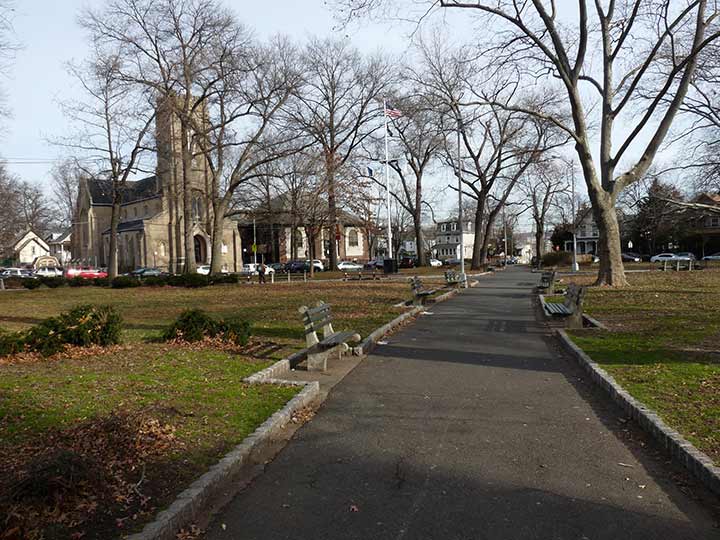

THE time between the leaves fall in November and when they come back again in April can be the best time for street photography but can also be the worst. How’s that? Well, building details are much more visible when foliage doesn’t obscure them. However the sun angle that time of year can be so harsh that many objects are in very dark shadow even at midday. Some years ago, I was in Boston the week after Christmas when I still thought my Forgotten Boston project could get traction, but none of the photos were really usable because the sun angle is even harsher that far north. Yet, out I trudge during the winter when it’s not as cold, since I don’t want to turn into a lump of protoplasm on the couch.
It’s been awhile since I have been in Port Richmond, Staten Island and I used to visit with alarming frequency, as it’s an older town and there is a plethora of interesting architecture—such as what surrounds Veterans Park. I was able to fire off these images a couple of days before Christmas in 2016. Port Richmond has its very own town square, Veterans Park, which sits between Park and Heberton Avenues and Bennett and Vreeland Streets. Arrayed around it are several choice samples of Port Richmond architecture. In fact this is Staten Island’s oldest park and has been here since 1836 when the majority of Port Richmond’s streets were platted. It was renamed in honor of American veterans in 1949. In 1930 the Daughters of the American Revolution dedicated a stone monument on the Park Avenue side to participants in Sullivan’s Attack of August 22, 1777, when American Revolutionary War officer and political leader John Sullivan led an unsuccessful night attack on Staten Island (according to NYC Parks; most American initiatives in NYC an environs in the Revolutionary War ended in defeat or strategic defeat, but we prevailed anyway). The marker got a new plaque in 1998 when the DAR rededicated it.
On the other side of the park, at Heberton and Vreeland, is a decorative drinking fountain dedicated in 1915 to Eugene G. Putnam (1865-1913), a longtime principal of nearby PS 20.
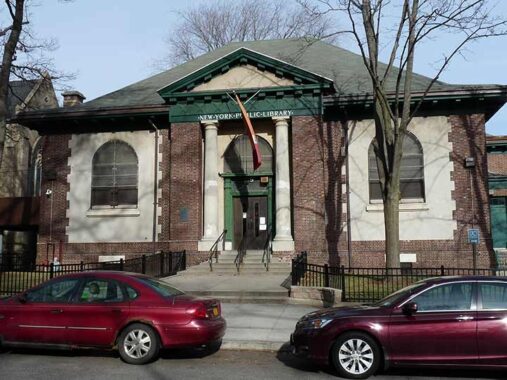
In 1901, the Scottish philanthopist/industrialist’s organization, the Andrew Carnegie Foundation, gave $5.2 million to New York City for its libraries across the five boroughs. This started a remarkable project that would go on to build 1,680 Carnegie libraries across the United States and another 800 plus in Canada, the United Kingdom, and elsewhere in the world.
Carnegie paid for the buildings, but the city would have to buy or acquire the land, buy the books, and provide for maintenance and upkeep, in perpetuity. Carnegie helped set up the library commissions and boards.
67 such libraries were constructed in NYC over the 20th Century’s first three decades. Of those, eight have been razed. I’d like to visit the remaining 59 and chronicle this remarkable project that adds to New York city’s richness of historic architecture.
Four Carnegie Libraries were built on Staten Island in St. George, Stapleton, Port Richmond and Tottenville. This one on Bennett Street and Heberton Avenue facing Veterans Park, which functions as Port Richmond’s town square, was constructed in 1905 in a Classical Revival style by architects John Carrere and Thomas Hastings, the architects behind all four of Staten Island’s Carnegie Libraries, Staten Island’s Borough Hall, and the main branch of the New York Public Library on 5th Avenue and West 42nd Street. John Carrere was a part-time Staten Islander, maintaining an home and office at St. Marks and Fort Places in St. George.
My entire shoot can be seen on this FNY page.
Check out the ForgottenBook (HarperCollins, 2006), as well as Forgotten Queens (Arcadia, 2013). I also have a chapter in the anthology “New York Calling: From Blackout to Bloomberg” (Reaktion, 2007). As always, “comment…as you see fit.” I earn a small payment when you click on any ad on the site.
10/13/26