
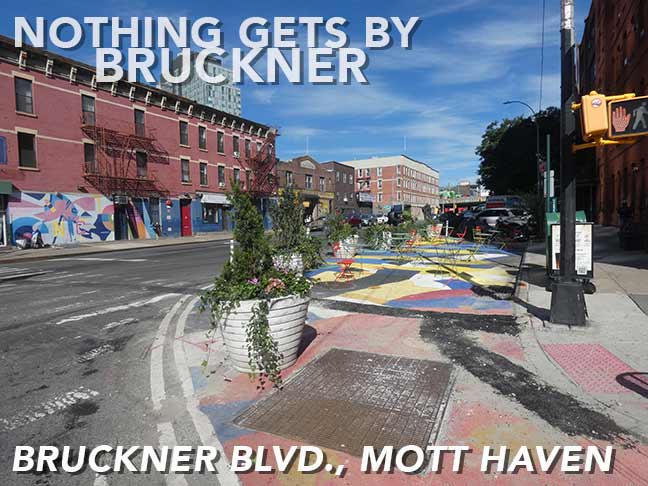

Squeezed in between the Harlem River and Yankee Stadium in the southernmost Bronx is a small neighborhood known as Mott Haven, after Jordan Mott, who built a tremendously successful iron works beginning in 1828 (the iron works continued to 1906), centered along the Harlem River from about Third Avenue to East 138th Street. His handiwork can be still seen all over town on airshaft and manhole covers built by the Mott Iron Works. Mott had bought the original property from Gouverneur Morris II in 1849; Morris was asked if he minded if the area was called Mott Haven, a name it had quickly acquired. “I don’t care…while [Mott] is about it, he might as well change the Harlem River to the Jordan.” The iron works produced practical and ornamental metalwork used worldwide.
Bruckner Boulevard begins on Third (in the Bronx, it’s “Third,” not “3rd” Avenue) and runs east, northeast and northwest to Westchester Avenue at Pelham Bay Park. For most of its length, it’s the service road for the Bruckner Expressway, built in stages from 1955 to 1972 in the northeast Bronx. But in Mott Haven, Bruckner Boulevard enjoys several blocks away from an expressway, though it remains a major trafficway and truck route.
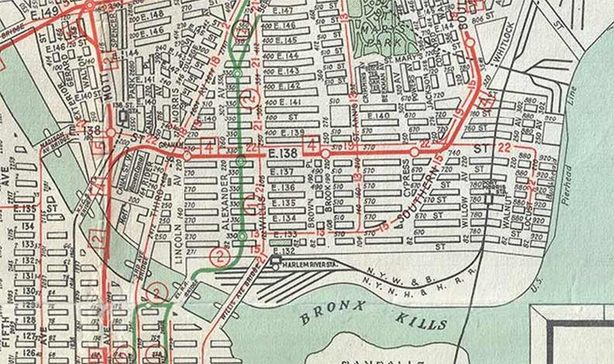
There was no Bruckner Boulevard until 1942! That’s the year that Eastern Boulevard, which includes a series of roads cobbled together from East 133rd Street, Southern Boulevard and Ludlow Avenue, was renamed for Bronx Borough President from 1918-1933, and Assemblyman and Congressman Henry Bruckner. Beginning in 1942, the newly christened road was accorded extra lanes (so it resembled Brooklyn’s Kings Highway and Linden Boulevard) and finally, traffic czar Robert Moses depressed some lanes in an open cut and elevated other sections to create a new expressway linking the Major Deegan with the northeast Bronx, over the course of some 17 years.
GOOGLE MAP: BRUCKNER BOULEVARD
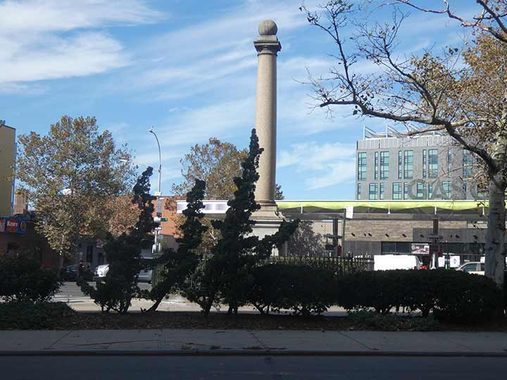
In October 2026 I took the #6 train to the East 138th Street station, which leaves you at a major crossroads, where East 138th meets Third Avenue, Lincoln Avenue and Morris Avenue at Graham Square. The triangle that forms the south side of the square is occupied by the most significant Spanish-American memorial in the city north of the grand Maine Monument (1912) at Central Park’s Merchant’s Gate at Columbus Circle, that honors the 258 American sailors who perished when the battleship Maine exploded in the harbor of Havana, Cuba, then under Spanish rule. Soon after, newspaper publisher William Randolph Hearst agitated for war with Spain.
“Although it was a short war with a questionable mission, the sacrifice of American troops during the Spanish-American War is commemorated by several memorials across the city. A column erected in 1919 at Graham Square, between Third and Lincoln Avenues at East 137th Street in Mott Haven section of the Bronx is dedicated to those from that community who served and died. In 1941, a large granite stele was dedicated to Spanish-American War veterans in Captain George H. Tilly Park in Jamaica, Queens. (Tilly, the son of a prominent Jamaica family, was killed while fighting in the Philippines in 1899.)”–NYC Parks
Staten Island’s Hiker statue honors local soldiers who served in the Spanish-American War. The statue depicts a foot soldier dressed in military fatigues, with a rifle slung over his shoulder. The image (and nickname) is derived from the long marches that the infantry endured in the tropical Cuban climate and terrain.
A Spanish-American War memorial flagpole is also in the center mall at Northern Blvd. and Main Street in Flushing.
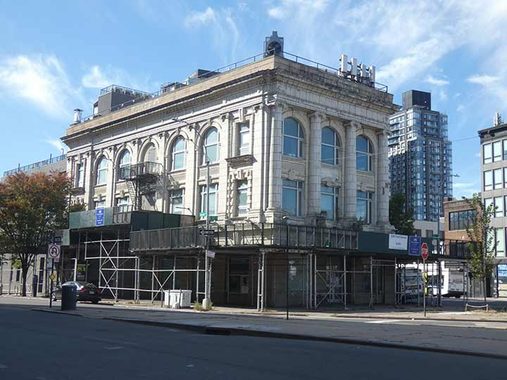
I always say (half jokingly) that building owners hastily assemble sidewalk sheds when somehow, word gets around that the prying Forgotten New York camera would be sniffing around (Who knows? Security cameras and AI are everywhere now). Classic Ionic columns and pilasters (half columns attached to a building front) punctuate this 1912 design by Albert Davis, founder of the North Side Board of Trade. It’s called the North Side Board of Trade building because Manhattan and the Bronx once formed New York County (Bronx became a county on its own in 1914), and this was north of downtown Manhattan.


Proceeding south on Lincoln Avenue. I wish I knew the original purpose of the building with the bricked arch, which looks like it could have been a theater. Mott Haven looks a lot different than it did a few years ago, as a series of high-rise apartment buildings have popped up on Third Avenue north of the old J.L. Mott Iron Works building, noted on this FNY page. Brookfield Properties, the developer of the Bankside and Maven towers, preserved Mott’s old building as a historical element amid the glass box high-rises.
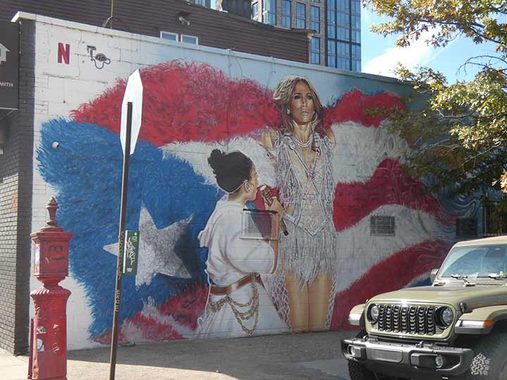
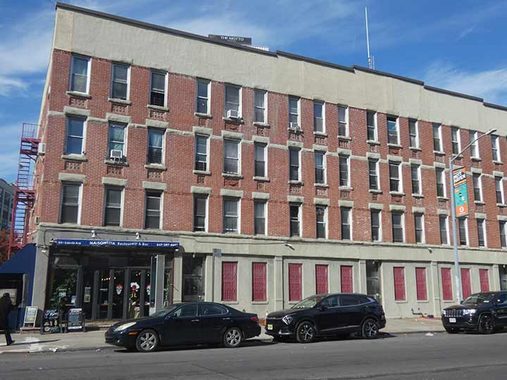
At Lincoln Avenue and E. 134th Street is an angelic mural of Jennifer Lopez with a Puerto Rican flag and the elevated 6 train (it appeared around 2022). Raised in the Castle Hill neighborhood, her first album On the 6 pays tribute to the subway train that took her to dance classes in Manhattan. Since then, she’s become an A-lister in dance, acting, and singing, plus four marriages as of this date. Note how the post-millennial towers are looking down at the old walk-ups. Their days are numbered, and this mural will go down with them.
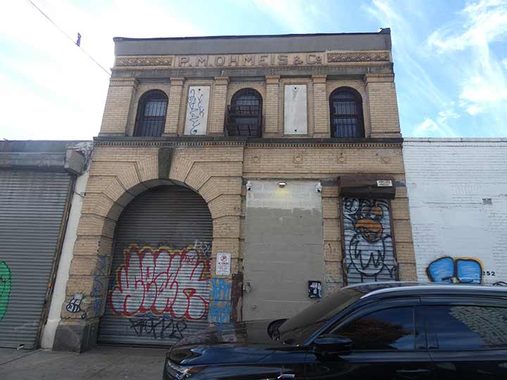
I recently posted on Substack regarding the persistence of remembrance. If you can get your name on something, people like me will be looking you up long after you’re gone. Whenever I’m in Mott Haven, I check on how the Peter M. Ohmeis stable building on East 134th near Third Avenue is doing. I need go no further than the Indispensable Walter Grutchfield for detals on Ohmeis, a restaurateur on 140 Fulton Street between Broadway and Church Streets from 1870 to 1926.
I recently posted on Substack regarding the persistence of remembrance. If you can get your name on something, people like me will be looking you up long after you’re gone. Whenever I’m in Mott Haven, I check on how the Peter M. Ohmeis stable building on East 134th near Third Avenue is doing. I need go no further than the Indispensable Walter Grutchfield for detals on Ohmeis, a restaurateur on 140 Fulton Street between Broadway and Church Streets from 1870 to 1926.
“Mr. Ohmeis was a descendant of a long line of restaurant keepers. He retired because of his age and because prohibition had reduced his profits. Mr. Ohmeis came here from Germany sixty-six years ago and moved to Harlem sixteen years later, continuing to live there until he died at the home of his daughter, Mrs. Cecelia M. Eckstein, at 57 East 123d Street. When he started in the restaurant business he bought the best turkeys for 25 cents each. He described his career when he retired as ‘from roast beef at 25 cents to roast beef at 90 cents.’ For years he was an agent for the Schlitz Milwaukee Brewing Company. He opposed prohibition and said not long ago, ‘I think the average business man still has a good digestion, but prohibition is hurting it. Men eat faster now. They used to take time to talk over a glass of beer.” [New York Herald-Tribune]
Mr. Ohmeis was also a beer distributor, most notably for Schlitz; this building was one of his wholesale distribution buildings. It likely was a stable and later, a garage. #140 Fulton was an empty lot as of 2026.


Several artists have made their mark on the ramps connecting the relatively new Third Avenue Bridge with Third Ave. and Bruckner Boulevard, opened in 2005 as the 4th bridge in this location. Its predecessor was damaged by a fire in 1999 and closed to traffic until its replacement could be constructed.


#1 Bruckner Boulevard, NE corner of Third Avenue, is tucked quietly beside both branches of the bridge ramp. At the corner of Third Avenue, a non-operational neon sign has Bruckner’s name. It was installed by the late Bruckner Bar & Grill, an early harbinger of change in this neighborhood. In 2013, facing a lawsuit, it changed the name to Mott Haven Bar & Grill and it survived for another decade. The building then made history again when the borough’s first legal cannabis dispensary opened here in 2023. The “Bar & Grill” sign stubbornly persists.
In 2024, Sergey visited the west end of Bruckner Boulevard, but I’m going for an even deeper dive today.
Bollermann Piano


Real estate developers have attempted to rebrand this stretch of Bruckner Boulevard as the “Piano District” and indeed, in the 19th and early 20th century piano manufacturers (with the notable exception of Steinway) did congregate here, given its poxonity to the East River and local freight railroads operating along the river. Several piano factories survived, and each has been converted to housing or offices. This is the former Bollermann Piano offic es and factory, Lincoln avenue from Bruckner Boulevard south to East 132nd.
AI robot: Dominic Carl Leopold Bollermann (born 1807 in Bavaria) immigrated to New York City in 1849 and began piano making. From the 1860s onward, Charles, Edwin, and Richard Bollermann were also listed as piano dealers, journeymen, and tuners. Bollermann & Son was founded in 1888 in Manhattan by Arthur and Arthur Martin Bollermann, and the firm later moved to the Bronx (E. 142nd St. in 1894 and E. 144th St. in 1897). After a fire destroyed their factory on September 9, 1900, they restarted on E. 132nd St. in 1901 and closed in 1918. Arthur Martin Bollermann operated independently at various New York City locations from 1909 to 1917, took over the Lincoln Ave./132nd St. building in 1918, and closed after 1918. Details on the company’s timeline are documented by Antique Piano Shop, Inc.
In 2007, I heard from a Bollermann descendant, who passed along an old business card and photos of the building when it still had corner towers.
Estey Piano
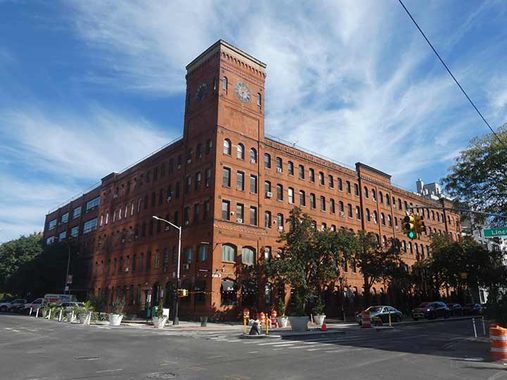
The former Estey Piano Company Factory at 112 Lincoln Avenue (corner of Lincoln Avenue and Bruckner Boulevard) in Mott Haven, Bronx, is an 1886 industrial landmark and the oldest known, and best-recognizable, surviving former piano factory in the Bronx. It features a signature corner clock tower, brick facades, terra cotta, contrasting stone, and round-arch industrial detailing visible from the waterfront and Harlem River bridges. It was designated an NYC landmark by the Landmarks Preservation Commission in 2006. It’s home to apartments as well as commercial enterprises on its ground floor. Amazingly, its clocks are still maintained and keep correct time.
The Estey Piano & Organ Company was one of the most important players in the late 19th and early 20th Century Piano & Organ manufacturing business. Established in 1846, Estey was one of the few American manufacturers to survive over a century. For decades, Estey manufactured several lines of upright pianos, player pianos and grand pianos. Estey instruments are known far and wide as being exceptionally well made, durable instrument, and they are well worth restoration and preservation today. Production under the Estey name was discontinued sometime in the 1970s. [The Antique Piano Shop]
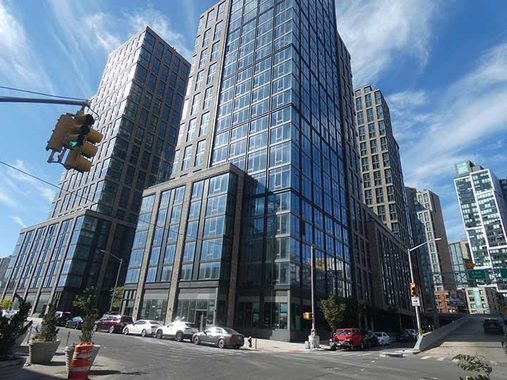
Bruckner at Lincoln presents a stark contrast in architectural tastes. At the southeast corner, the glassy Lincoln at Bankside towers were constructed from 2020-2021 and greeted their first residents in 2023.


New and old Bruckner. When East 133rd Street became Southern Boulevard (later renamed for boro prez Bruckner), it was widened somewhat to accept more traffic, but it has been shrunk to two traffic lanes again with the addition of pedestrian spaces and bicycle lanes.


Almost unrecognizable as an old ice house after a recent renovation is what was, through much of its history, used to store the Ruppert Beer brand in the early to mid 20th century. “The Ruppert Ice House took advantage of the growing need for manufactured ice after natural ice sources became too polluted. Before the advent of modern refrigeration, ice could only be produced by large icehouses, of which this building is a rare example in New York City. Ice was a particularly important component for the brewing of beer, and in 1899 this factory was designed and built by Julius Kastner for Jacob Ruppert, a well-known brewer.
The four-story steel frame factory with brick cladding utilized a steam powered ammonia compression system to manufacture ice and took advantage of the site’s proximity to truck, waterand rail transportation for the shipment of the finished product to Ruppert’s brewery at 3rd Avenue and East 92nd Street in Manhattan, in addition to other area merchants. The ice factory became obsolete with the invention of modern refrigeration in the 1940s, which made small-scale ice production a more feasible operation. The building is consistent with the surrounding factories and warehouses, contributing to the overall character of the industrial district.”
The large frame work atop the building has carried a number of illuminated signs over the years, from Ruppert Beer to the History Channel to NYU Langone Health.
Brewery owner Jacob Ruppert also owned the New York Yankees during their Ruth-Gehrig “Murderer’s Row” era, 1915-1939. The Yankees won the World Series in 1923, 1927, 1928, 1932, 1936, 1937, 1938, and 1939 during the Ruppert era.
Kroeger Piano
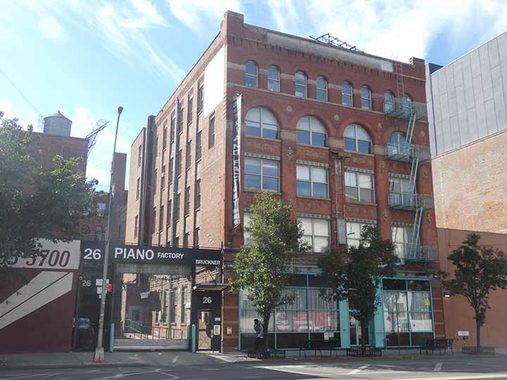
At #26 Bruckner is the Hanes-Kroeger piano factory. According to my go-to website for Mott Haven, Antique Piano Shop, “Henry C. Kroeger was born in Germany in 1827, and began apprenticing for a German piano maker by the age of 15. Kroeger worked for several illustrious piano makers in Hamburg before migrating to the United States in 1852. Kroeger is first listed as building pianos in Stamford, CT in 1852, before moving to New York City in 1855. In 1855 Kroeger worked as one of the main designers and builders at the Steinway & Sons Piano Company, remaining there in a very important capacity until 1879. In 1880 Henry Kroeger went into partnership with his son, Henry Kroeger Jr., forming the firm of ‘Kroeger & Son’. In 1885, the firm became ‘Kroeger & Sons’ when Henry’s second son, Otto, joined the firm.
Kroeger & Sons was also associated with P. J. Gildemeester, and pianos built in partnership with P.J. Gildemeester and were labeled as both ‘Gildemeester’ and ‘Gildemeester & Kroeger’. Just before the Great Depression era, Kroeger was taken over by industrial giant Kohler & Campbell. Kohler & Campbell continued to build the Kroeger name well into the 1950’s era. Instruments built by Kroeger and Gildemeester & Kroeger were of exceptional quality and design.”
The building’s dramatic arched windows and swirled sandstone flourishes make it a powerful example of the Romanesque revival industrial architecture, which was popular in the 1880s but had waned in prominence by the end of the 19th century.
Mathushek Piano


I noticed the painted letters MAT on the tidy brick building at Alexander Avenue and East 132nds Street, and a quick search with the municipal tax photo archives reveals it as the Mathushek piano factory. Antique Piano:
“One of the greatest innovators in piano design and construction was Frederick Mathushek. Mathushek’s vision was to create the finest pianos possible, and with his unique approach and unconventional designs, he eventually succeeded in building some of the finest pianos in American history. Mathushek immigrated to New York City in 1849 and was hired as a scale designer for the firm of J. B. Dunham. In the 1850s Mathushek worked for the noted piano designer Spencer Driggs.”
The painted sign referring to 1863 refers to Mathushek’s partnership with Leopold Kuhner, which lasted only two years. The Mathushek factory on Alexander Avenue operated from 1919-1947, and was noted for its production of spinet grand pianos, as noted on the painted sign.
Walter Grutchfield also has interesting info about Frederick Mathushek, who hailed from Worms, Germany (pronounced vohrms)
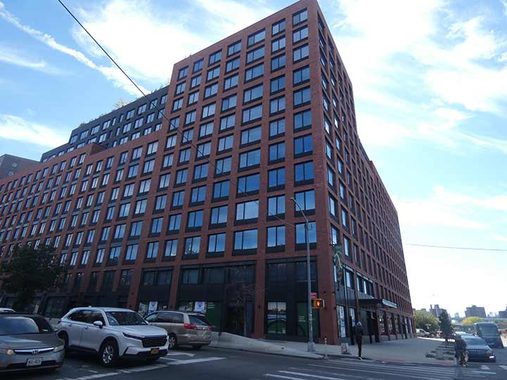
I don’t dislike all new construction. I can deal with Bruckner House, #40 Bruckner at Alexander Avenue, because of its squarish picture windows and brick, or faux-brick, exterior. Interior views, though, look totally anodyne to me. The building replaced a one-story garage in 2022.


That said, on the opposite corner, #127 Alexander, built in the late 19th or early 20th century, is a better building with its intricate brickwork design. One face, and only one, peers down from the 5th floor and judges all.
Further north, the Mott Haven Historic District is found along Alexander Avenue. It was landmarked as early as 1969; its Landmarks Preservation report was banged out on a typewriter.


This unbroken line of attached 3 story walkups on the north side of Bruckner between Alexander and the McDonalds at Willis Avenue must be among the city’s longest. The Alexander Avenue corner features a couple examples of local street art.
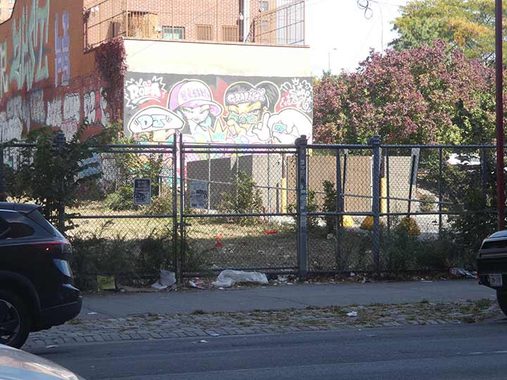
Nothing to see here, at this fenced -off empty lot west of Willis Avenue? Well, not any more, but the Third Avenue El once crossed the boulevard here, as seen on this 1922 map. The right-of-way joined Third Avenue proper further north, at East 145th Street.


I believe I have yet to walk the “new” Willlis Avenue Bridge. In 2009, as part of my “Five Across the Harlem” walk, I traveled the previous Willis Avenue Bridge, built between 1897-1901 for about $2.5 million; the architect was Thomas C. Clarke. After years of neglect the old bridge was demolished and a new one opened in 2010.
When I first encountered this bit of Willis Avenue, beneath the bridge ramp, it looked rather different as it was still Belgian blocked. If you look carefully, some of the old masonry supports fior the “new” bridge are still in place.


This group of apartment houses on the east side of Willis between Bruckner and East 134th have been completely and lovingly restored from the abjectly ruinous condition they had when I encountered them in 2002. You don’t have to demolish in order to renew.
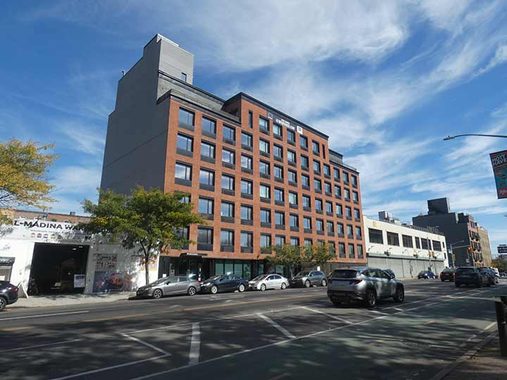
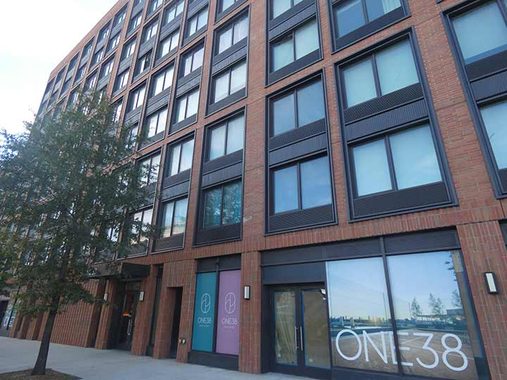
If you think #101 Bruckner, east of Willis, One38 Bruckner, and #40 Bruckner, seen above, resemble each other, it’s no surprise because all were developed by Jacob Schwimmer of 101 Bruckner Realty LLC, though each building had a different architectural firm. #101 was constructed in 2020. A row of garages lined the row before #101 sat as an empty lot for over a decade.
There’s a similar situation in Greenpoint, Brooklyn, where Belvedere Bridge Realty, LLC has constructed multiple buildings that resemble each other.
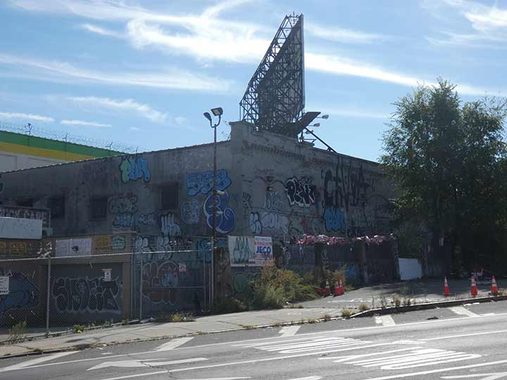
Bits of the “old” Mott Haven, pre-2000, still seep into view on occasion. The billboard atop this abandoned storage unit is only visible from motorists speeding past on a Willis Ave. Bridge exit ramp, or vessels sailing on the Harlem River.


I wish I knew the original purpose of this tall-windowed, buff brick building with a water tower at Bruckner and Brown Place. In 1940, the bricks were darker, according to tax photos, but that’s about all of the past I am vouchsafed. The building was likely a factory or contained lofts.
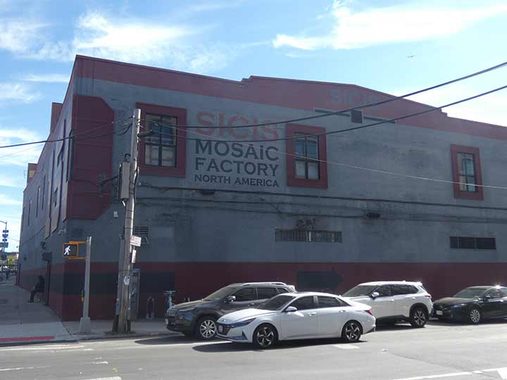
Luxury mosaic and architectural surface manufacturer SICIS Mosaic Factory at #150 Bruckner at St. Ann’s Avenue (SICIS stands for the Latin Sic Immensos Clarosque Inceptos Somniavi, or “Thus I dreamed of vast and illustrious undertakings,”) was founded in Italy in 1987 by Maurizio Leo Placuzzi. I liked the lettering on the sign in Copperplate, a font I used during Forgotten NY’s early days.
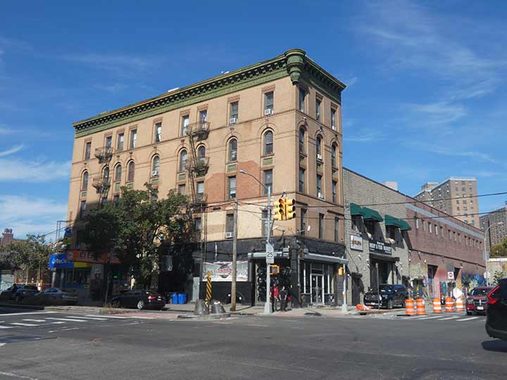
#147 Bruckner, with its unusual cornice, was once just the end of a row of 4-story walkups along St. Ann’s Avenue that continued north to East 134th, but this is now the only one that remains. You can see what replaced them; it’s just 20th Century Functional.
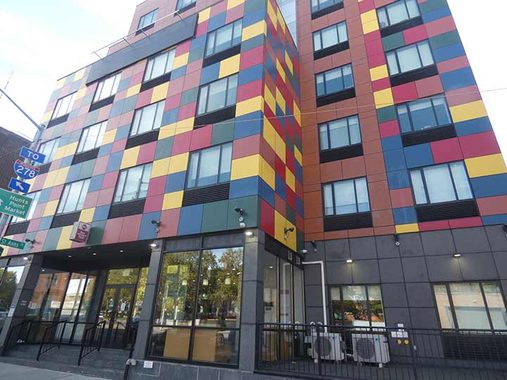
At#156 Bruckner, east of St. Ann’s, I liked this Mondrian-esque Best Western so much, I did a separate post about it.


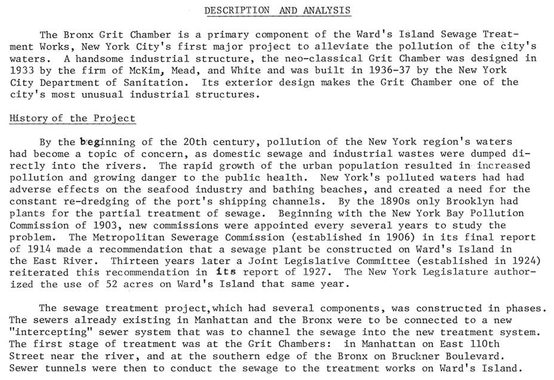
Just next door, at #158, individual landmarked buildings are hard to come by in Mott Haven (here at the Port Morris junction) but here’s one: the NYC Sanitation Department Grit Chamber, built in 1937, designed by the same firm that built NYC’s old Penn Station, McKim, Mead and White.
What’s a grit chamber? I’ll screenshot some of the Landmarks Preservation Commission Report:
The Historic Districts Council has a more condensed assessment.


Bruckner Boulevard “breaks away” from East 133rd here, ultimately becoming the faithful companion, or service road, of the Bruckner Expressway all they way to Pelham Bay Park. This creates a fork in the road, filled by the architecturally interesting South Bronx Charter School for International Cultures and the Arts, decorated by mosaics presumable created by students (I’d gather not by SICIS). This spot was once occupied by the Golden Lady strip club.
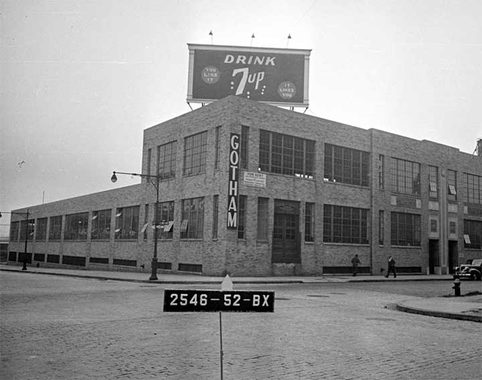


Welcome to Port Morris! We’re not quite there yet as the neighborhood proper is on the east side of the Triboro (RFK) Bridge ramps, but a local street artist drawing colorful hexagons on the former Gotham Pressed Steel building at East 133rd and Cypress Avenue disagrees.
To be honest, I never quite understood the old 7-Up catchphrase, “You Like It, It Likes You,” unless it had stomach-settling properties they were promoting. (In reality, it just adds to dentists’ bank accounts).
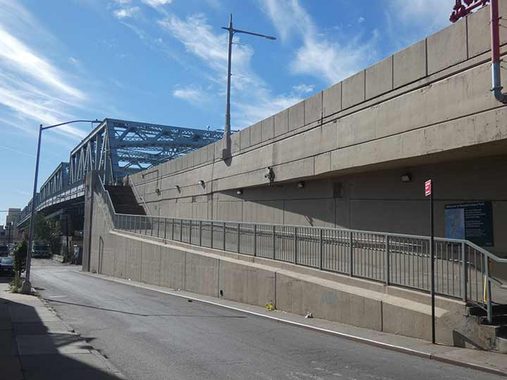
This leg of the Triboro crosses Bronx Kill and leads traffic to the Deegan and Bruckner Expressways. It has its own bicycle and pedestrian paths (the latter shown ere). Original 1936 Triboro lampposts light the road, which have seen several sets of lighting fixtures.


East of the Triboro, East 133rd presents, at least briefly, a residential aspect. Among these buildings, which one approximates its earliest appearance before the aluminum-siding “tin men” got through with them? If you guessed the one with the red paint trim, you’re right.
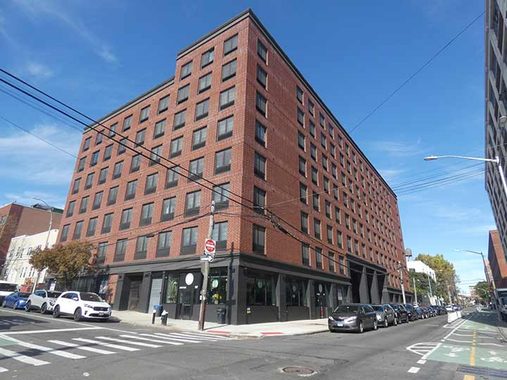
#750 East 134th, facing on Willow Avenue, designed by Newman Design Architects and co-developed by JCAL Development, closely resembles other new housing developments shown above. According to New York Yimby, it’s that “affordable housing” rarity, containing 112 units for residents at 30 to 80 percent of the area median income (AMI), ranging in eligible income from $17,006 to $140,080.
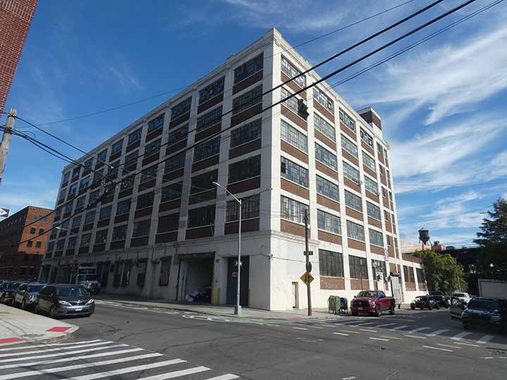
Across Willow Avenue is the many-windowed industrial building, #780 East 134th, which looks much the same as it did in 1940. A number of industrial cleaning businesses are located therein.
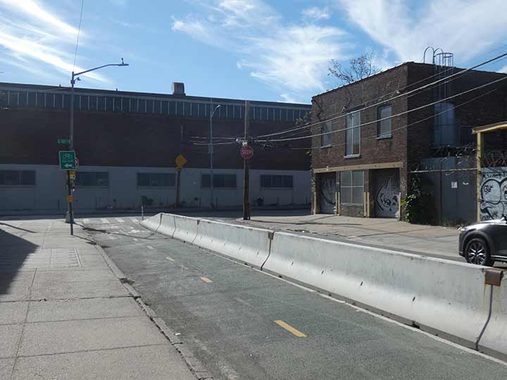
Had I more time, I would have proceeded north on Willow Avenue, which satisfies me with a number of brick factories and warehouse buildings in the mostly industrial Port Morris. It also has bike lanes protected by Jersey barriers, as at times it has bicycle traffic emerging from the passageway to Randall’s Island (see below).
New York Post



Port Morris is also the site of the New York Post printing plant for the newspaper founded by Alexander Hamilton in 1801, with the plant entrance on East 132nd Street just east of the Connector entrance (see below) I have actually been here before — in 2005 I was invited to tour the inside of the plant by my pal, Dawn Eden Goldstein (rock journalist, singer, songwriter, Doctor of Theology and canon law attorney), when she was a NY Post employee. Here’s a photo of her with some of the huge paper rolls the paper works with. (Do they use this much paper now? Most now read it in a phone app).


The east-west streets of Port Morris are spanned by two huge iron and steel bridges: the approaches to the Hell Gate Bridge, which connects Penn Station with suburban counties north of NYC and then Connecticut, Rhode Island and Massachusetts; and, soon, it is hoped, four new Metro-North stations. Further west, the Bronx leg of the Triboro Bridge span them.
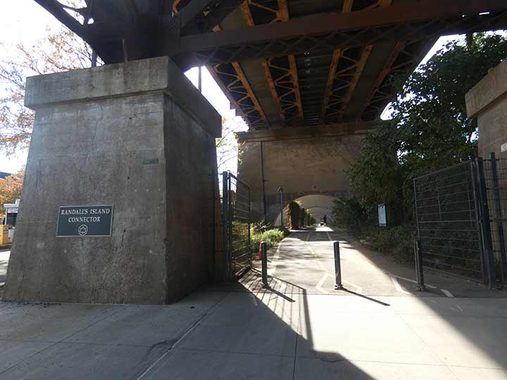
The Randalls Island Connecting pedestrian/bike path looks modest enough when looking south beneath the concrete Hell Gate arches from East 132nd Street, but its importance can’t be overestimated if you’re not in a car, it’s a bikers/walker’s connection to Randalls Island and also, via the 103rd Street pedestrian bridge, to the Upper East Side in Manhattan.
This is not the first pedestrian-bike connection between the Bronx and Randalls Island. The first appeared in the early 1930s when walkways were built on the Triborough Bridge and a set of ramps delivered the walker or cyclist to the island, but the ramps are lengthy and have been in disrepair for several years. I have walked the ramp connecting Wards Island with Astoria a couple of times, and recorded the experience on this FNY page.
The Randalls Island Connector was built directly below the Hell Gate Bridge as it crosses Bronx Kill. It was first proposed in 2006 but it took seven years of negotiations with both NY State and private owners to obtain easements.
I continued on through Randalls Island for my first visit in perhaps a decade, and then on into Manhattan. I will describe that walk on a later FNY post.
Check out the ForgottenBook (HarperCollins, 2006), as well as Forgotten Queens (Arcadia, 2013). I also have a chapter in the anthology “New York Calling: From Blackout to Bloomberg” (Reaktion, 2007). As always, “comment…as you see fit.” I earn a small payment when you click on any ad on the site, which helps in site upkeep and also aids Greater Astoria Historical Society.
11/22/26