

By PATRICK O’CONNOR
Forgotten NY Contributor
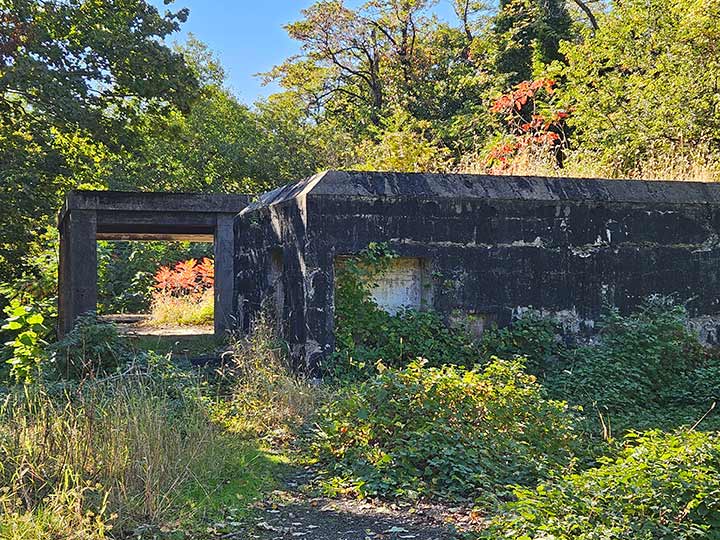
FORT Totten is a military base dating back to 1862 and located in northeast Queens, near the Throgs Neck Bridge at Willets Point. It was previously chronicled in FNY by Sergey Kadinsky. One of the more obscure facilities within the fort is known as Endicott Battery and is typically off-limits except for rare tours offered by Urban Park Rangers. In October 2026, I was able to join one of these tours for an inside look at Endicott.
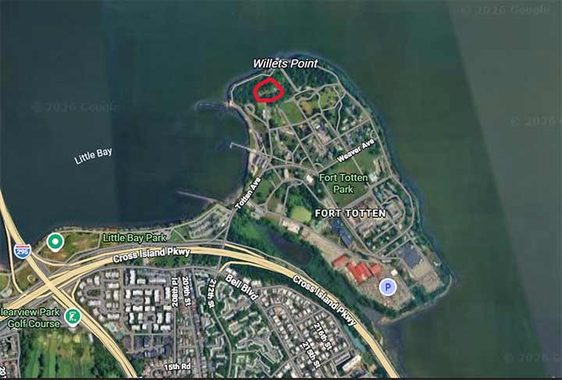
Endicott Battery was constructed in the 1890s and named for William C. Endicott, Secretary of War 1885-1889, during the second Grover Cleveland administration. Endicott was constructed with concrete and is deteriorating much faster than the Water Battery which was constructed with granite block walls and blue stone floors. Test shots of exploding shells were directed at the granite blocks, and they did not fare well as compared to solid shells or cannon balls. Concrete was thought to be more resistant to exploding shells than granite, so it was used to construct the Endicott Battery. The key feature of Endicott was a system of water mines, then called torpedoes. Two of these torpedoes (or at least the casings) are on display at the top of the Fort Totten entrance gate.


Fort Totten was also a technology development center where the torpedo system was created. Fort Totten’s “Castle,” aka the Officer’s Club and Mess Hall, was used by the Army Corps of Engineers, and a rendering of the building is still used as their logo. Torpedoes were laid out in a grid system in the East River and electrically wired to a control panel developed by Thomas Edison. If enemy ships were observed within the grid system, a lookout would call out the grid location number, and someone would detonate the corresponding torpedo by triggering an electrical impulse.


Stairs to the upper level and roof were in moderately good condition to pass but caution was always required. Above the second level, several more structures were built. Elevator structures were in place to allow for moving ammunition from storage to the gun stations. Bare metal is deteriorating faster than the concrete and only fragments remain.


Endicott Battery’s upper level held cannons with rifled bores. A rifle bore imparts a spin on the projectile allowing for more distance and accuracy. Think of it like throwing a football. A football thrown with a spiral goes farther compared to throwing it without spinning. These cannons were retractable to lower and conceal them if required. This area that is now overgrown is where cannons could be stored.
As with the Fort Totten Water Battery, Endicott never saw hostile action, and both remained unfinished due to becoming obsolete.
Patrick O’Connor is a lifelong resident of Queens, retired with 40 years of service for City of New York Department of Environmental Protection and is a licensed sightseeing guide in New York City.
Check out the ForgottenBook (HarperCollins, 2006), as well as Forgotten Queens (Arcadia, 2013). I also have a chapter in the anthology “New York Calling: From Blackout to Bloomberg” (Reaktion, 2007). As always, “comment…as you see fit.” I earn a small payment when you click on any ad on the site, which helps in site upkeep and also aids Greater Astoria Historical Society.
11/13/26