
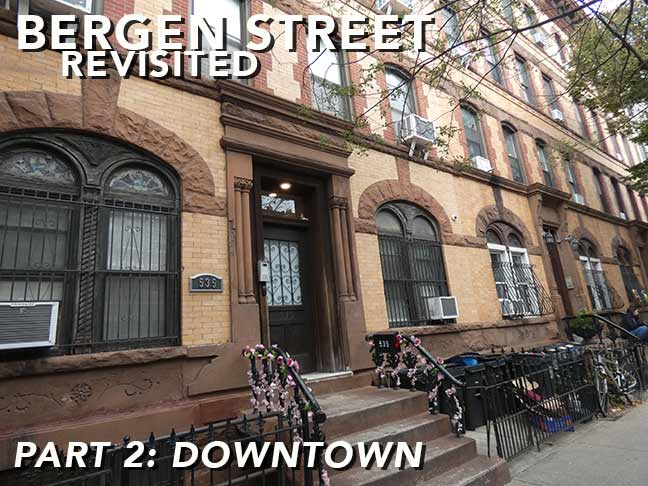

WHEN a website is as old as Forgotten New York, which was conceived in the “stone knives and bearskins” (to quote Mr. Spock) era of the internet in which you accessed it using dial-up modems in 1998, there’s going to be some repeat ideas and concepts. When I walked a few miles on Bergen Street in October 2025 between Court Street and Underhill Avenue, I forgot I had already walked much of that route back in 2014. But NYC is ever-changing, and there are some things I missed, or didn’t research throughly; and there are also some items that have been torn down since 2014. This was the first leg of a walk I hope to do on Bergen all the way out to its eastern end that will probably take two or three walks to finish. There are a number of nearby subways I can jump on if I get tired or my back acts up as it has for a few years now. In October, I got 155 photos, so this leg alone will take up three posts alone.


Where was I? I had gotten as far east on Bergen Street as Nevins Street so I’ll pick it up there, pressing east toward the numbered avenues. I was attracted to the Bethel Baptist Church, the first African American Baptist church in Brooklyn, #265 Bergen, at first not from the handsome brick construction but the neon sign. Unfortunately the sun position cast shadows and I couldn’t get a good look at it. The church was founded in 1907, broke ground in 1914 and the building completed in 1923, hence the three dates on the stone.
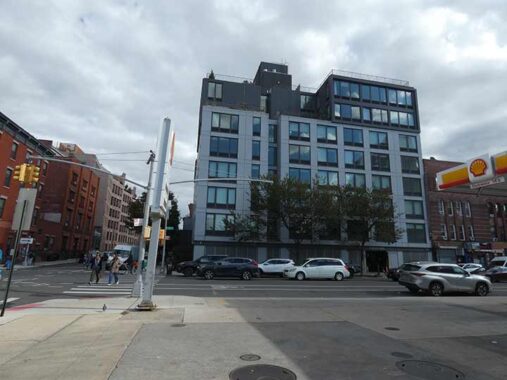
This forbidding object at 3rd Avenue and Bergen Street contains luxury apartments and is called simply The Bergen. Lucky residents on the first few floors on the 3rd Avenue side have a nice view of a Shell gas station, but the view from the upper floors is undoubtedly better.
“Say hello to The Bergen, a unique addition to historic Boerum Hill and one of the most distinguished new rental residences ever to arrive in Brooklyn. Inside, you will find a collection of distinctive studio, one and two-bedroom residences in addition to a range of high end amenities including an attended lobby, state-of-the-art fitness center, two resident lounges, a fully landscaped and furnished roof deck, an interior courtyard and unlimited access to noted concierge, Abigail Michaels.”
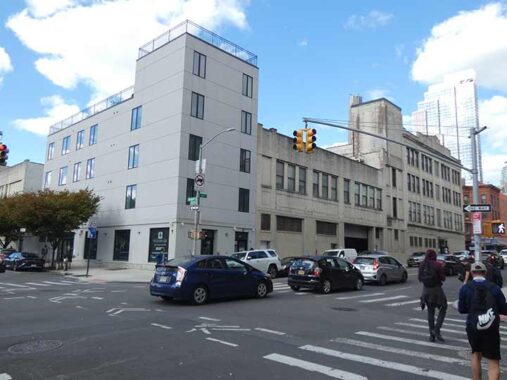
While #96 3rd Avenue, on the corner of Bergen, is relatively new, I vaguely remember the building on the right, toward Dean Street. The 1940 tax photo reveals it was a Borden’s milk bottling plant, but I vaguely remember it back in 1980 as the printing plant where we would bring the mechanicals for the college paper, the St. Francis College Voice.
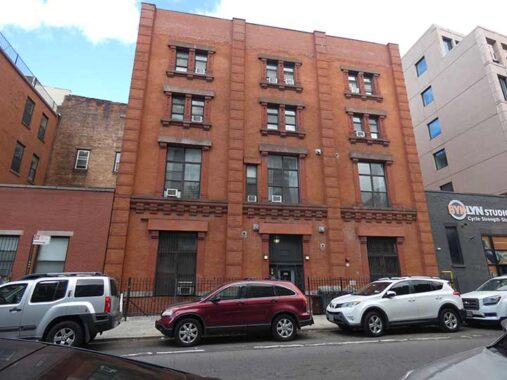
The 1940 tax photo reveals #305 Bergen as the Gustav A. Olsen Moving and Storage Company. A lot of fine brickwork and detailing on what was basically a warehouse, but that’s how they did things in the early 20th Century. Today it’s residential.
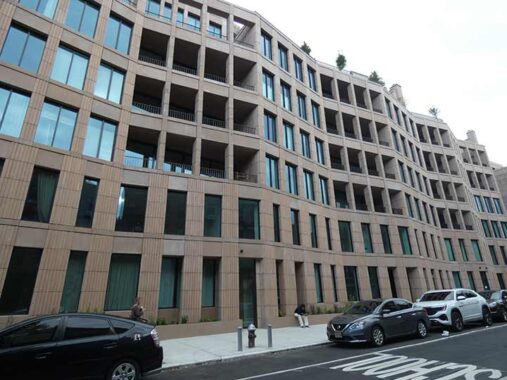
I was fascinated by the wavy concrete exterior at #232 Bergen, named Bergen Brooklyn by its developer, which describes it on its website thusly:
Designed by creative leaders Frida Escobedo, Workstead, DXA Studio, and Patrick Cullina, Bergen softens the boundaries of city living through the layering of dynamic architecture and an abundance of considered greenspace.
Composed from handmade geometric modules, the facade elegantly weaves light, shadow and air throughout the home, revealing crafted finishes and celebrating the natural environment. With a highly curated collection of indoor and outdoor amenities, focused on community, health, wellness, and the arts, Bergen provides a universal sense of belonging. Envisioned to establish roots and connection, it’s a place of refuge built to grow, age, and last with intention.


I am attracted to interesting signage, old or new. Peace Manufacturing is a printmaking shop at Bergen Street and 4th Avenue. From its website: “Peace Manufacturing (formerly ESPO’s Art World) is the studio and print shop of artist Stephen ESPO Powers. For the last decade Peace MFG has editioned exclusively for ESPO but in 2025 expanded their practice to include client work, printing for the likes of Mimi Gross, Todd James, Eric Haze, and Alexis Ross.” Some of his prints are displayed on the Bergen Street side.
Where does the universal “peace sign” come from? I discussed it when I found one in the cemetery outside St. Mark’s Church in the East Village.
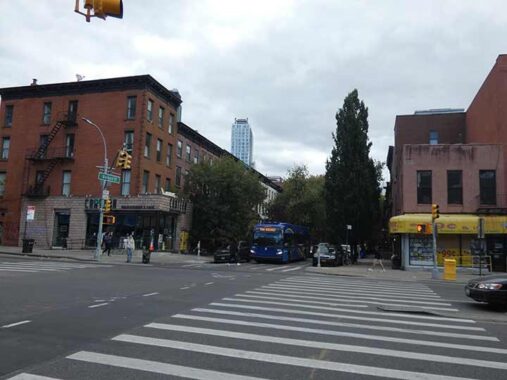
Looking east on Bergen Street from 4th Avenue. One of the Pacific Park Towers rises in the background. Bergen Street has always been served well by transit and hosts IND (F, G) and IRT (2, 3) subway stops. The westbound B65 runs on Bergen Street from Ralph Avenue. In the streetcar era, the #2 and 3 lines ran on Bergen.
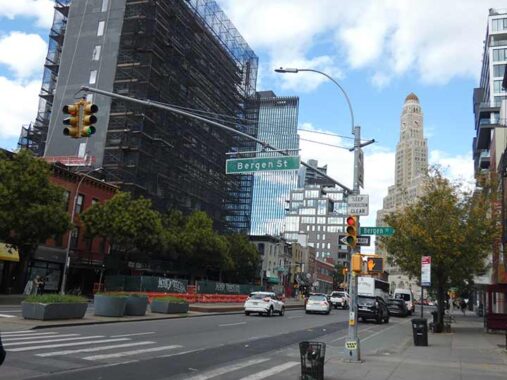
For several decades, The Williamsburg Bank Tower, built in 1928, reigned supreme as Brooklyn’s tallest building. It has been supplanted several times over since the 1990s. It is now called One Hanson (Place) and supports expensive apartments. I called it the “House of Pain” as I had a couple of oral surgeries there. The view from the chair was spectacular though. The bank floor is now a catering hall.
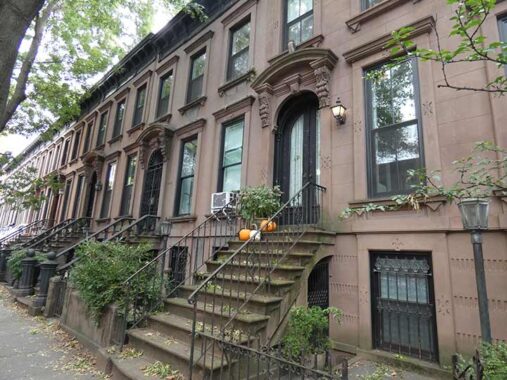
Between 4th and 5th Avenues, Bergen Street isn’t part of any landmarked district at all. Yet, the brownstones on both sides of the street are nearly untouched by time or renovators and are certainly landmark worthy. In some cases, lamps in front of brownstones have flickering flames that are controlled by electricity.
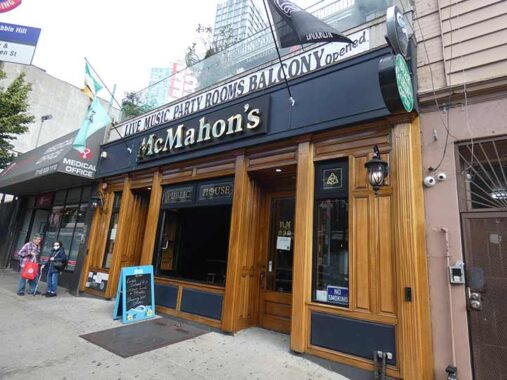
McMahon’s, #39 5th Avenue between Dean and Bergen Streets, features that favorite of Gen Xers and Millennials, karaoke, but for decades, it was O’Connor’s, founded in 1933, where generations of hard drinking old men gathered and fulminated about the old days. Around the corner is Barclays Center. Here’s what used to be there.
From FNY’s first Bergen Street page: Fifth Avenue in Brooklyn has always, with apologies to Billy Joel, been my “river of dreams.” Since the 1960s, I’ve seen all its phases, and have ridden the B63 bus thousands of times. As a kid, one parent or the other, knowing my obsession with looking out the bus window for lampposts, signs and other interesting items, would accompany me on rides to the end of the line, which was then at Furman Street and Atlantic Avenue; the bus, in those days, would take a jog along Hicks and Joralemon Streets in Brooklyn Heights. I knew about Sunset Park and Green-Wood Cemetery, both bordered by 5th Avenue, from a very young age. Not until my twenties, though, was I aware that there had been an elevated train on 5th Avenue between Flatbush Avenue and 38th Street until 1940.
I continued to travel on the 5th Avenue B63 all through high school, since my school was on Atlantic and Washington Avenues and I got there via a transfer to the B45 bus. With the transit pass, the ride and transfer only cost me a nickel; I don’t know what it is now. I continued with the B63 in college; since my school was on Remsen and Court Streets, I took the bus to Court Street and walked a few blocks.
Throughout that time (1963-1983), the stretch of 5th Avenue between Carroll Street and Flatbush Avenue remained petulantly averse to ‘improvement,’ even as the rest of Park Slope east of 5th gentrified; and lengthy stretches of it were abandoned or burned out, with paintings of flowerpots covering the abandoned buildings. The old carnicerias, bodegas and botanicas survived amidst hole in the wall coffee shops. Gradually, though, the money found its way even to 5th Avenue. The first relatively upscale ginmill, 200 5th Avenue (200 Fifth) near Union Street, showed up in the mid-1980s, but has since closed. It has been a gradual process but 5th Avenue has joined the rest of Park Slope for better or worse.
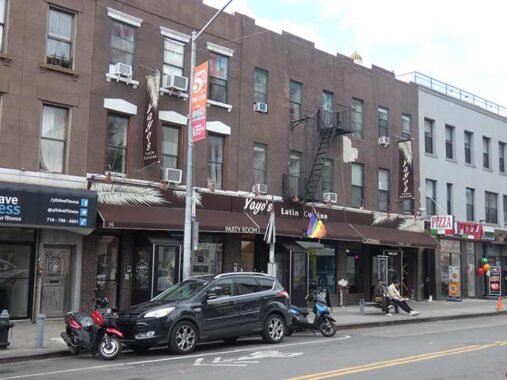
Throughout my years on upper 5th Avenue, there’s been a constant: I’m happy to see the El Viejo Yayo (“Old Yayo”) restaurant, now called Yayo’s Latin Cuisine, still going strong between Bergen and Dean Streets. It was established in the early 1960s. Yelp reviews are up and down. There’s an El Viejo Yayo in Ozone Park, but not sure if it’s the same management.


#443 Bergen, between 5th and Flatbush Avenues, looks like it was an existing building that had been renovated, but it actually tales the place of what had been a garage and later, an empty lot. In 1940, it was Frank Thompson Plumbing & Heating.


A look at #456 Bergen in 1940 and 2025 exhibits the changing sensibilities in Brooklyn in the downtown area that borders Park Slope. What was once a place where dock and construction workers went to belt them down is now the painted pink Invictus Bakery.
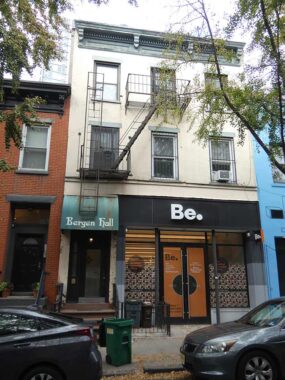
Be. is a medical cannabis chain (this is Park Slope). I searched for some historical context why the relatively modest #451 Bergen is called Bergen Hall on its entrance awning, but didn’t find anything.


Joe Coffee (redundant perhaps) is another brightly-colored storefront, no doubt previously drab in 1940 when #472 was home to a store selling cutlery and musical instruments, which I was unaware were once sold together. Because they were made of metal perhaps? Ice craem sodas were once made at drugstores, after all. Next door at #474 was Donovan’s Bar & Grill for the professional drinkers in the area, of which there were many. At left in 1940 was (and is) the entrance to the Bergen Street IRT station. The tilework within is identical to what it was 86 years ago.
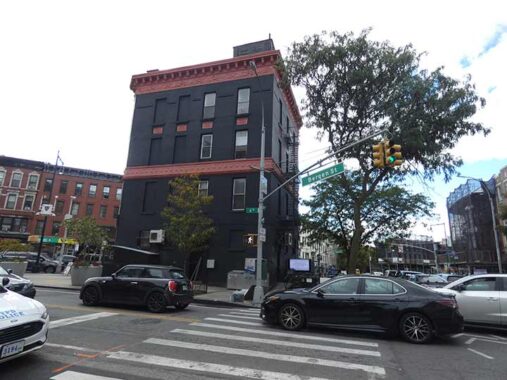
Because Flatbush Avenue cuts athwart the downtown and Propect Heights street grid, a number of triangle-shaped plots exist. The old Triangle Sports building can be found at 5th Avenue, while here at 6th Avenue and Bergen Street is #245 Flatbush, with apartments above, Doughnut Plant chain below. The now-eliminated pediment contained its name, The Denmark. Much of the building’s other detailing has been preserved.


NYPD 78th (former 42nd) Precinct, #65 6th Avenue at Bergen Street, looks like a police precinct’s police precinct. TV producers have agreed about the 1925 neo-Renaissance building, and it has been featured in a number of TV shows including exterior shots for “Brooklyn Nine-Nine” for 8 years from 2013-2021.
[Series creator] Dan Goor loosely based the show’s fictional 99th precinct on Brooklyn’s real-life 78th, one of the most diverse parts of one of the most diverse cities in the word. It’s a fast-gentrifying area that’s home to its share of crime, but also the Brooklyn Nets and yoga classes for babies. Goor knows the area well. He went to high school in Brooklyn, lived there again as a “Late Night With Conan O’Brien” writer, and can tick off the name of the best restaurants and sandwich places in the 78th. [Brooklyn Nine-Nine Wiki]
The ornate entrance lamps feature police precincts’ traditional green glass. The tradition of green lights dates back to colonial times. According to the NYPD, “It is believed that the Rattle Watchmen, who patrolled New Amsterdam in the 1650’s, carried lanterns at night with green glass sides in them as a means of identification. When the Watchmen returned to the watch house after patrol, they hung their lantern on a hook by the front door to show people seeking the watchman that he was in the watch house. Today, green lights are hung outside the entrances of Police Precincts as a symbol that the “Watch” is present and vigilant.”


In the early 20th Century many of the most massive buildings constructed were not office buildings, but fireproof storage facilities like #491-495 Bergen, originally built for Sofia Brothers storage and then by Peter F. Reilly. In Brownstoner, Montrose Morris (Suzanne Spellen) relates:
[T]he Peter F. Reilly Storage Company has been a mainstay of Prospect Heights, at 491 Bergen Street. Their handsome storage facility is a large Neo-Gothic limestone, brick and iron building on Bergen near 6th Avenue.
|
They also advertised fireproof vaults, and the storage of household goods. Peter F. Reilly began his moving and storage business in 1860, and by the late 1880’s was located in warehouses on Dean Street, near Vanderbilt (now part of AY lands).
|
He advertised often in the Brooklyn Eagle, offering large moving vans which could move furniture, pianos, pier mirrors and other large pieces across the country, or to his warehouses on Dean St.
|
By the turn of the century, his ads boasted 900 rooms of storage, as well as open air carpet cleaning. Peter Reilly’s son, also Peter F. Reilly, took over the business at his father’s death in 1898, and is credited for the invention of the enclosed moving van. He must have built this facility, as well as a similar one in Manhattan.
|
The building is a Gothic fortress of storage, with Gothic style ornament, including decorative faces. It’s a great building. The Manhattan facility, as well as this one appears to now store business records, no longer storing furniture and silver for the wealthy.
Since the piece was written in 2010, the building has ceased use as a storage facility, but is still apparently being cared for. Over the years, some of its detailing has been lost to the elements or careless repair. Suzanne does not know the date of construction but the building does show up on a Belcher Hyde Brooklyn atlas in 1929.


On Bergen midway between 6th and Carlton Avenues, we enter Bergen Street’s 4th Landmarks Preservation Commission landmarked district, this one in Prospect Heights. I took a special liking to this grouping at #531-539 Bergen. From the report:
Designed for Thomas Farrell by Isaac D. Reynolds and built c.1894, these three flats buildings were constructed at a time when multiple dwellings were gaining favor among developers in Prospect Heights due to increases in population and property values in Greater New York. Primarily Romanesque Revival in style, the buildings feature Romanesque-style colonettes at their main entrances, rough-faced brownstone basements and upper-story trim, and round arches over their fourth-floor windows. No. 535 retains its first-floor stained-glass transom sashes, although these appear to have been painted … Bearing strong resemblance to the adjacent group of two flats houses at 537 and 539 Bergen Street, they were built by the same architect and owner, but differ in some details.
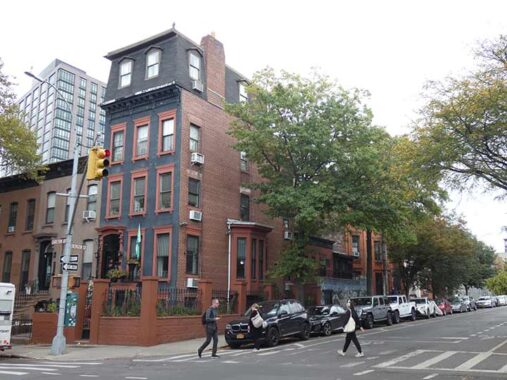
#575 Carlton Avenue, corner of Bergen, is an Italianate building constructed between 1869 and 1880. It’s quite unusual as it has a historic element added fairly recently: its slanted (mansard) roof, added in the 1980s according to the LPC report! It looks original, a tribute to the developer who added it. See the 1940 tax photo.
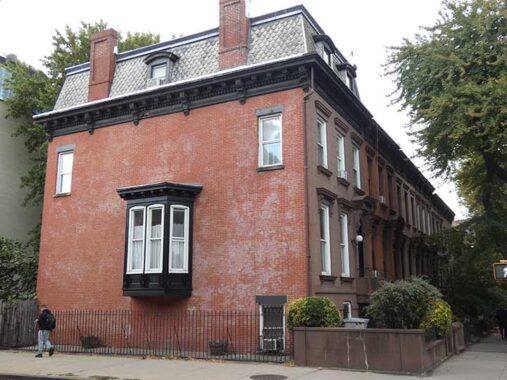
Across the street, the mansard roof at #560 Carlton, built in 1882, is in fact original. “Located at the corner of Carlton Avenue and Bergen Street, 560 Carlton Avenue has two primary facades: a main brownstone façade similar to that of No. 558, and a brick south façade, which retains its three-sided wood oriel. In addition, No. 560 and the rear of No. 558 are crowned by impressive mansard roofs covered with slate shingles.”
#560 has the Google Street View Blur of Anonymity, but the Forgotten NY camera doesn’t have one.
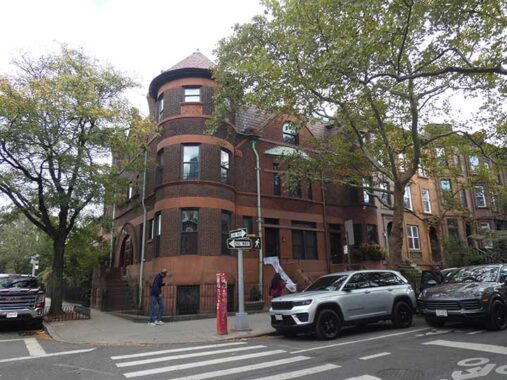
Now let’s visit #577 Carlton, on the SE corner of Bergen. The Romanesque Revival building with thew cylindrical side turret was built by architect Magnus Dahlander in 1892 for developer William L. Beers, it contains three separate residences, with a stoop entrance on Carlton and an arched doorway accessed by stairs on Bergen. They don’t build residences like this anymore, kidz!


#582-602 Bergen Street between Carlton and Vanderbilt Avenues form an unbroken line of attached brownstone and brick buildings on the south side, built from 1874-1886. You can get good cardio workouts as accessing many of them requires walking two flights of steps, as here Bergen is on a slight incline. The wide front yards are reminiscent of the ones in the Carroll Gardens Historic District.
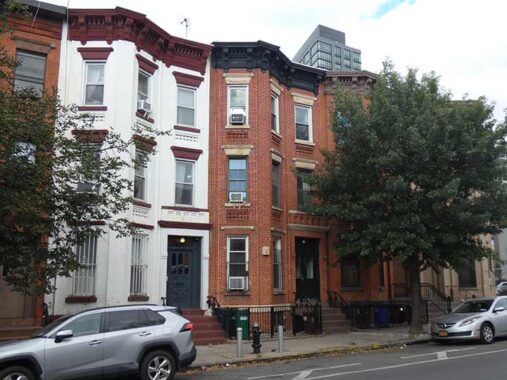
#573-585 Bergen on the north side, meanwhile, were designed by Walter M. Coots for developer C.B. Sheldon in 1889. All but one have their original brickface. I always wanted an apartment with a projecting bay allowing views east and west.


I always thought of tacos as a dinner choice as well as lunch, but King David’s, #611 Bergen, doesn’t agree: they close at 2 PM daily and 3 PM Saturday, so they were closed when I was by around 4:30 PM on a weekday. The store signage bears the hallmarks of Noble Signs, which now has a recognizable style around town (the “S” gives it away).


Farm One, #625 Bergen, is a combination brewery, plant dispensary, and event space, but there is also pizza. It’s tough to get a handle on it.
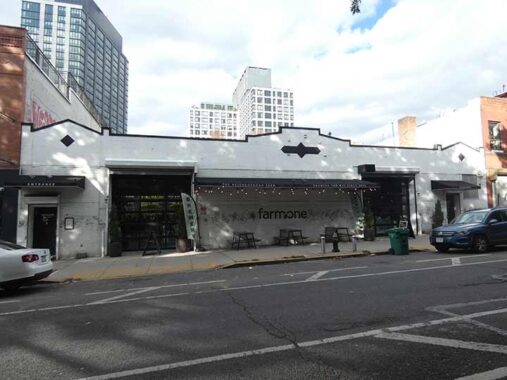
Part of the Farm One complex is this one-story building whose wide entranceways give it away as a former auto repair business, which may have even been a stables before that.
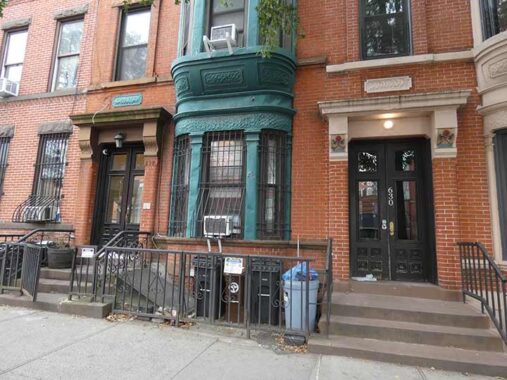
On the other side of Bergen is #630 and its neighbor #632, Romanesque building built as “flats” in 1892 and containing apartment units from the start. I was attracted to the projecting bays allowing three different views that climb all the way to the roofline. They are joined on the south side of Bergen by another grouping of 3 story attached brick residences with 3 units designed and constructed by Christopher P. Skelton in 1889.


In the East 80s when Billy Crystal was on “Saturday Night Live” he would do a sendup of actor Fernando Lamas, whose character’s mantra was “it’s more important to look good than to feel good.” The Nuaa Table is a Thai restaurant on the corner of #638 Bergen Street and Vanderbilt that specializes in creating edible works of art, that look their best before you tuck into them, located in a Romanesque/Queen Anne building constructed in 1891.


Some interesting artwork can be found on buildings on Bergen Street between Vanderbilt and Underhill Avenues. The western-themed Branded Saloon was founded at #640 Vanderbilt, corner of Bergen, in 2008. Some of the art, though, honors activist Marsha P. Johnson (1945-1992), a transgender activist and a familiar figure in the West Village, who co-founded (with Sylvia Rivera) the group STAR (Street Transvestite Action Revolutionaries), which offered housing to homeless and transgender youth. Johnson is also remembered by Marsha P. Johnson State Park, along the East River between North 7th and 10th Streets in Williamsburg.
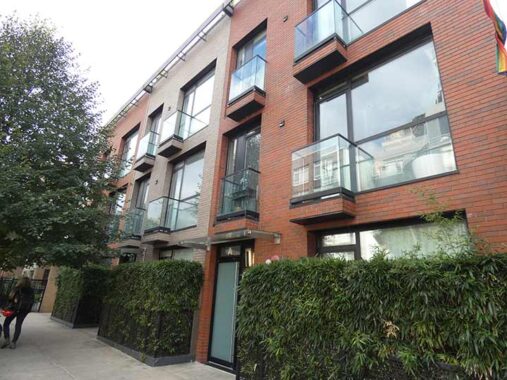
With exceptions, I usually don’t have much in the way of compliments about new residential architecture; on the high end it’s as above my familiarity as Mount Olympus; in the middle of the affordability range, it’s blanditecture; on the lower end, it’s Fedders specials with concrete yards. I do like three buildings, #648-652 Bergen, with traditional brick fronts, large picture windows, and small balconies if you want to catch some air.


It’s generally pointless to try and ascertain architectural details on school websites, which are not concerned with design or decor at all. That said, PS 9, the Sarah Smith Garnet School, has some engaging and even wild artwork on the exterior, in part by Jappylemon and Mitrooper. The school was named for an early influential African-American school principal in the New York City public school system. PS 9 has also been called the Teunis G. Bergen Elementary School. Its namesake (1806-1881), a member of the large Bergen clan in Kings County and NYC as a whole, as New Utrecht Town supervisor and Democratic Party councilman, and opponent of the city of Brooklyn’s annexation to NYC in 1898.
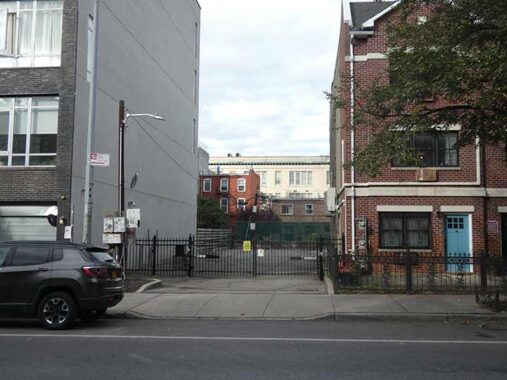
There is an attached grouping of townhouses on the north side of Bergen, #665-703. I was more attracted to the rear parking lot entrances, which have telephone pole lighting mastarms that make them look like public alleys.


I did not have the time at around 5 PM to walk the entire length of Bergen Street; at my pace, it would have taken 2 or 3 more hours. I turned north on Underhill Avenue, a street I have rarely been on.
The ancient brick building on the corner of Bergen Street and Underhill Avenue retains a pair of chiseled street signs. This was the standard method of delineating streets before signs were mounted on lampposts. The street was named for Captain John Underhill (1597-1671) whose claim to fame was leading colonists against Native Americans in the Pequot War, an armed conflict between the Pequot tribe and an alliance of the English colonists of the Massachusetts Bay, Plymouth, and Saybrook colonies and their Native American allies in 1638, which the Pequots lost. Perhaps Underhill is remembered here because of his vehement opposition to Peter Stuyvesant as a Long Island selectman in 1645; he believed Stuyvesant’s rule was tyrannical.


From the Department of Transportation Street Design Manual:
A bike boulevard is a low-traffic, slow street designed to prioritize bicycle and micromobility travel while maintaining local vehicle access. This type of treatment incorporates traffic devices and other calming interventions to enhance safety and provide more comfortable conditions for cycling. Bike boulevards typically extend across multiple blocks, providing continuous, connected routes through neighborhoods, promoting health and well-being by encouraging cycling and walking as active transportation options.
In recent year, the NYC Department of Tranportation has rebranded itself away from its original purpose of moving motor traffic quickly and efficiently, and now encourages other means of transport (which some consider slower and less comfortable) like bicycling. (I am a bicycling veteran of 4 decades). A planter in the middle of a street would seem to be endangering traffic, but I’m no expert other than experience.
And there’s a bicyclist on the sidewalk, making many of these traffic calming measures moot. (Comments are open)
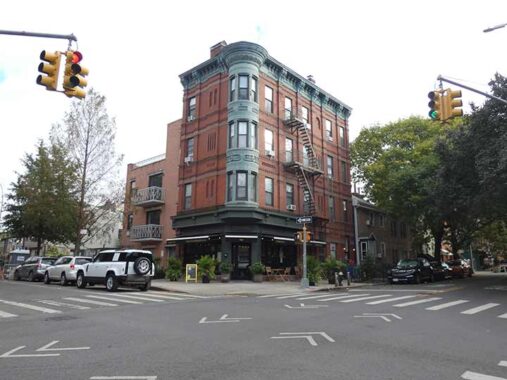
One of two identical buildings catercorner to each other, at Underhill Avenue and Dean Street. There are countless buildings like this in NYC outside of designated landmarked districts that are subject to the predations of developers. #49 Underhill/#760 Dean is home to the Underhill Cafe, a name hard to forget. The cozy neighborhood cafe is a hallmark of gentrified areas, of which some are critical. My town, Little Neck, has lost its neighborhood cafes: you have to go to Bayside for those. In the old days, you would hitch Dobbin to the cart and ride to the next town over on the only road across the marshes, which we now call Northern Boulevard.
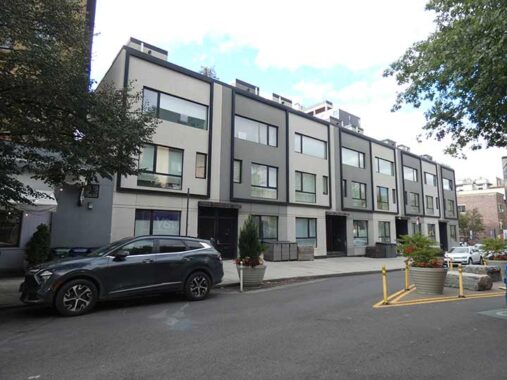
Compare that philosophy of residential architecture on Underhill between Dean and Pacific, a minimalist design featuring gray panels attached to a metal framework. I do like the large picture windows, but I hope there are venetian blinds or curtains that wide. Once again, we have planters in the middle of the street and in the gutter to deter motor traffic.


Art Cafe and Bar, #884 Pacific at Underhill, describes itself as Bohemian haunt showcasing local artists in a funky space with a cozy patio, light fare & cocktails.


South of Atlantic Avenue in Clinton Hill and western Bedford-Stuyvesant, north-south avenues take a decided southwest angle. Not so Washington Avenue, which keeps true to its north-south orientation until it meets its southern end at Flatbush Avenue and Lincoln Road. Along the way, it forms the eastern boundary of the Brooklyn Botanic Gardens. This orientation forms a couple of triangle parks along its route.
One of them is Lowry Triangle at Underhill and Atlantic Avenues, which has been an oasis of green since the streets were laid out hereabouts in the 1870s. For most of those years it was called Underhill Gore. According to the Parks Department the word “gore” refers to a small triangular park, taken from the word’s original meaning of a small odd-shaped or triangular piece of material sewn into clothing to alter the shape. There’s still a Memorial Gore with a World War I monument in eastern Williamsburg at Metropolitan and Maspeth Avenues.
Since 1982 Underhill Gore has been called Lowry Triangle after the longtime pastor of the Zion Baptist Church at 523 Washington Avenue, Rev. Benjamin T. Lowry 1891-1982). The sculpture and its black granite pedestal were made by Brooklyn artisan Robert Pugh.
Elsewhere on the pedestal is inscribed a quote from the Reverend:
“Life has taught me that there is no substitute for persistence and hard work. No matter how gifted or talented an individual, life does not guarantee him success. Successful and worthwhile lives come from consecration, dedication, persistence and faith in God.”


One of the most beautiful buildings in Brooklyn was my high school, Cathedral Prep, a college and then a high school from 1914 through 1985. One of its attendees, though not a graduate, was Green Bay Packers coach Vince Lombardi. It was opened as Cathedral College and built in a Flemish Gothic style complete with spires, gargoyles and even a moat (!) in 1914. The building was converted into condominiums in the 1990s, and in something of a miracle, most of its original details have been preserved and even a couple of the interior details as I found when I was let in a few years ago by ForgottenFan Linda P., one of the current residents.


I am perplexed about the name of the Nine 30 Gallery, as the address of the building on the NW corner of Washington and Atlantic Avenues is actially #596 Washington. The tall, slim residential/commercial building is relatively new, and when I attended classes across the street in the Super 70s, it was a used car lot.
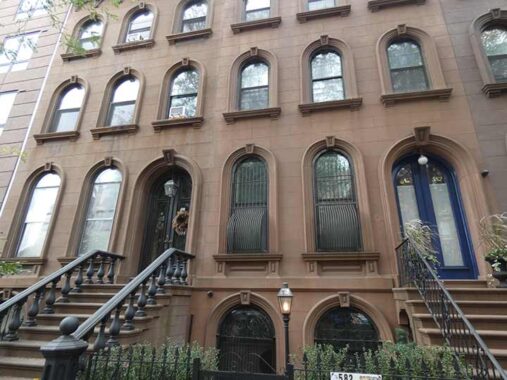
The brownstones with distinctive arched windows were viewable from class.
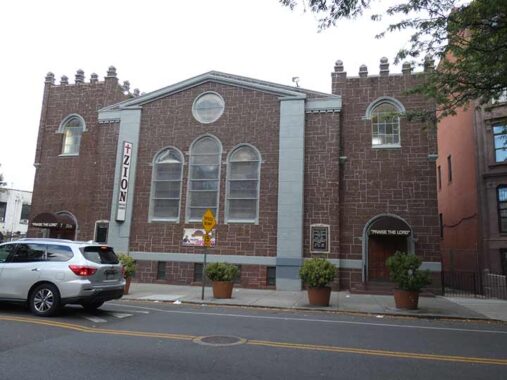
Surprisingly, Zion Baptist Church, #353-529 Washington, had its origins in my home town, Bay Ridge:
On February 17, 1917, a small group of people began holding prayer meetings in Sheepshead Bay, Brooklyn, and on June 6, 1917, having laid the foundation under the leadership of Reverend J.E. Roberson, Zion Baptist Church was organized at 48 Shore Road, Brooklyn, New York. The names of the founders were: Brother Lincoln Downing, Brother Alexander Clayborn, Brother Daniel Pugsley, Sister Estella Francis, Sister Fannie Montree, Sister Jane Downing, and Sister Ethel Hill. [Zion Baptist]
The church moved to its present home in 1921 in a much altered building under the leadership of Rev. B.J. Lowry (see above).
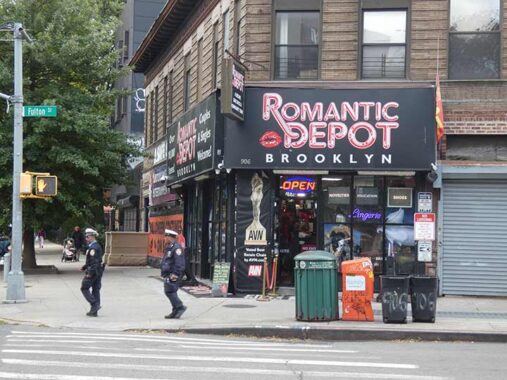
So we have this, on the SW corner of Washington Avenue and Fulton Street, across from Zion Baptist and down the block from what was once a seminary. And Bishop Laughlin High School, St. Joseph’s College and the seat of the bishop of the Diocese of Brooklyn are nearby. Various need for different populations are being met.
It’s time I rewalked this stretch of Fulton, which I have’t done in over 20 years, and the full length of Washington. This summer, maybe.


Today, though, it was time to go home…
Check out the ForgottenBook, take a look at the gift shop. As always, “comment…as you see fit.” I earn a small payment when you click on any ad on the site.
2/10/26
7 comments
You need Doan’s Pills.I take them all the time to relieve back pain.
They’re made with Magnesium Tetrahydrate.In the brightly colored box.
It’s osteoarthritis in a disk.
Osteoarthritis doesn’t affect discs. Low bak pain is the result of joint space narrowing that impings the nerve ending in a particular joint space. It’s often referred to as “low back syndrome. But wait, here’s more:
https://www.bing.com/search?q=radiculopathy%20lumbar%20region&FORM=QSRE10
Chris’ advice is likely the best way to approach the problem because most surgical procedures promise much but deliver only disappointment.
The problem is in a disk, my orthopedist took an xray and diagnosed strain in a disk, and prescribed PT. I took 3 months, and so far the spasms have not recurred, but it’s a matter of time. There is no magic surgery to fix it, he concurred.
You’re fortunate to have found such a wise orthpedist. Good luck. I wish you a less painful future.
In her younger years my mom lived in a Bergen Street brownstone close to the one pictured. Back in 2016 my sister drove her to see it after many decades. We have a photo of her standing in front of it with her two great grandsons. Mom passed away in 2022 at 88. I’m glad she got to see it in person one last time.
Oh yes I know this area. This was besty’s neighbourhood for a couple years prior to moving back to PA. I was working at the same office in the city as her for a short stint. That brings me to a question. Outside the 930 gallery is a black box on a pedestal (as seen in the pic). I assume it’s mailboxes. I used to walk past that thing at like 6 am whenever I’d b going to work after catsitting for the weekend. Anyhoo, that thing looks much older than the building. I figured they renovated the building and left that there. Any ideas about its history?