
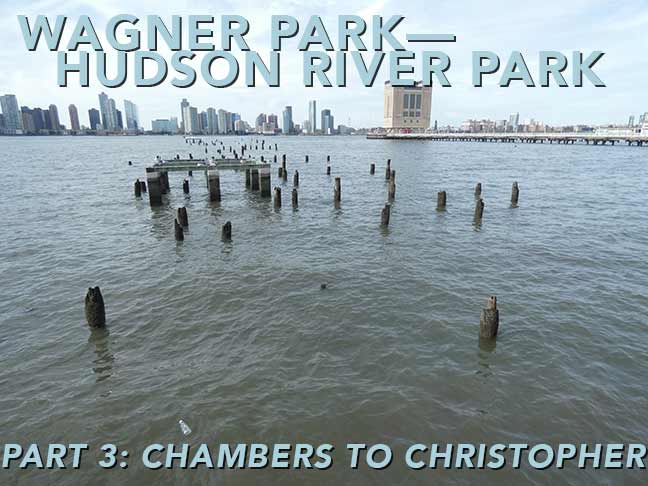

WHENEVER I am by the water, I always silently thank providence I live in a city with ready access to it. It wasn’t always the case; NYC’s waterfront was once semiprivate and where thousands worked, loading and unloading ships. Railroads were built to transport goods from the waterfront to separate handling facilities. During this time, NYC and its traffic czar Robert Moses thought it’d be a dandy idea to locate parkways and expressways along the water. (Moses wasn’t alone; cities as diverse as Philadelphia, San Francisco and Boston also built elevated highways along their water frontage.) It’s only been in the last few decades that cities have decided to make their waterfronts available to all and built parkland.
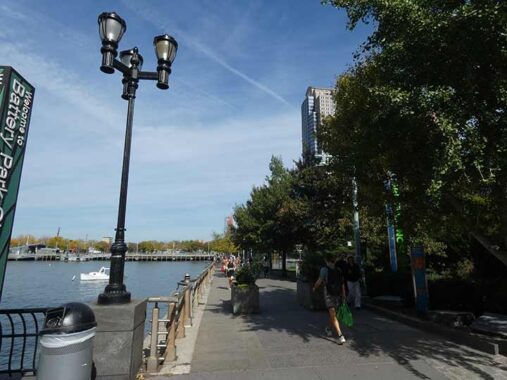
Unlike, say, Washington, DC, Boston or Los Angeles, NYC doesn’t have much of a tradition of post-top streetlamps. One exception is in the parks, where the Type B park lamp can be found by the thousands. Battery Park City features Type Bs in the midblocks, and there are special “cluster” type Bs with three lamps, as on the southern end of the Hudson River Park waterside walkway. There’s even a five-lamper on South End Avenue at the World Financial Center, as seen on this FNY page.
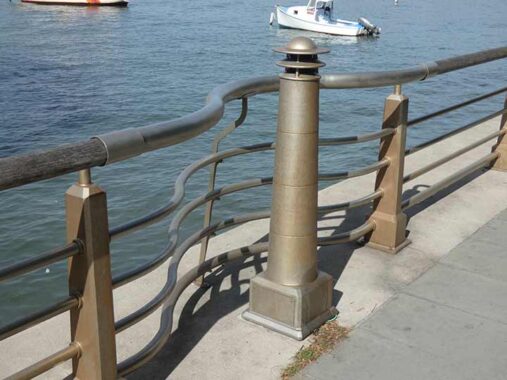
Infrastructurally speaking you have to like the Hudson River Park railings, which have decorative mini-lighthouses.


The Department of Transportation first installed retro Triborough lamps in Hudson River Park and piers, and later installed full-size versions on roads in Queens and the Bronx (two of the boroughs connected by the Triboro (RFK) Bridge. Since 1980, old designs such as the Bishop Crook, Type F and longarmed Corvington, have been revived. Some of the retro designs are available at Spring City Lighting.


Pier 25, at North Moore street, is the largest recreational pier at Hudson River Park and features an 18-hole miniature golf course, sand volleyball courts, a children’s playground with water features and climbing structures, a flexible turf field and a snack bar. There are also the steam powered lighthouse tender Lilac, restaurant ship Grand Banks, and fireboat McKean. When this was a working waterfront, Pier 25 was home to Eastern Steamship Co.
Steamship dock workers would be … amused to see the recreational activities along the waterfront if they could see it in 2026.


Pier 26, which formerly docked Navy ships, has become a key Tribeca recreational and dining spot. From the Hudson River Park website:
This 2.5-acre ecologically-themed pier in Tribeca incorporates indigenous plants evocative of Manhattan’s ecosystem prior to human development. A short habitat walk leads visitors through five native ecological zones: woodland forest, coastal grassland, maritime scrub, rocky tidal zone, and of course the Hudson River. A sunning lawn and a sports play area make Pier 26 — already popular with the Downtown Boathouse (New York’s busiest non-motorized boathouse) and City Vineyard — a place to please everyone.
In addition to a multi-use recreation field, spacious lawn, boardwalks and seating areas, Pier 26 features an innovative, engineered Tide Deck. Located at the western edge of the pier, the Tide Deck is a cultivated rocky salt marsh created to provide an immersive and educational river ecology experience. The elevated cantilevered walkway above the Tide Deck provides spectacular city and River views.
Photographer and violinist Shelley Seccombe and her husband moved to Greenwich Village in 1970. She set about getting pictures of the deteriorating docks and piers along the Hudson waterfront in the ensuing decades, along with the Miller (West Side) Highway in mid-demolition. Pier 26 has an exhibit, but fortunately, HRP also has a page devoted to the photos on its website. Seccombe also published a book with her photographs (Fordham University Press, 2008.)
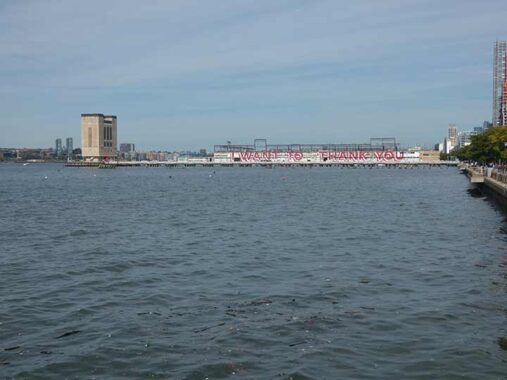
Walking north on the waterside path you see the words “I Want to Thank You” painted on the south side of the Pier 40 complex. I had thought this was done in connection to the healthcare industry response to the COVID 19 pandemic: but the phrase was painted in 2019 by artist Stephen Powers as part of The Global Fund Replenishment Conference that year. The Global Fund invests around $4 billion a year to fund efforts to reduce malaria, AIDS and tuberculosis worldwide. I first saw Powers’ work, “Love Letter to Brooklyn,” in downtown Brooklyn on a parking garage on Livingston Street which has since been demolished.
Powers: “‘I Want to Thank You’ is a song by Alicia Meyers. I paint it in the spirit of a DJ playing the song, as double dedication to the Paradise Garage and artist David Wojnarowicz. Paradise Garage was once a members-only dance club near Pier 40, that played the ideal music through the ideal sound system under the ideal conditions to foster the best nightlife community in New York’s storied history. Even today, 30 years after the closing of the Paradise Garage, the songs that made up the playlist of the Paradise Garage are touchstones that remind us in the present day what we can achieve together, even if it’s just to have fun. Especially if it’s just to have fun.”
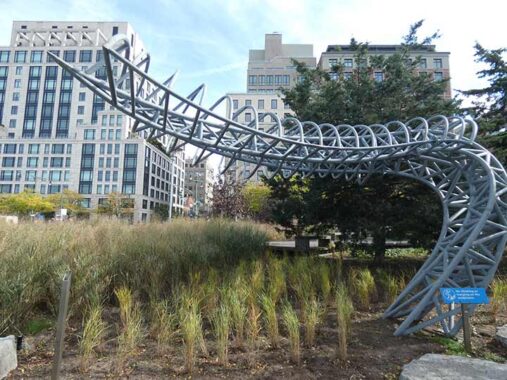
More art: “Serpentine Structures” are permanent steel pipe installations by artist Mark Gibian.


Though the Hudson River Park marks some of the old pier sites on railings, most are nonexistent or visible only by ancient wood pilings, such as Pier 32, which once berthed ships from the mighty Moore-McCormack line.


The Holland Tunnel runs beneath the Hudson River at Spring Street and its Ventilation Shaft 2 can be seen just offshore. Two bridges connect it to the mainland, and both feature lighting not seen elsewhere around town. This one is for official vehicles only and is lit by davit-style poles with LED fixtures I can’t identify (help me in comments.) The thin devices at the top of the lamp are meant to prevent birds from landing there and doing what they do.
A public walkway bridge, the remains of former Pier 34, also goes to the shaft, though I presume access to it is locked. It also has davit posts and what appears to be sodium lamps that shine yellow light. Pier 34 formerly served the Clyde-Mallory shipping line, a product of the merger of the Clyde and Mallory lines. If you’re curious, more on these former shipping lines can be found here.


Compared to locales like London, UK or Abu Dhabi, Saudi Arabia, New York City is rather staid, architecturally speaking, but there are some modern gems to be found along Hudson River Park and the routes that border it, such as this Department of Sanitation salt shed at West and Spring Streets. It’s part of DSNY’s gi-normous complex and by far is its most novel element. Designed by Dattner Architects with WXY Architecture + Urban Design and opened in 2016, it’s supposed to be reminiscent of a very large salt grain. It can store 5000 tons of salt, in a region that can have as much as 6 feet or snow or less than 6 inches over the course of a winter. An additional glass and steel complex was also built for New York’s Strongest on the other side of Spring Street.
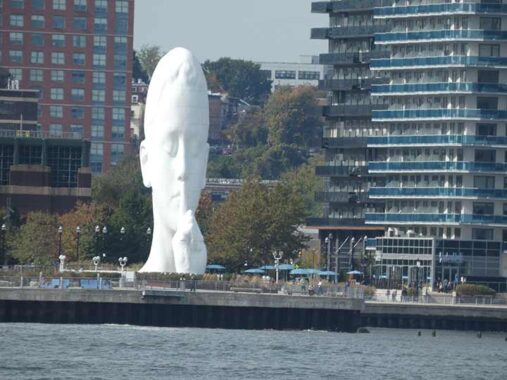
Across the river in Jersey City, south of Christopher Street I spotted a sculpture of a huge woman’s head and hand making a “shushing” sign. Newport Green Park is a relatively new waterside park created in 2012 along the waterfront. Open to the public, it was built as an amenity for a new apartment complex. The 80-foot-tall sculpture, “Water’s Soul,” was created by Spanish artist Jaume Plensa:
A large majority of Plensa’s work includes sculptures in public spaces. Plensa’s public art installations can be found in Spain, France, Japan, England, Korea, Germany, and Canada. The sculptures are usually over-sized heads, torsos, or spheres. [Jersey City Upfront]
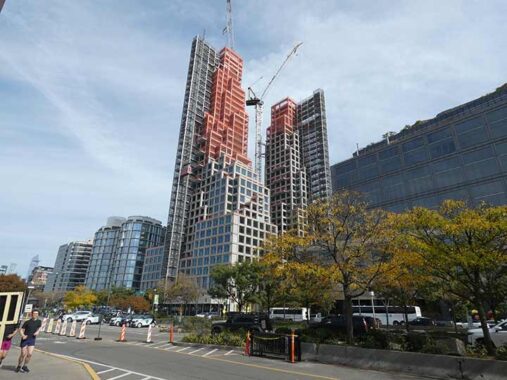
Going up at #570 Washington, facing West Street at West Houston, is luxury senior living. I’ll have to win Megamillions to afford that place. I anticipate being shuttled off to a rundown place in Far Rockaway by the boardwalk, where they’ll wheel me out twice a day to watch the gulls.
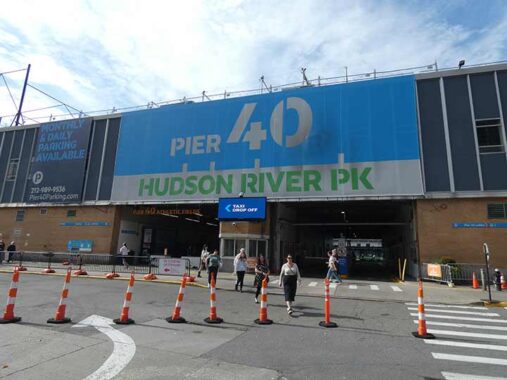
Pier 40 served as the terminal for the Holland America Line from 1962-1974. Before that, it was a pier used by various transportation companies including the Pennsylvania Railroad. It has served as a sports complex since 2005, but also contains parking and berthing for excursion vessels.
Pier 40 also serves essential public recreational functions, including a large athletic field complex, Hudson River Park’s River Project Wetlab, mooring field and a community boating program. Plus, New York City’s only outdoor Trapeze School is located on the rooftop. [HRP]
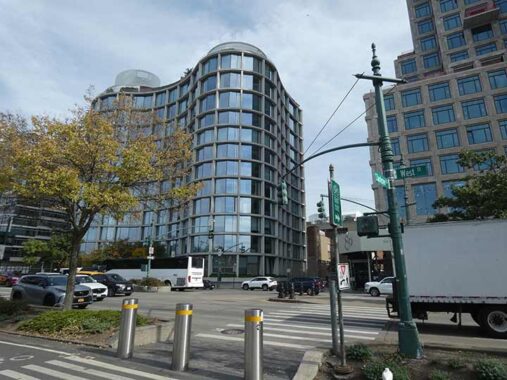
The undulating exterior of #160 Leroy Street, views facing west to the Hudson from West Street between Clarkson and Leroy. The high-priced residential building went up in 2017, designed by Brazilian architect Oscar Niemeyer “from a concept by Ian Schrager.” If that name sounds familiar, in the Super Seventies Schrager co-founded disco hotspot Studio 54 with Steve Rubell.
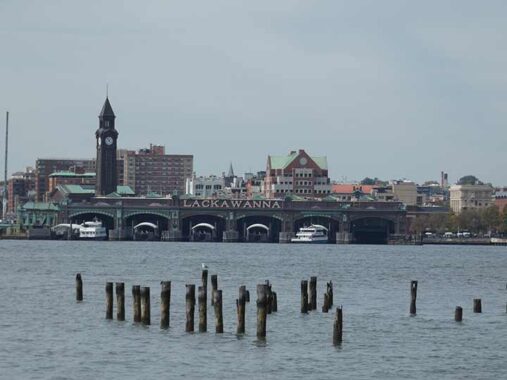
Another “ghost” pier, this time Pier 42. Across the Hudson is the old Lackawanna Terminal in Hoboken, still a transit hub serving PATH trains, New Jersey Transit trains, several bus lines, and Hudson-Bergen Light Rail. It was a twice daily visit for me from March to November 2016 when I temped at Pearson Publications on River Street.
That’ll conclude this leg of my Hudson River walk, as the rest of the photos in this batch are from Christopher Street. I hope to return to Hudson River Park soon when the ice melts to possibly take things all the way to 59th Street.
Check out the ForgottenBook, take a look at the gift shop. As always, “comment…as you see fit.” I earn a small payment when you click on any ad on the site.
2/28/26
3 comments
“I want to thank” is one of the most common mistakes. You’re supposed to say “I thank [so and so],” not “I want to thank [so and so].” Why are you asking permission to thank someone? Who are you asking?
Since I’m here, you’re also supposed to shorten “in order to” to “to.” No meaning is lost by the shortening.
Zzzzz
Ditto, Kevin