
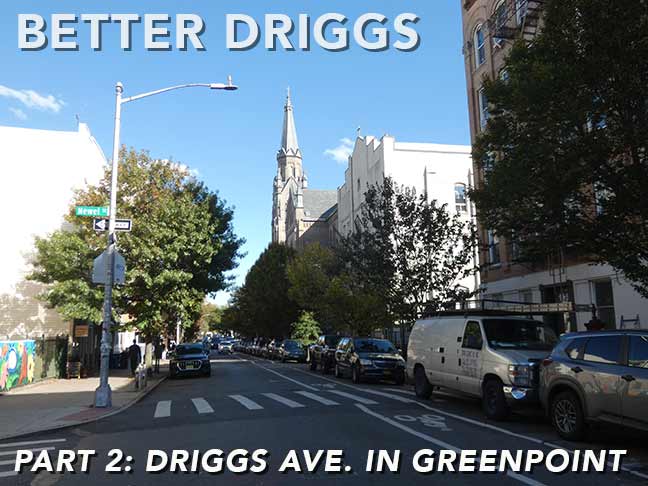

PART 2 of my Driggs Avenue odyssey was actually committed to before Part 1. In October 2025 word reached me that an ancient storefront sign had been revealed on Manhattan Avenue in Greenpoint and I assumed (I’m usually right about this) that it would quickly be expunged or covered over by new tenants. Thus, I raced over (LIRR and two subways) for a rare weekday jaunt and duly covered the sign that turned out to be for Weinholz Drugs. I was later heartened to hear that the signs had been preserved and incorporated into a new facade (let me know if I’m wrong; Comments are open).
Finding myself in Greenpoint, mission accomplished, I set off east on Driggs from Manhattan Avenue and covered Engert Avenue on my way back to the subway (that leg will turn up in the future). Driggs’ span in Greenpoint is shorter than that in Williamsburg, thus so will this page be. In November, I walked Driggs in Williamsburg, linked in Part 1.
Driggs Avenue is unusual, in that its house numbering runs east to west, in contrast to the majority of NYC streets oriented west-east. Thus the lower house numbers are in Greenpoint, the higher in Williamsburg. The street is named for Edmund Driggs, the last village president of Williamsburg before it briefly became a city in 1855, only to be absorbed into the city of Brooklyn. His son Edmund Hope Driggs was a two-term NYS Representative from 1897-1901. Until many of Williamsburg and Greenpoint’s street names were changed in the 1890s, the Williamsburg section of Driggs Avenue was 5th Street, and the Greenpoint section was Van Cott Avenue, for a local farming family. The Williamsburg section changed to Driggs first, then the Greenpoint. See this 1858 Dripps map of this section of Kings County.
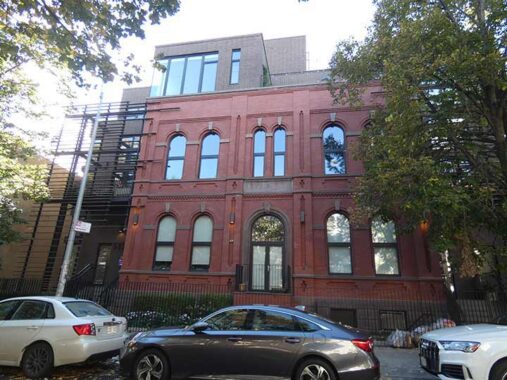
The first cross street Driggs Avenue encounters east of Manhattan Avenue is Leonard Street. Remembering a long-ago Forgotten NY post, I detoured north to check it out. Magnificent as a pro-cathedral, with ecclesiastical-looking brick crosses and arched windows of three different sizes. Francis Morrone doesn’t mention it in his Architectural Guide to Brooklyn, and the AIA Guide to NYC (the latest edition is from 2010, so it’s overdue for an update) overlooked it, too. Thus, I know next to nothing of the building’s history, though a past as a house of worship wouldn’t surprise me. The original metal fence is still intact.
#535-539 Leonard used to be Public School 59, and after that it was the headquarters of the Polish Legion of American Veterans. I am thankful the old pile is still standing and has been converted to residences, but it’s had modern additions piled on its roof and south side.


By day #261 Driggs, at Eckford, is the Polish National Home, a community organization founded in 1914 to further Polish culture in the region (also home to occasionally raucous community board meetings); by night, the ground floor is Warsaw, one of Brooklyn’s #1 rock venues. The building itself went up in 1914.
I have only been in once and it wasn’t for a concert: I witnessed Mitch Waxman of the Newtown Pentacle (he is now based in Pittsburgh) receive an award from Newtown Creek Alliance.


The triangular plaza at Driggs and Graham Avenues is named Father Joseph Studzinski Square. Fr. Studzinski (1887-1954) was the longtime pastor of nearby St. Stanislaus Kostka Church.
Father Joseph Studzinski was born on February 12, 1887 in the province of Silesia, a coal-mining region in present day Poland near the German border. Ordained in 1911, Father Studzinski immigrated to the United States one year later.
Father Studzinski served as pastor at Greenpoint’s Saint Stanislaus Kostka Church from June 1935 until his death in December 1954. Known for his generous and caring nature, Father Studzinski gained the love and respect of his congregation. Now, years after his death, the memory of Father Studzinski remains steadfast within the Greenpoint community. [NYC Parks]
I didn’t like the switch to upper and lowercase on street signs introduced in 2010 or so, but I have warmed to the idea, especially since The Department of Transportation went back to Highway Gothic after a 5-year flirtation with Clearview. However, Greenpoint is one word, not two.
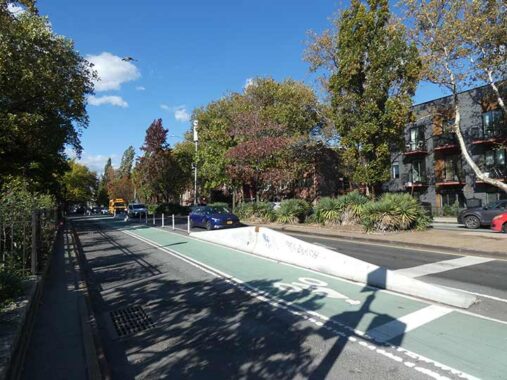
Graham Avenue ends its northward progress at Driggs Avenue and McGuinness Boulevard, seen here. Prior to 1964, Oakland Street’s southern end was at Driggs, but that year it was expanded into a multi-lane trafficway to bring motor vehicles from the Pulaski Bridge south to the Brooklyn-Queens Expressway, and Oakland was renamed for Peter McGuinness, a long-time Greenpoint Democratic alderman and ward boss.
McGuinness Boulevard functioned perhaps too well as a pedal to the metal conduit, and local leaders say it proved too dangerous for walkers and bicyclists, so it was given a “road diet” from four lanes to two. The remaining lanes were converted to bike lanes and given fencing and Jersey barriers.
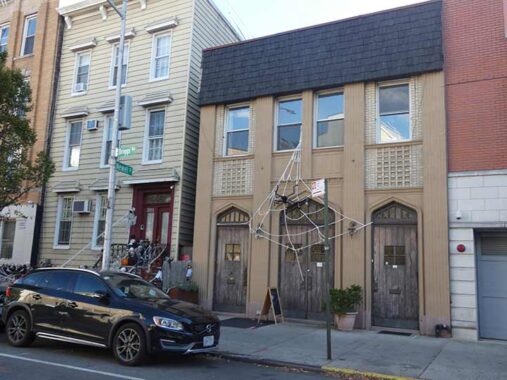
#205 Driggs, opposite Newel Street, appears to have had a special purpose other than residential space, and a 1940 photo proves it had once been a funeral chapel.
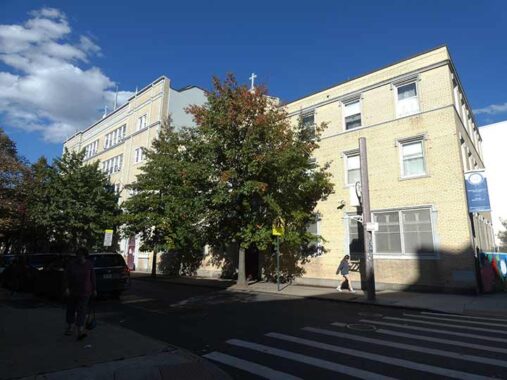
The sun was so bright, I actually had to lower the levels on this photo of the “new” building of the St. Stanislaus Catholic school complex, built in 1940. I didn’t head up Newel to see the older school building, which has “St. Stanislaus School” in Polish on the exterior.


The wood Monger’s Palate shingle sign stood out for me. The cheese shop (#192 Driggs) describes itself as a “a cheese, charcuterie and specialty foods store and caterer.” The word “monger” is not used as a standalone, but as a suffix: Webster’s: “denoting a dealer or trader in a specified commodity.” In a general pejorative sense, it has also served as a suffix in “fearmonger” and “warmonger.”
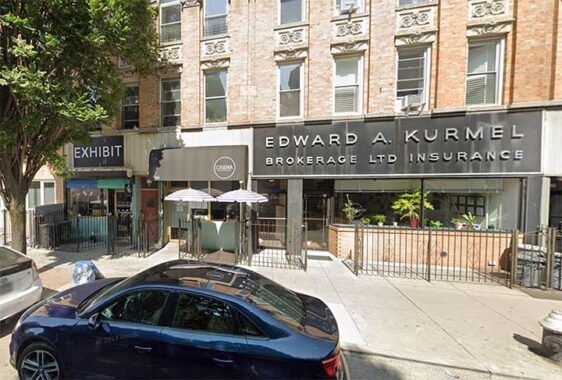
#180-184 Driggs feature three very different businesses but with nearly identical color schemes on sidewalk signage, Exhibit (hairdresser), Crema (coffee shop) and Edward A. Kurmel home, auto business, and renters insurance, by far the oldest sign, with metallic lettering at least 30 years old.


Stanislaus Kostka (1550-1568) was a Polish Jesuit novice who walked from Vienna to Rome, likely contracting malaria on the journey, from which he died at age 17. He was canonized in 1726. There are a number of NYC churches named in his honor, including this one at Humboldt Street and Driggs Avenue and a second one, across Newtown Creek in Maspeth. Greenpoint’s Kostka serves the largest Polish congregation in Brooklyn and was visited by Pope John Paul II in 1979; his likeness is in view on Humboldt. The parish was established in the 1880s, and the magnificent Gothic building was dedicated in 1904.
Lech Walesa (pronounced va-LEN-za), born in 1943, is the mustachioed former Polish president and Nobel Peace Prize winner who helped begin the process of freeing Poland from the Soviet empire when the trade union he led, Solidarity, engaged in several strikes for workers’ rights in the port of Gdansk in 1980.
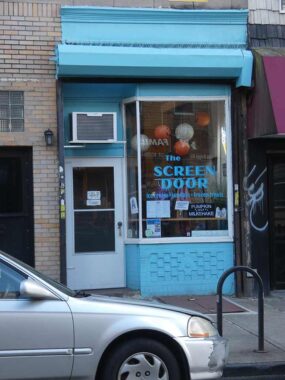
I found this tiny storefront at #145 Driggs west of Russell, painted in light blue, one of my favorite colors, for an ice cream parlor called The Screen Door. Unfortunately a written sign in the door said it would be closing on November 2nd (I passed here on Oct. 22, 2025). However! That meant it was seasonal and would reopen in March, so it’s still with us. Huzzah!


Bear with me here because I’ve covered McGolrick Park fairly extensively in Forgotten New York but not at least for a couple of years. McGolrick Park features winding paths that are separated from the grassy malls by iron railings, as well as numerous benches that the area homeless find attractive, as well as three substantial public monuments. The park was set up by the City of Brooklyn in 1889 with a funding assist from assembly Winthrop Jones; when it opened in 1891 the park was duly named Winthrop Park — possibly, there was a pre-existing Jones Park. The park was later renamed Monsignor Edward J. McGolrick Park, in honor of the pastor of the nearby St. Cecilia’s Roman Catholic Church from 1888 until his death in 1938. McGolrick, an Irish immigrant, was a major fundraiser for the parish, which built new church, convent, rectory, hospital, lyceum, school, and playing field under his direction.
Greenpoint can boast McCarren, McGolrick and the recently established Bushwick Inlet, Transmitter, Greenpoint Landing, Box Street Parks and Newtown Creek Nature Walk.
A triumphant crescent-shaped shelter pavilion was designed in 1910 by famed architectural firm Helmle and Huberty. The brick and limestone creation features an elegant wood colonnade connecting two buildings. Each building served as a comfort station, one for men, and the other for women. The pavilion was designed to invoke the feeling of 17th and 18th century French garden structures. The structure is currently listed on the National Register and is protected as a New York City landmark. It was reconstructed in 1985 — some critics felt it strayed too far from the original design, so it was again rebuilt in 2001. It was declared a NYC landmark in 1966.
When I lived in Flushing (1993-2007) I would bicycle fairly extensively from its central Queens location east and west. On those occasions I made it to Greenpoint I found the arch here a convenient landmark to begin my eastward journey back home.


When I’m in McGolrick Park, my camera can’t keep its sensor off this Angel of Peace statue by German immigrant Carl Augustus Heber, dedicated in 1923. On three sides of the pedestal are inscribed names of major battles of WWI: Argonne, Somme, Chateau Thierry, Saint-Mihiel.
Here, in a park that is still at the heart of working-class Brooklyn, the “angel of victory” carries the palm and holds out the olive branch. Like all our angels she is young and beautiful, and her face, tipped slightly askance, bears that indefinable look of longing and exaltation that seems to come from another world, bearing hopes that we would never dare but for her blessing. The pedestal’s words ring with the soul of the Great War innocence, beginning: “To the living and dead heroes of Greenpoint who fought in the World war because they loved America…” –from Out of Fire and Valor, Cal Snyder


Given that it’s a relatively small park, McGolrick has more than its fair share of classic architecture and statuary. The John Ericsson (Monitor and Merrimac) Monument by Italian immigrant sculptor Antonio De Filippo was dedicated in 1938. The Swedish-born engineer Ericsson (1803-1889) designed the Monitor, the USA’s first ironclad vessel, at Greenpoint’s Continental Iron Works in 1861, and engaged the Confederate States’ Merrimac at Hampton Roads in 1862. Less than a decade after the battle, William Street was renamed for the famed warship. We’re approaching the dodransbicentennial, or 175th anniversary, of this historic naval battle.
Rather than a portrait statue, such as Jonathan Scott Hartley’s bronze depiction of Ericsson (1903) which stands at the north side of Battery Park, De Filippo sculpted a monumental stylized male nude allegorical figure. NYC Parks


Before leaving McGolrick Park I couldn’t help but tear off a couple of more photos. In one of them, you can see a Donald Deskey lamp pressed into service to hold NYC Parks spotlights.
What I wouldn’t give for a local park like this I could go sit in and relax…


PS 110 (The Monitor School) at Monitor and Driggs Avenues has its first floor obscured by construction scaffolds, as is often the case with interesting buildings around town, but Street View preserves photos of it unadorned as such. The architect, in 1895, was James Naughton, who designed so many of Brooklyn’s handsomest school buildings.


On the SW corner of Driggs and Monitor is the Little Dokebi Korean restaurant. I noted the gold leaf lettering on the exterior in the Century Schoolbook Bold font, as well as the blue and white enamel Receiving and Shipping sign left over from a long-ago previous tenant. “Dokebi” is the Korean word for ogres or sprites, spirits who inhabit inanimate objects.
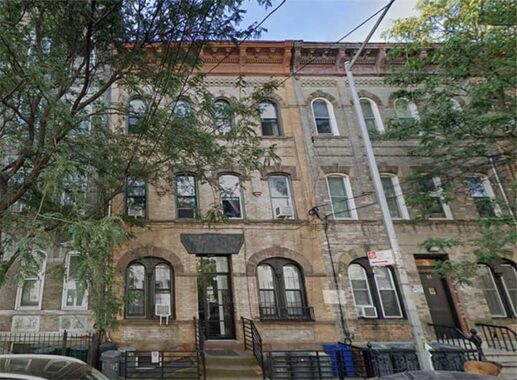
They are un-landmarked, so it’s hard to find info on them, but I found this grouping of handsome attached residences on Driggs between Kingsland and Sutton notable.
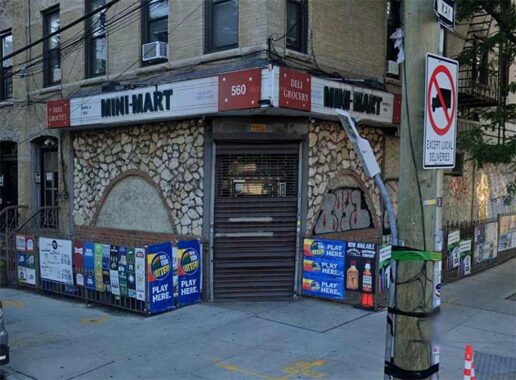
I liked the movie-marquee-esque signage at Mini Mart, #560 Morgan Avenue, corner of Driggs. It reminded me of the marquee signage for the La Esquina restaurants around town.
This is actually the “beginning” of Driggs Avenue, as its lowest house number is #4 Driggs at Meeker, home of Rebels N Saints Tattoo.
Till next time…
Check out the ForgottenBook, take a look at the gift shop. As always, “comment…as you see fit.” I earn a small payment when you click on any ad on the site.
3/28/26