
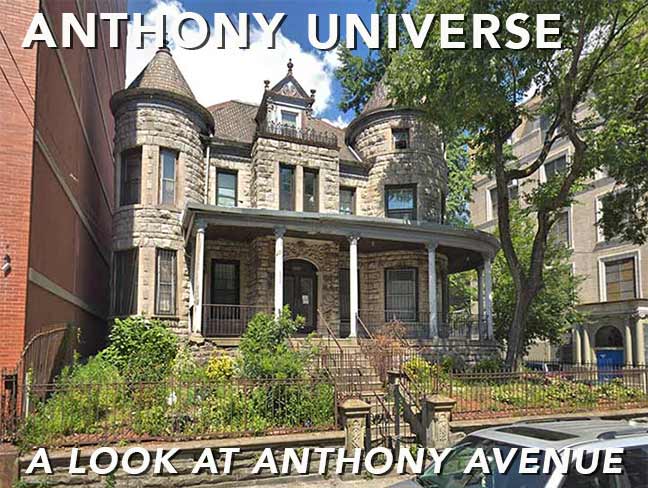

MOUNT Eden and Mount Hope are two communities in western Bronx along the Grand Concourse, which is built on a natural ridge. Mount Eden is an old name driving from a landowner living here in the 1820s, Rachel Eden, while the reason for Mount Hope’s name is unclear; according to the late Bronx historian John MacNamara, it was originally named, much less poetically, the “Western Reserve” of Upper Morrisania prior to the Civil War. Crotona Park is nowhere near the Croton Aqueduct, which runs through the western Bronx; it was named for a colony in ancient Greece famed for Olympic athletes. It was purchased from the estate belonging to Andrew Bathgate in the 1880s; a dispute with the Bathgate family prevented the new Crotona Park from being named for them. Bathgate Avenue today remembers these early Bronx gentry.
I haven’t been in the Bronx since November 2025 (as I write this in March 2026). What can I say, it was a cold and snowy winter. Don’t worry, I’ll get back soon. Meanwhile, I depended on Google Street View for the photos in this feature. It runs from Clay Avenue at Claremont Park (visited on this FNY page) northwest along a ridge to the Concourse at East 181st Street, and is divided into two sections by the Cross Bronx Expressway.
Anthony Avenue was once called Prospect Avenue for its position on a ridge offering views of the surrounding area, but when Bronx’s towns were consolidated, it was renamed to avoid confusion with today’s Prospect Avenue in Longwood and Crotona Park. It briefly became Avenue C before local officials settled on naming it for landowner Charles Anthony.
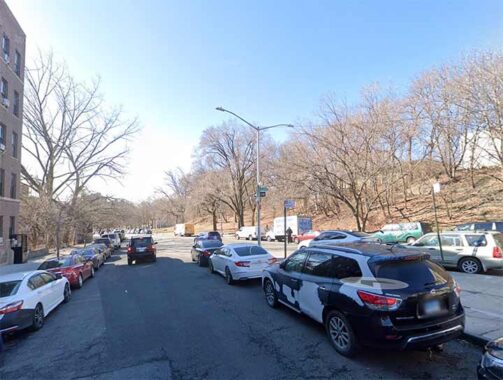
Looking south at Anthony Avenue’s southern end at Clay Avenue at Barry Plaza and East 173rd Street. Claremont Park is seen in the background.
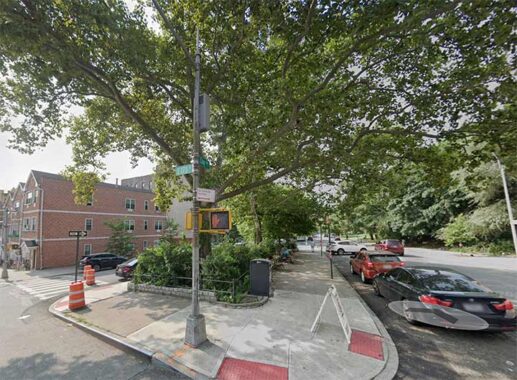
Barry Plaza, a small triangle of green, was named for William T. Barry, a local resident casualty of World War I.
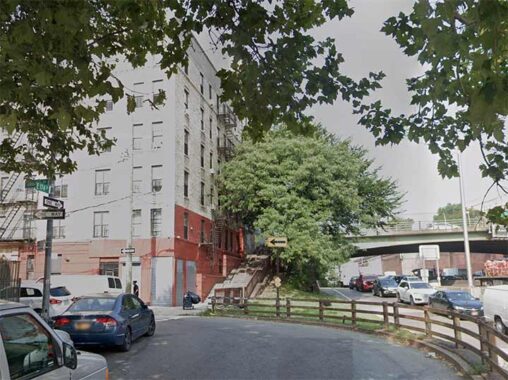
At Anthony Avenue’s interruption at the Cross Bronx Expressway and East 174th, one of Bronx’s many step streets, many unmarked on maps, runs along the CBX, connecting Anthony and Clay Avenues.
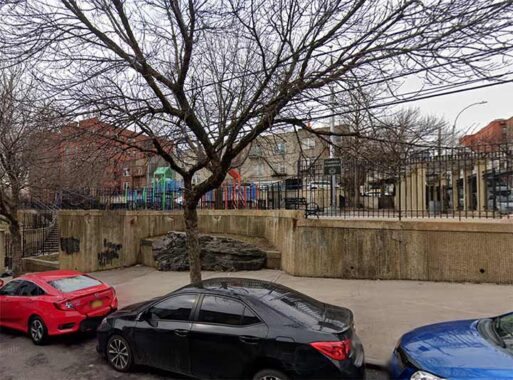
North of the CBX, some of the schist rock found beneath the Bronx surfaces on Anthony Avenue, and within it was constructed the Anthony Avenue Playground several years ago. Henry Stern, longtime City Councilman and later Commissioner of NY Parks and Recreation from 1983 to 1990 and again from 1994 to 2000 during the Ed Koch and Rudy Giuliani mayoral administrations, was fond of giving NYC’s parks and green spaces engaging and playful names, and thus renamed the playground for Cleopatra, a queen of ancient Egypt who became the consort of Roman statesman Mark Anthony. The two died by suicide in 30 BC.
Another unmarked public walk connects Anthony and Clay Avenues south of the playground.
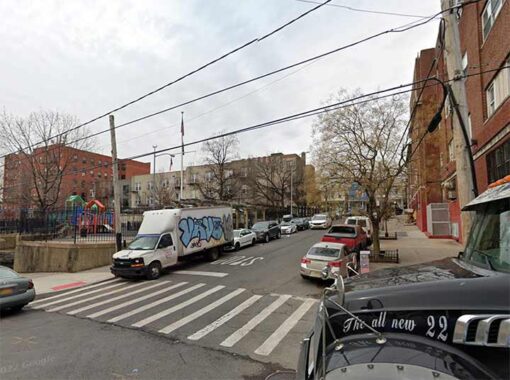
North of the playground, Prospect Place also connects the two avenues, Anthony and Clay. It was likely named such when Anthony Avenue was still called Prospect Avenue.
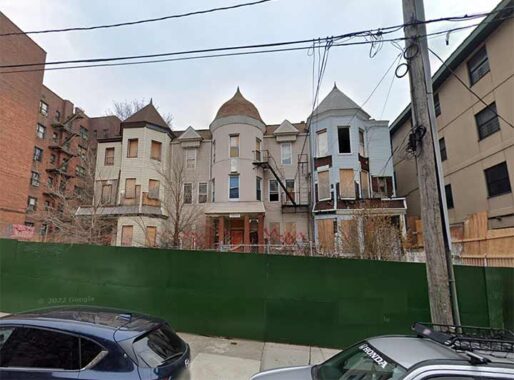
A turreted trio, #1804-1808 Anthony Avenue, has seen better days and may be marked for demolition. Oddly the handy website 1940s.nyc does not have them in its database of photos.
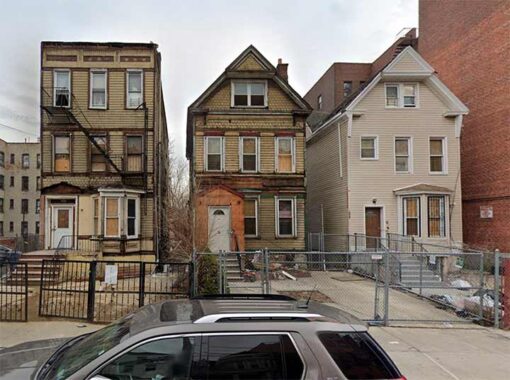
A second trio, #1824-1828 Anthony, opposite East 175th. Again, 1940s.nyc has no images of these buildings in the 1940s. Neither does the NYC Municipal Archives: but they do have tax photos from the 1980s, on this page. From those we discover that #1826 (center) and #1828 (left) have had their former exteriors stripped off, leaving the woodwork underneath. #1824 (right) has been provided with new siding in recent years.


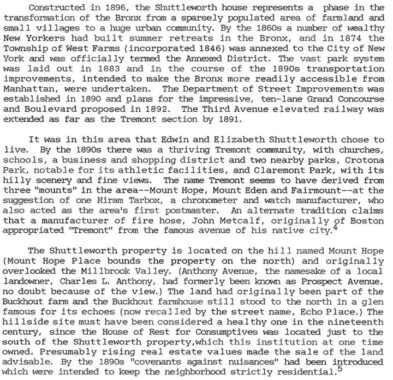
The Shuttleworth Mansion, #1857 Anthony at Mount Hope Place, is the only landmarked structure on the avenue. In 1896 Edwin Shuttleworth was a stone dealer and approached the Neville & Bagge architectural firm with the idea of creating house using one of the varieties of stone he sold. The architects embellished the plan by bringing in stone carvers who created ornate male and female forms, marine elements and picturesque busts. 1857 Anthony is one of a kind.
From the linked Landmarks Preservation Commission text:
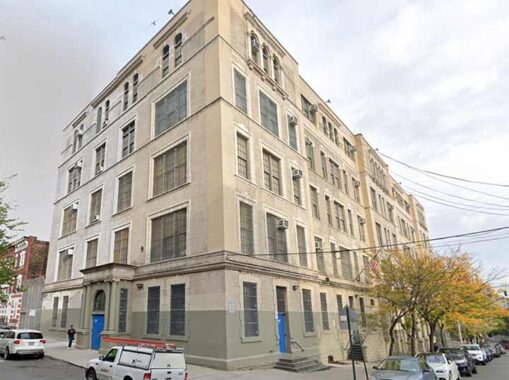
Across Mount Hope Place from the mansion is the massive PS 28. Since it’s landmarked, and NYC public school websites generally do not provide information about school buildings, all I can tell you is it was built in 1896. If you know more, Comments are open. The building was covered in construction scaffolds recently, so this view is from a few years ago.
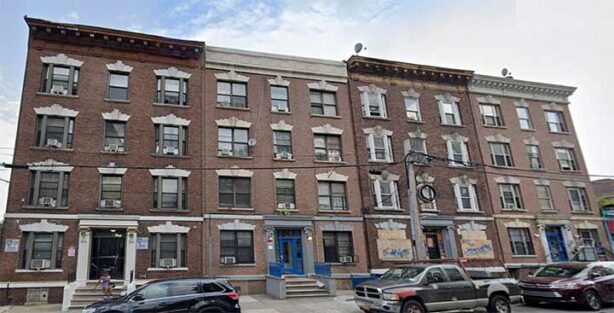
The mighty have fallen at these four attached buildings at #1940-1948 Anthony, opposite the Shuttleworth Mansion, as they are in varied conditions of upkeep. The original heavy window lintels are still there, as well as the cornices on three of the four.
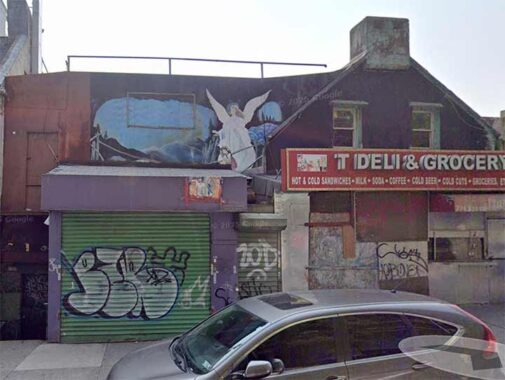
The colorful angelic mural at #1970 Anthony is left over from when the building supported a storefront ministry.


Today’s theme seems to be faded glory. I’m surprised this Federal style building at #300 East Tremont, corner of Anthony, wasn’t landmarked: so much as been done to the exterior, it couldn’t happen now.
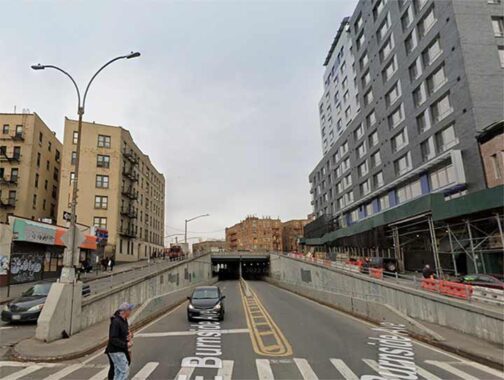
Looking west on East Burnside Avenue from Anthony. Many cross streets, especially those that had trolley tracks, were built to run in tunnels beneath the extra-wide Grand Concourse, built in 1909. As some many not know, the avenue was named for Ambrose Burnside, a Civil War general who had a mixed record. He later became Rhode Island governor and later, a senator from the same state.
… Burnside had repeatedly demonstrated that it had been a military tragedy to give him a rank higher than colonel. One reason might have been that, with all his deficiencies, Burnside never had any angles of his own to play; he was a simple, honest, loyal soldier, doing his best even if that best was not very good, never scheming or conniving or backbiting. Also, he was modest; in an army many of whose generals were insufferable prima donnas, Burnside never mistook himself for Napoleon. Physically he was impressive: tall, just a little stout, wearing what was probably the most artistic and awe-inspiring set of whiskers in all that bewhiskered Army. He customarily wore a high, bell-crowned felt hat with the brim turned down and a double-breasted, knee-length frock coat, belted at the waist—a costume which, unfortunately, is apt to strike the modern eye as being very much like that of a beefy city cop of the 1880s.— Bruce Catton, “Mr. Lincoln’s Army”
His extravagant set of muttonchop whiskers apparently gave rise to the term “sideburns” to mean thick, bushy hair besides the ears shaved short of an actual beard. In Britain the term is occasionally “sideboards.”
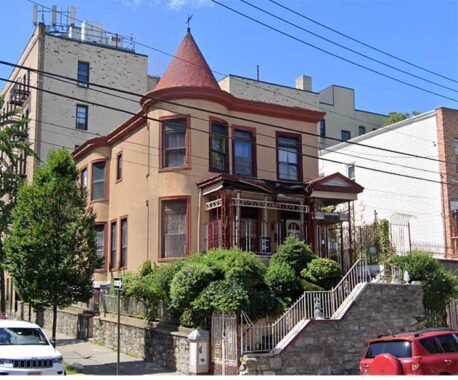
An impressive, turreted survivor, complete with weathervane, at #2081 Anthony Avenue, at East 180th; readers know by now I’m impressed with decorative turrets.
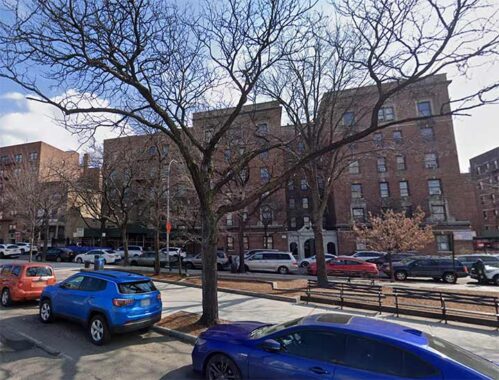
Anthony Avenue reaches its northern end at Bergen Triangle, formed by its angular intersection with Grand Concourse at East 181st Street. Its namesake, Police Officer William C. Bergen (1862-1925) has an interesting story, related on the NYC Parks website:
[Bergen was a] one-time policeman known as the “millionaire cop” because of the fortune he made buying vacant lots in the Bronx at the beginning of the 20th century. Bergen was a patrolman on the New York City Police Force and was assigned to the Bronx in 1905. Walking his beat, he often spotted large vacant areas that had remained undisturbed by subway lines. Seeing the potential of the undeveloped land, Bergen began buying portions of it with his life’s savings.
In 1900, the Third Avenue elevated line was extended into Fordham Plaza, and in 1918, the Jerome Avenue elevated line opened. After the arrival of the subway and the Bronx land boom, Bergen’s realty holdings skyrocketed in value. He sold several of the lots to developers and acquired a small fortune, enabling him to retire from the police force. Bergen embarked on a new career as one of the largest developers in the Bronx, building over two hundred houses on his remaining land. Later Bergen became a prominent figure in Bronx Democratic politics.
See the link for the full story!
Check out the ForgottenBook, take a look at the gift shop. As always, “comment…as you see fit.” I earn a small payment when you click on any ad on the site.
3/30/26
4 comments
Of course, it’s a shame that the “turreted trio” will come down. They are indeed a handsome lot!
The trouble with turret houses is that the turret part is rarely its own separate
room with a door which would be really cool to live in and with the ceiling in the top
floor room cone shaped just like on the outside
Grew up on 1755 Anthony Avenue (1963-76). What is now the north section of Cleapatra Park and Prospect Place. The southern part of the park was exposed rocks about 12-15 feet above street level. Neighborhood kids would play army in the big holes on the top. We said those were dinosaur footprints. We we attended PS 28 on Mount Hope, played football, baseball and bike riding at Claremont. Basketball and Salsa /disco block parties at PS 28 school yard and Echo Park. The dead end at CBX made our block boarded by Prospect Place (our stickball street) to the north, a very close knit community. I am in contact and maintain close friendships with many of my childhood friends from Anthony. Thank you for this article. Brings back many good memories.
Ed, you grew up at 1755 Anthony Avenue and it comes back as a park now. The sidewalk is still there, the room is not. That is the case I cannot stop thinking about.
I walk streets for people who cannot get back to them, on foot through the street view of a place, and I tell you what is actually true there. If you want, I will take what is left of 1755 Anthony, corner to corner, and narrate what stands there now. One street runs $25, back inside four days, no account needed, and the page linked on my name lays the whole thing out.
If you would rather not pay anything, tell me what you remember of that block and I will take that instead.