

ACCORDING to the undefeated AI robot on the Google, the Public National Bank and Trust Company of New York (Charter Number 11034) was a prominent commercial bank that grew significantly through the mid-20th century before merging into the Bankers Trust Company in 1955. Led for decades by president E. Chester Gersten, the institution surpassed half a billion dollars in total resources by 1945 and issued its own national currency prior to its absorption.


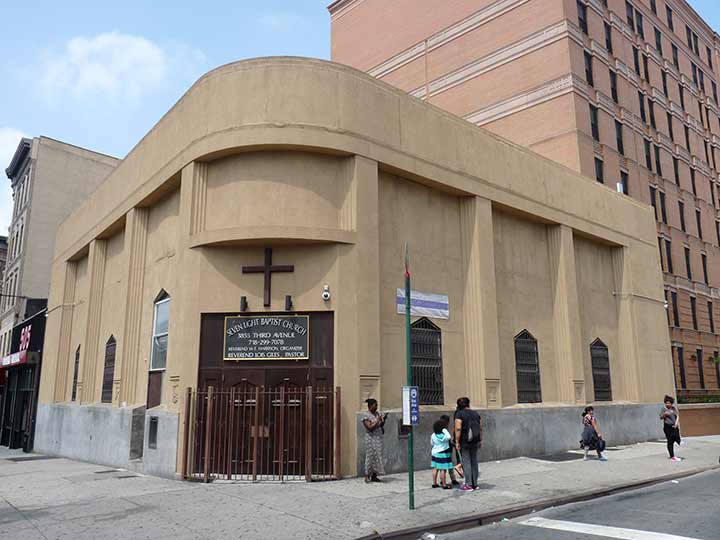
At first glance the Seven Light Baptist Church, on the southwest corner of Third and Claremont Parkway between the Bronx Croton and Claremont Parks, seems like just another repurposed bank building of which there are many around town. That’s until you see the extraordinary bas reliefs on the pilasters on both facings, showing skyscrapers, early planes, the large passenger blimps called dirigibles (the Hindenburg, which crashed and burned in Lakehurst, NJ in 1937, was one) and locomotives. It’s possible that the bank, whichever it was, that occupied this building, was associated with transportation.
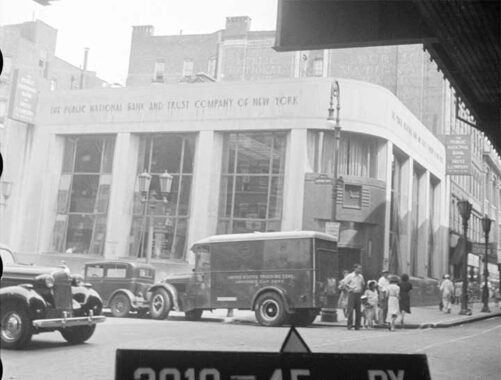
Public National Bank and Trust Company of New York in 1940. The Third Avenue El remained in place until 1973. The building boasted huge picture windows, long since filled in. I’ll bet there were decorative artworks on the interior walls, as well. Note the several “bank lamps” wrapping around the corner. I’ve never heard and explanation of why so many banks had or have them, but my bet is they provided extra illumination to discourage overnight break-ins by yeggs and safecrackers.
Check out the ForgottenBook. As always, “comment…as you see fit.” I earn a small payment when you click on any ad on the site.
7/23/26
4 comments
The architecture of banks was intended to provide a feeling of institutional stability. They were designed to impress, with large open spaces and high ceilings. Marble and decorative woodwork were typical. The “bank lamps” were part of the look. That was necessary to convince depositors to put their money into a bank instead of hiding it in box in their apartment or house. It was not until 1933, during the Depression, that the Federal Deposit Insurance Corporation was created. Before then, when a bank failed, you simply lost your money, regardless of how much marble or plate glass or shiny brass adorned the bank’s building. After WWII many people moved to the new suburbs and the banking industry followed the money, opening new banks and new branches. With FDIC protection in place and the creation of new strip malls, banks found that they no longer had to build marble palaces, and banks started showing up sandwiched inbetween nail solons and pizza parlors.
Public Bank of the City of New York (and its successor, the Public National Bank) was not fundamentally a transit or transportation company; it was purely a commercial financial institution. What i found on the topic:
The transportation iconography you see—such as locomotives, skyscrapers, early biplanes, and dirigibles—stems from two primary historical reasons:
Public Bank stopped issuing National Bank Notes in 1935, 20 years before its merger with State Bankers Trust Company. The entire National Bank Note system was discontinued in 1935 when the federal government retired Civil War-era bonds used to back the notes, consolidating all paper currency production under the Federal Reserve.
he Machine Age & Progress Themes: During the 1920s and 1930s (the Art Deco era), banks frequently commissioned artwork celebrating “modern progress,” speed, and international commerce. Depicting state-of-the-art transportation was a popular shorthand for industrial power and economic growth rather than an indication of the bank’s core business.
Inherited Architecture & Infrastructure Locations: Public National Bank grew rapidly and often bought existing grand buildings or built branches directly adjacent to New York’s major transit lines. For example, their Bronx branch at Claremont Parkway and Third Avenue sat right next to the busy Third Avenue Elevated Line. In other cases, like their 37 Broad Street location acquired in 1941, they inherited existing nautical and aviation murals originally commissioned by the previous investment firm.
Not specifically relevant, but, interesting:
https://www.nyc.gov/html/records/pdf/govpub/4462publicnationalbank_final.pdf
The church’s address is listed as 3855 3rd Avenue, which is the same address listed in a 9/23/64 ad for Bankers Trust in the Daily News. The PropertyShark website says the building is a two-story building that was built in 1930
Dates of construction used by real estate brokers, such as 1899, 1930/31, are just placeholders used when the exact construction date is unknown. DOB does this and these companies use the same incorrect info. Go to NYC Fire Insurance, Topographic and Property Maps at https://www.nypl.org/collections/nypl-recommendations/guides/fire-topo-property-maps to check if a particular structure existed at a specific time.