
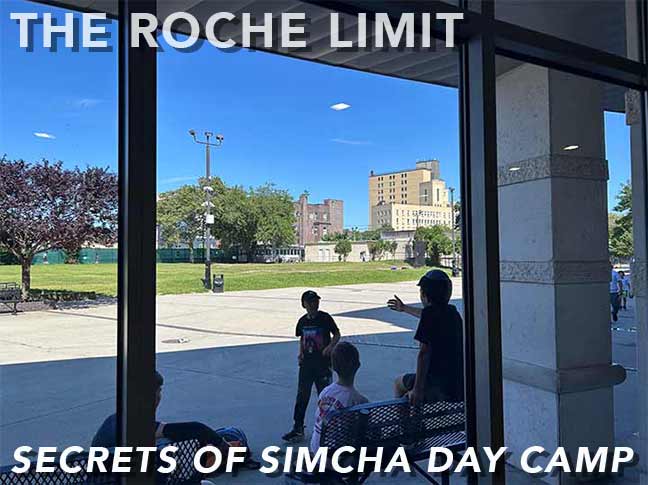


In the Orthodox Jewish community of the Five Towns and Rockaways, Simcha Day Camp is among the popular summer choices for boys on account of its sizable campus. The superblock at Seagirt Boulevard and Beach 17th Street belongs to Yeshiva Darchei Torah with whom this camp is affiliated. Prior to the yeshiva’s arrival on this block, it had more than a century of Jewish history under the auspices of older organizations.
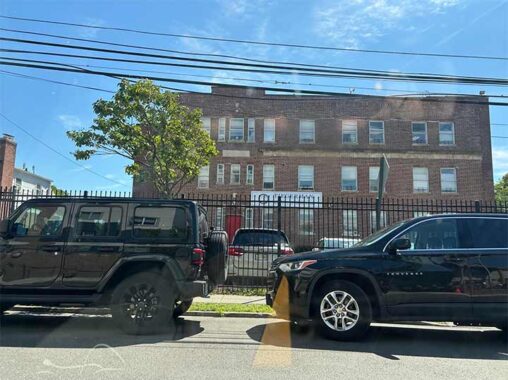
The oldest building on this superblock is the Tiegerman preschool at 264 Beach 19th Street, which has a stone plaque with the name Children’s Haven of Far Rockaway. Established in 1914, it hosted children whose mothers were hospitlaized or institutionalized. At the time, its founder Rabbi Ephraim Frisch had the pulpit at Temple Israel. His liberal politics earned him a lot of scorn as he bounced around various synagogues across the country.
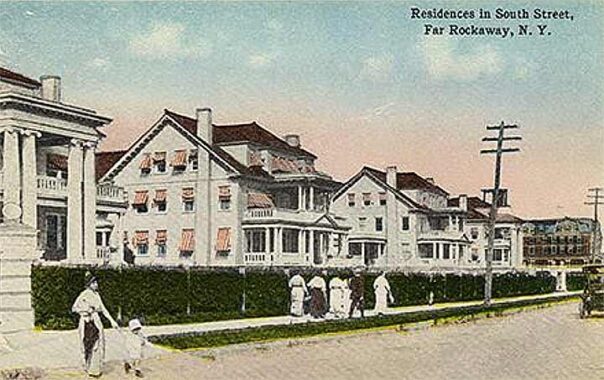
In 1939, the first yeshiva on the peninsula, Hebrew Institute of Long Island (HILI) moved into this building. On the same block were four handsome mansions on South Street, which was later absorbed into Seagirt Avenue. Built by developer David Roche, they appeared inthis undated postcard from the early 20th century. Across the street, bathhouses stood on the water’s edge where the Ocean Park apartment towers were later built.
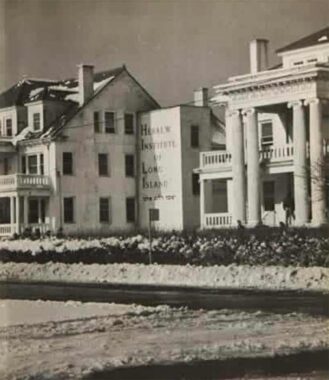
The rest of the block contained sizable resort homes and hotels, like much of the Rockaway peninsula. Among them was Hotel Rochelle at 1720 Seagirt Avenue, before it was upgraded to a boulevard. Its name is derived from Roche. By 1953, Roche’s four buildings were acquired by HILI as the elementary school now had a middle and high school. During the summer, the campus operated a summer camp.
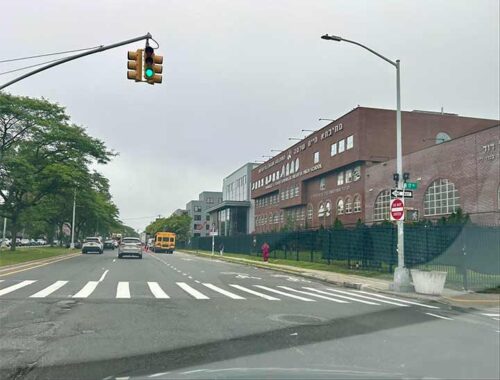
As other neighborhoods on the peninsula experienced white flight in the 1970s along with migration to the suburbs, HILI merged with the Hillel School to form the Hebrew Academy of the Five Towns and Rockaway (HAFTR), located in Lawrence. In its absence, the Gustav Hartman YM-YWHA, a Jewish version of a YMCA, purchased the property and tore down Roche’s mansions. Its namesake also appears in a park on the Lower East Side where he lived. In the meantime, Yeshiva Darchei Torah, led by Rabbi Yaakov Bender was leading the Orthodox Jewish revival in Far Rockaway. With support from philanthropists Lloyd Keilson and Yaakov Melohn, the yeshiva purchased the superblock property in 1991. Two decades later, I attended the grand opening of its 186,000-square-foot main building.
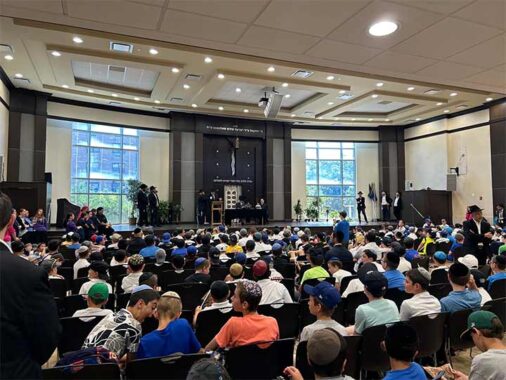
This summer, I returned to celebrate the dedication of a new Torah scroll at the summer camp and used the occasion to write about the history of this superblock. Some of the supporters and staff spoke of the property’s past, when they attended HILI and the YMHA, with Darchei Torah as the latest educational institution on this block.
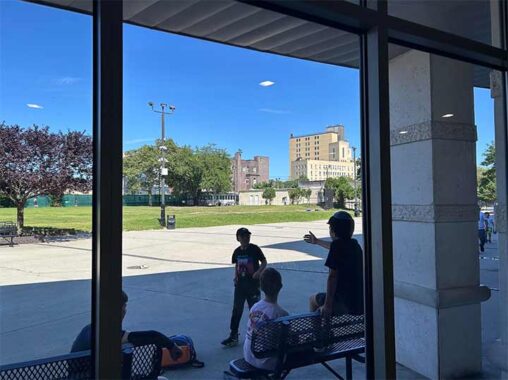
Behind the post-milennial buildings, the school has a lawn and one other item from its past as a Jewish community center: the outdoor pool. Built by the Hartman YMHA in the 1960s, it is used by Simcha Day Camp and open to the Jewish community with separate hours for men and women.
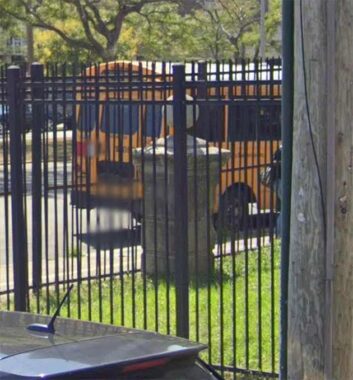
There is one small piece of Roche’s estate still standing on the Darchei Torah: a stone post that marked its borders. An overlooked relic on a block that changed so much in the past century. To see another example of a stone marker indicating a long-gone estate, see my essay on Innerwyck in Flushing.
Sergey Kadinsky is the author of Hidden Waters of New York City: A History and Guide to 101 Forgotten Lakes, Ponds, Creeks, and Streams in the Five Boroughs (2016, Countryman Press), adjunct history professor at Touro University and the webmaster of Hidden Waters Blog.
Check out the ForgottenBook. As always, “comment…as you see fit.” I earn a small payment when you click on any ad on the site.
8/7/26
6 comments
https://rochdalevillage.com/
Are these two communities related/connected? (just curious).
No relation, but we have a separate essay on Rochdale Village.
Thanks for the info.
Darchai Torah was definitely there some time before 1991 – I was there in 1983. Maybe then they just rented it?
That’s correct. Darchei Torah arrived as a tenant and then became the owner.
As someone who’s followed you for years, and a Los Angeles resident for over 20?
Son, this is the literal fucking business.,
Well, well done.