
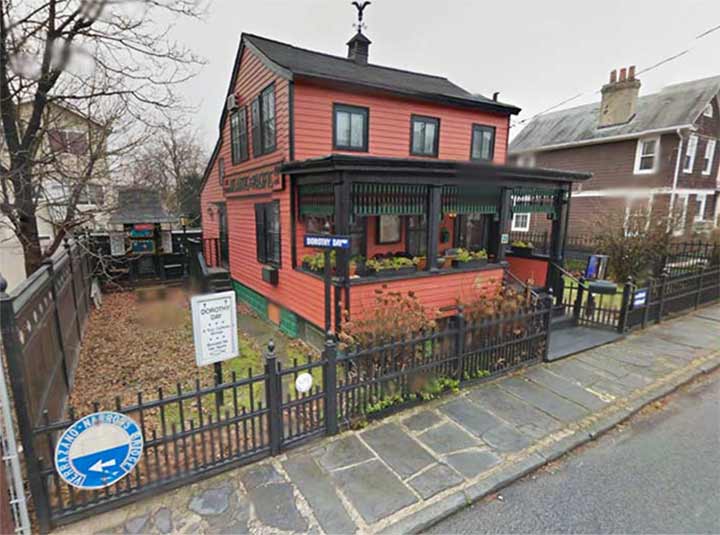

OVER on Facebook, the valuable Pat Salmon History page has an item about this building, #29 Cottage Place at Vreeland Street in the heart of Port Richmond, a small town on Staten Island’s north shore. I wrote about it during a camera sweep of the area in 2017:
Take a detour off Heberton down Bennett, and then down Cottage Place, and at #29 you will find this beautifully preserved cottage (on Cottage Place!) that was once a stagecoach station. According to Phillip Papas & Lori R. Weintrob’s Images of America: Port Richmond (Arcadia, 2009) the owners have lovingly restored the interior with tin ceilings and a vintage 1936 refrigerator. The Dorothy Day on the sign was a prominent Catholic social activist and co-founder of the Catholic Worker newspaper. Between 1972 and 1980, Day lived in the Spanish Camp, a now-demolished colony in southern Staten Island.
Even more interesting, though, is the story of the man behind the building’s renovation, John Foxell, who passed away the year before I photographed the building. Before he purchased the house, it was a virtual ruin. I’ll quote from SiLive, though the article may be paywalled:
Mr. Foxell, described by his many friends as a gentle “renaissance man” who enjoyed music, literature and the arts, died Dec. 4 at home. He was 72. Learned and unassuming, he eschewed modern technology, preferring to live among older things, which he often said made him feel more evocative of a simpler place and time.
|
Mr. Foxell earned the respect of preservationists for lovingly-restoring his nostalgia-stuffed, quirky-colored city-landmarked home on Port Richmond’s Cottage Place. Born and raised in Troy, N.Y., Mr. Foxell moved to Staten Island with his family in 1952. After graduating from New York University, Mr. Foxell traveled the country, living in 13 states and Canada, holding down various jobs, from button factory worker to census taker. He moved back to Staten Island in 1981, bought a home on Congress Street in Stapleton, and became active in the community. For 15 years, until 2005, he commuted to work as an administrative assistant in Manhattan Family Court.
|
Meanwhile he shopped for houses across the Island until a real estate agent unlocked the doors to 29 Cottage Place. The original saltbox small home, measuring 1,122 square feet, was built around 1848. It was once a stagecoach stop on the New York to Philadelphia run. Its Greek Revival and Craftsman details made it one of the North Shore’s few surviving saltboxes, a roofing style popular in the Colonial period. When Mr. Foxell bought the home it had drooping ceilings, crumbling walls, and mice and birds nesting in the attic. He set about a painstaking rescue and restoration.
|
“I felt I had to rescue it,” Mr. Foxell told the Advance in a February interview. “It was very important to try to restore as much as possible to retain the atmosphere of that time, and the atmosphere of the house.”
|
Mr. Foxell removed wood-shake shingles and installed cedar clapboarding in their place, cleared overgrown shrubs, and restored porches and sidewalks. He added 29 antique stained glass windows and put up tin ceilings on every ceiling. There is a small shrine in honor of Dorothy Day — the founder of the Catholic Workers Movement, who had ties to Staten Island — and a meditation house, floor-to-ceiling bookcases and artifacts he collected from his travels, including a collection of African wood sculptures and skeletons In keeping with the time period of the house, he kept few modern conveniences, save for electricity and indoor plumbing.
|
His efforts paid off. The house was designated a city landmark in 2011.
There’s a story behind every building in NYC! Sadly I do not know if any new ownership has preserved Foxell’s interior furnishings.
Check out the ForgottenBook (HarperCollins, 2006), as well as Forgotten Queens (Arcadia, 2013). I also have a chapter in the anthology “New York Calling: From Blackout to Bloomberg” (Reaktion, 2007). As always, “comment…as you see fit.” I earn a small payment when you click on any ad on the site, which helps in site upkeep and also aids Greater Astoria Historical Society.
11/19/26