
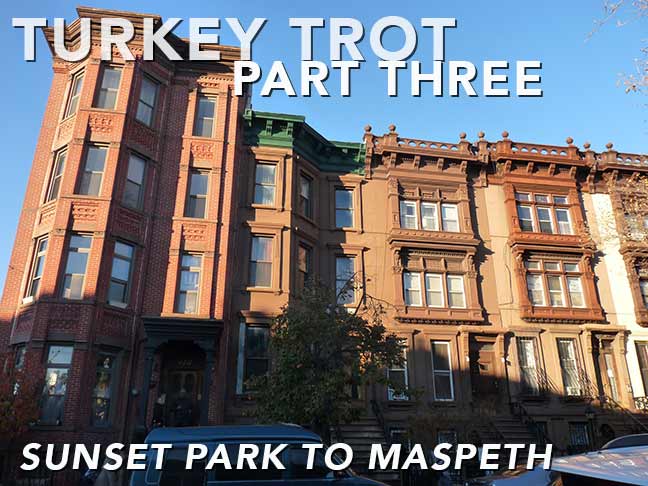

THURSDAY, November 23, 2017, Thanksgiving Day, dawned sunny and bright. I usually have been at one cousin or the other’s Thanksgiving extravaganza but that year, they were doing it on the weekend, thus I was at loose ends. Perfect photography conditions, though, if I didn’t mind the harsh shadows. So I hatched a plan. Why not link two neighborhoods that have nothing to do with one another with a walk? I arrived at Sunset Park to Maspeth, which would take me through Borough Park, Lefferts Gardens, Crown Heights, Bedford-Stuyvesant, Bushwick, Ridgewood and Maspeth. I walked from the light of day to the dark of night, nonstop (maybe a bathroom break, I forget). To my surprise it totaled only 12-13 miles; I know people who have walked triple that in one walk. It’s 8 years later, and at age 68, my back as well as other parts will no longer permit a nonstop walk like that. It’s not my longest: that was the full length of Metropolitan Avenue, Williamsburg to Jamaica, in May 2015.
I obtained over 300 photos; I won’t use them all but I’ll be splitting this walk into multiple pages to avoid the ever-present TLDR issue. And to make it easier on me.
GOOGLE MAP: SUNSET PARK TO MASPETH
^ Open the map in a separate browser window and follow along with me!
As I mentioned in Part 2, Bedford Avenue, and Kings County’s former Bedford Village, were either named for England’s Bedfordshire or the Dutch Bestevaar, “meeting place of old men.” The boundaries of Bedford-Stuyvesant, the vast mid-Brooklyn neighborhood, are well defined on the north ( Flushing Avenue); east (Broadway) and south (Fulton Street) but I am unsure about the west. I think Clinton Hill leaves off and Bedford-Stuyvesant begins at Bedford Avenue itself. Stuyvesant Heights was a smaller neighborhood centered on Stuyvesant Avenue north of Fulton. Bedford Village and Stuyvesant Heights were conjoined by either the Brooklyn Eagle or a survey by the Brooklyn Edison Company (now National Grid after multiple changes in ownership.)


I left off Part 2 on Kingston Avenue. Here it crosses under the Long Island RR on Atlantic Avenue. This is the only true elevated LIRR section in NYC, though parts of the main line and Port Washington branch sit on embankments and are bridged over some streets. The RR ran at grade until 1940, when an overall grade crossing elimination program was achieved, with some sections placed in a tunnel and an elevated section, based on topography. In East New York, an elevated section was subsequently placed in a tunnel.


I could not visit this area and not check on a pair of picturesque dead ends on the north side of Atlantic Avenue east of Kingston, Alice and Agate Courts. The two-court complex was built for Swiss industrialist Florian Grosjean, who set up an importing business with French businessman Charles Lalance in 1850. The firm gradually expanded into a variety of products, including housewares, champagne, tinware, sheet metal and hardware. L&G became a nationally renowned manufacturer that was among the first to make porcelain enamelware, a cheaper, lighter alternative to heavy cast-iron cookware, under their brand name, “Agate Ware.” Eventually L&G operated a small company town in Woodhaven, with a number of brick manufacturing plants along Atlantic Avenue of which the 1876 clock tower is the only survivor. Workers’ housing nearby along 95th Avenue and elsewhere does survive, but in a heavily altered condition. Alice Court was named for Grosjean’s daughter, Alice Marie.


The “new” Interfaith Medical Center, built after 1982, towers over the old St. John’s Hospital building, built in 1926, at Atlantic and Albany Avenues and Herkimer Street. Brooklyn Jewish Hospital, later called Interfaith Medical Center after a 1983 merger, occupied a huge swath a couple of miles west in Prospect Heights in buildings facing Classon Avenue, St. Mark’s Avenue and Prospect Place. Its original name is still showing in terra cotta lettering on its Classon Avenue side.
In 1903, the Brooklyn Hebrew Hospital Society purchased property along Classon Avenue belonging to the Memorial Hospital for Women and Children, and spent three years fundraising and acquiring additional properties, opening to patients in December 1906. Even more property was acquired in 1928 that was used to build an additional wing.
After several decades, Jewish Hospital’s fortunes declined along with the neighborhood. In 1983, it merged with St. John’s Episcopal Hospital (established in 1859) to form Interfaith Medical Center. Ultimately Interfaith moved here on Albany Avenue, and the old property became residential units (much like my old high school, the nearby Cathedral Prep, did in 1985).
I have a personal memory of Brooklyn Jewish Hospital. I went in there just once, in 1975, to visit an ailing classmate in high school, Fred Costanzo. Though Fred was undersized, he was an agile athlete and active in our school’s extracurricular activities. Late in our senior year, Fred contacted leukemia and though he seemed upbeat when I and other friends went to see him, he succumbed during the summer in an era when there were not the life-extending treatments for leukemia available today. In August 2025 I and other classmates attended a 50th anniversary memorial Mass in his honor; he has never been forgotten.
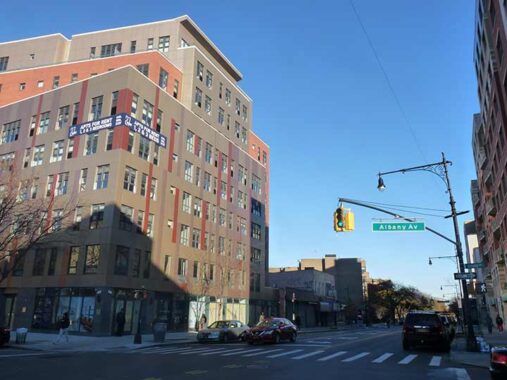
The new #27 Albany Avenue at Fulton Street opened in 2016, constructed by BRP Architects in partnership with the Bedford Stuyvesant Restoration Corporation. Interiors can be seen here.


Well-known images, and recently deceased not as well-known names, are featured on this mural on the west side of Albany Avenue at Fulton Street.


All of Brooklyn’s “New York State avenues” except one begin at Fulton Street, and all except Kingston Avenue were extended south to Flatbush Avenue as that part of Kings County became ever more populated in the late 1800s and early 1900s. The one avenue in the sequence that runs one block north to Decatur Street is Albany Avenue—but it didn’t, always. This one-block section was once alled Glenada Place. I discuss it in depth on this FNY page.


Bethany Baptist Church, #460 Marcus Garvey Blvd. at Decatur Street, looks older than it is—it was constructed in 1967 to serve a congregation established in 1895.
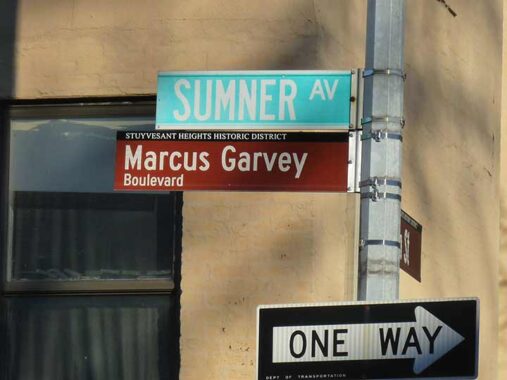
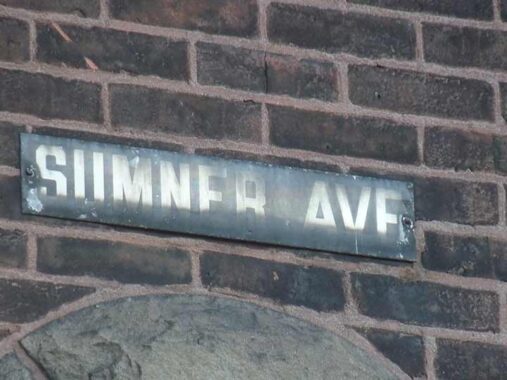
Street name histories are fascinating. In 1987, Sumner Avenue was renamed Marcus Garvey Avenue and later Boulevard, for Native Jamaican Marcus Garvey (1887-1940), a charismatic community leader in the early 20th Century who was an early promoter of African-American self-sufficiency; his goal was to found an independent country for African Americans in west Africa. He was found guilty of mail fraud, was deported to Jamaica in 1927 and died in exile. He remains a revered figure, however, for his founding of the UNIA in 1914 and as a promoter of social, economic and political freedom. Sumner Avenue, in turn, was named in the 1800s for abolitionist Massachusetts senator Charles Sumner, who was whipped with a cane in the Capitol Building by a US Representative in 1856 who was incensed by his stand on slavery. The country was primed for civil war over the issue.
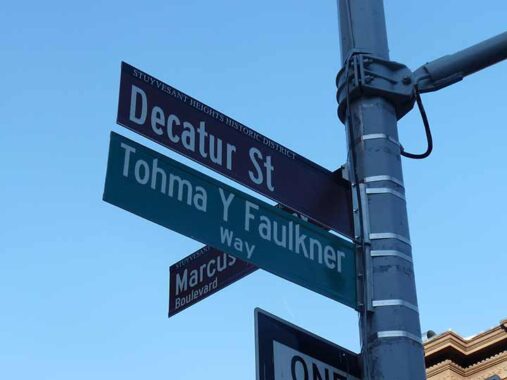
Decatur (da-KAY-ter) Street honors early US Navy hero, Commodore Stephen Decatur (1779-1820), who battled the French Republic, the Barbary pirates during two separate conflicts in Tripoli, and the British during the War of 1812. He lost his life via a duel by pistol. Community activist Tohma Faulkner was one of the founders of BedStuy Alive!, a week-long festival promoting tourism and stimulating community pride.


Most armories are forbidding: they are meant to look like that; when built, they are where weapons are stored and where soldiers are drilled and trained. The 13th Regiment Armory and the National Guard occupied this vast building on Marcus Garvey Boulevard and Jefferson Avenue from 1894 to 1974, after which it became one of the worst homeless shelters in Brooklyn. Conditions improved somewhat after its conversion to the Pamoja House, named for the Swahili word for “together.”
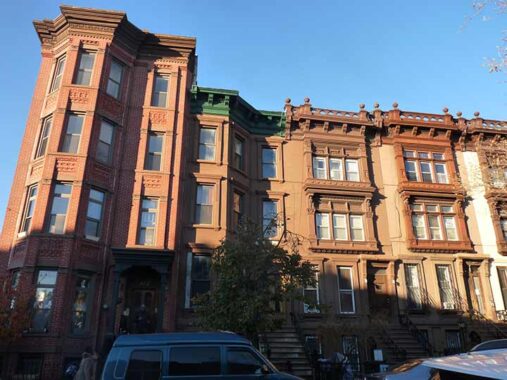
The casual elegance of brownstone Brooklyn, at #473 Madison Street at Marcus Garvey Blvd. Much of the neighborhood looks like this
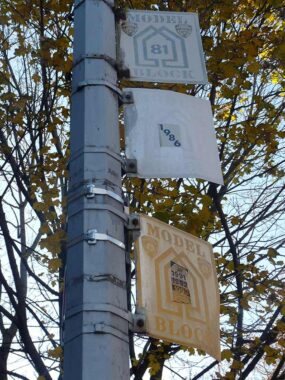
Madison Street between Garvey and Lewis Avenue has won multiple awards.


Cornerstone Baptist Church occupies two buildings at Lewis Avenue and Madison Street. The church was founded by the Rev. William H. Rodman and organized in 1917. It outgrew the churches it had occupied by 1944 and under the guidance of pastor Rev. Dr. Sandy Frederick Ray purchased the 1893 Romanesque Revival Lewis Avenue Congregational Church, where it has been since. Cornerstone Baptist Church became involved in the civil rights movement and established a credit union and the Cornerstone Education Center, both of which are also recognized for their historic significance.
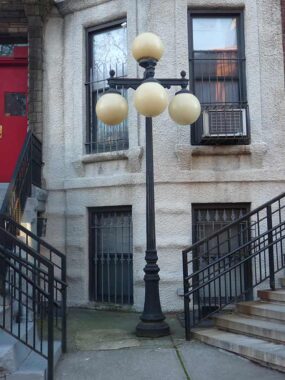
A lamppost once part of the “Brighter Brooklyn” ad campaign beginning in the early years of the 20th Century by the Brooklyn Edison Company has made its way to #574 Madison Street. The February 1916 number of Lighting Journal has additional information on these Brighter Brooklyn posts, which n=have turned up as far away as Union Square in Manhattan.
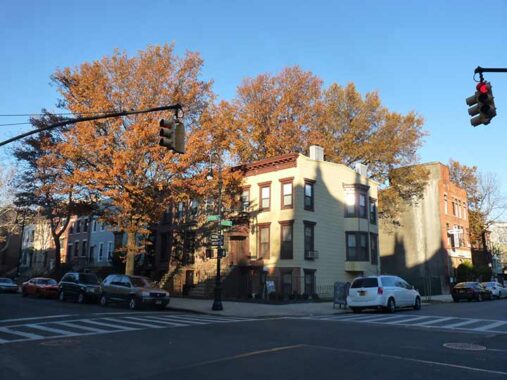
A rare Bedford-Stuyvesant woodframe house, at the corner of Madison Street and Stuyvesant Avenue, a route I featured on this FNY page.
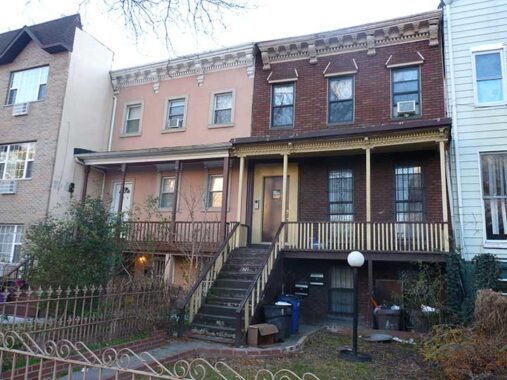
This pair of brickfaced buildings with rare Bed-Stuy porches and original roof treatments, #670 and 672 Madison between Stuyvesant Avenue and Malcolm X Boulevard.
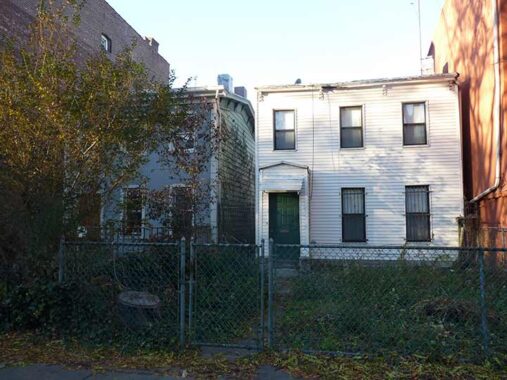
And how about this two-story pair across the street, #659 and 661. Interestingly, for a few block on Madison Street, the house numbers on the north side are 20 or more behind the south side. The situation arose because the north side is occupied by the Isaac Putnam Playground and PS 44 between Throop and Marcugs Garvey a few blocks west.
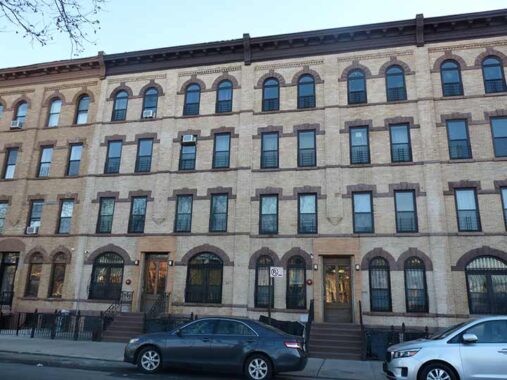
Quickening my pace a bit, as sunshine was beginning to be at a premium in November. This impressive facade of eight buildings, #782-796 Madison, east of Patchen Avenue, faces P.O. Reinaldo Salgado Playground.


At #798-800 is a parochial school building associated with Our Lady of Good Council, whose steeple on Putnam Avenue can be seen behind the Bishop Joseph M. Sullivan Residence, established in 2015, serving homeless veterans. OLGC Parish was established in 1866 in Bedford-Stuyvesant, and the Gothic Norwegian granite church was dedicated in 1891.


To my surprise I found a second parochial school building further east, with a chiseled sign identifying it as LGC Academy, and dated 1893. A high school associated with the parish, perhaps?
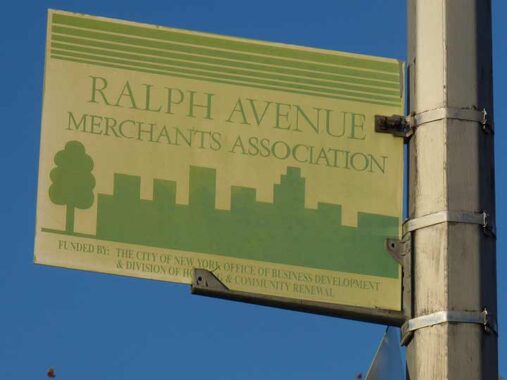
Ralph Avenue is interrupted,and changes character as it runs south through Bedford-Stuyvesant, Brownsville, East Flatbush and Bergen Beach; Menahan Street in Bushwick, which issues north from Broadway, was once called Ralph Street. Ralph Patchen, who owned 150 acres in Kings County, has not one but two avenues named for him. Brooklynites can be excused if they thought the avenue was named for The Honeymooners’ Ralph Kramden.
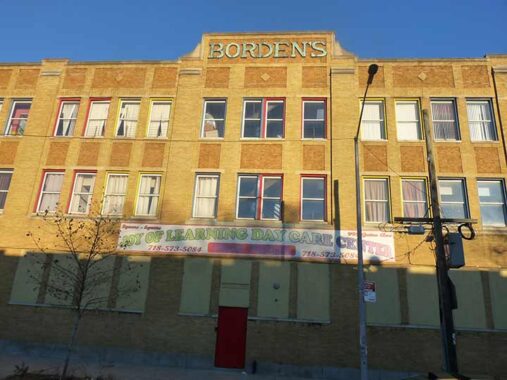
There were once dozens of milk bottling plants in NYC, and here’s one on Ralph Avenue between Monroe Street and Gates Avenue, and according to Suzanne Spellen in Brownstoner, things would get a bit cutthroat. This Borden’s plant manufactured condensed milk, a sweet variety favored by my father in his tea (he would typically use two teabags per cup).
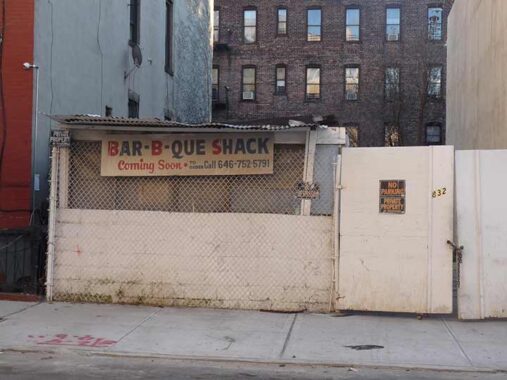
The Bar-B-Que Shack, unfortunately, was not coming soon on Monroe Street west of Broadway, according to the latest Street View.
RKO Bushwick
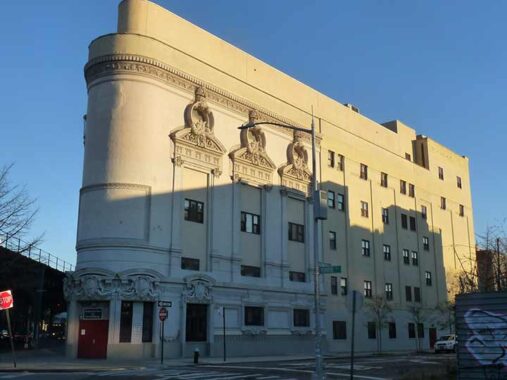


All I could say when encountering the RKO Bushwick, Monroe Street at Broadway and Howard Avenue, is …wow. And it’s a lot more streamlined than it used to be.
The 2000-seat Bushwick was, and is, a riot of terra cotta with trumpeting angels and the initial “B” festooned with musical instruments on the corner entrance. It was built by showman Percy Williams with William McElfatrick as architect, and first opened on September 11, 1911, as a vaudeville house. The Bushwick later became part of the RKO organization. Architect Charles Lamb performed some alterations in 1926 and again in 1929, and Max Weinberger further modernized the interior in 1938. The Bushwick showed its last picture in 1969 (it had also hosted some rock and R&B concerts) and put in some years as a church before it stood mostly idle for the next 34 years, though the mostly-ruined interior did attract some filmmakers: a scene depicting human sacrifices was filmed by John Schlesinger for the Martin Sheen/Robert Loggia/Helen Shaver vehicle “The Believers” in 1987.
Benjamin Franklin Keith was creator of the vaudeville circuit, opening a number of theaters for vaudeville artists beginning in the 1880s, and though he died in 1914, B.F. Keith theaters thrived for years afterwards, with the B.F. Keith circuit booking vaudeville acts regularly into hundreds of theaters by the 1920s. For years after that, the RKO organization ran dozens of theaters and held various radio and television stations as well.
Vaudeville and its rather racier cousin, burlesque, were the pre-eminent forms of American show business entertainment from the late 1800s to the motion picture era began in earnest in the early 1920s. Comics, singers, dancers and dramatic plays all shared the same stage. Television picked up the variety show concept in the 1940s and it was arguably TV’s most successful genre until the Ed Sullivan Show went off the air in 1971, after which it gradually faded away.
The Three Stooges, Cary Grant, Jerry Lewis, Jackie Wilson, Mae West, George Burns, The Dave Clark Five and Jackie Gleason, and many others from the golden age of showbiz all appeared at the Bushwick; it was a vaudeville house featuring live performances and movies, and in its later years, performers would often introduce pictures in which they appeared from the stage.
The Bushwick stood as a ruin for over three decades, until its interior was completely rebuilt for the ACORN High School for Social Justice in 2003. Its rococo exterior was mostly preserved in the renovation, and so people going by on the J train can continue to marvel at it.
Check out the ForgottenBook, take a look at the gift shop. As always, “comment…as you see fit.” I earn a small payment when you click on any ad on the site.
12/2/25
6 comments
This honorary street naming shit is really getting out of hand
Actually I’d like one. But as a rule you have to die first.
There’s always a catch, Kevin!
That’s quite an eclectic group of performers who appeared at the RKO Bushwick! (I can’t wrap my head around suave, debonair Cary Grant having been in that neighborhood.) My 94-year old father attended PS 73 on McDougal Street in Brooklyn about 10 years after Jackie Gleason was a student there and recalls seeing him emcee Saturday afternoon movie matinees ands live vaudeville shows in the RKO Bushwick (although it could have been the much smaller nearby Madison Theatre).
It reminds me of every kid on the team getting an award at the end
of the season even when some of them didnt play in a single game.
Or a Hollywood Lifetime Achievement Award b.s.
I was born at Brooklyn Jewish Hospital a long time ago.