
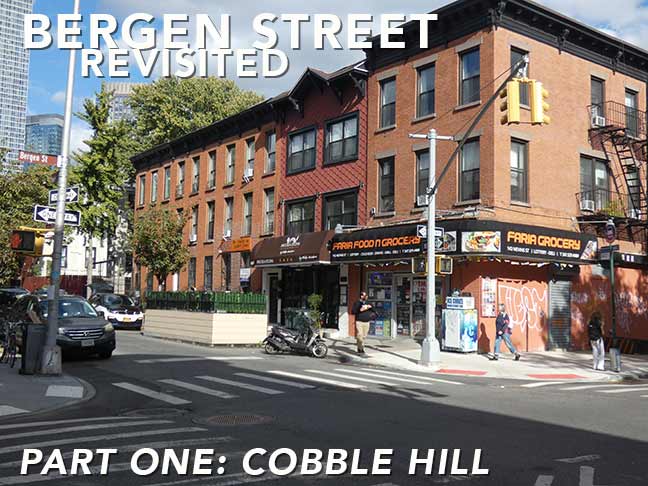

WHEN a website is as old as Forgotten New York, which was conceived in the “stone knives and bearskins” (to quote Mr. Spock) era of the internet in which you accessed it using dial-up modems in 1998, there’s going to be some repeat ideas and concepts. When I walked a few miles on Bergen Street in October 2025 between Court Street and Underhill Avenue, I forgot I had already walked much of that route back in 2014. But NYC is ever-changing, and there are some things I missed, or didn’t research throughly; and there are also some items that have been torn down since 2014. This was the first leg of a walk I hope to do on Bergen all the way out to its eastern end that will probably take two or three walks to finish. There are a number of nearby subways I can jump on if I get tired or my back acts up as it has for a few years now. In October, I got 155 photos, so this leg alone will take up three posts alone.
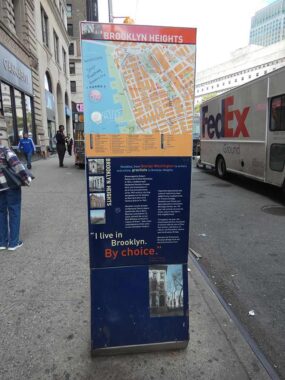
Before heading east on Bergen Street I first had to walk a bit on Court, so I decided to check on the demolition of my old school on Remsen (on this walk I visited two of my old schools). The subway took me to Court and Joralemon where I found one of these helpful maps of the area; these have been placed in selected neighborhoods round town and I wish each neighborhood could get one. Vandalism is likely in many areas around town, which probably keeps the city from spending too heavily on them. The maps contain nearby architectural and historical highlights.
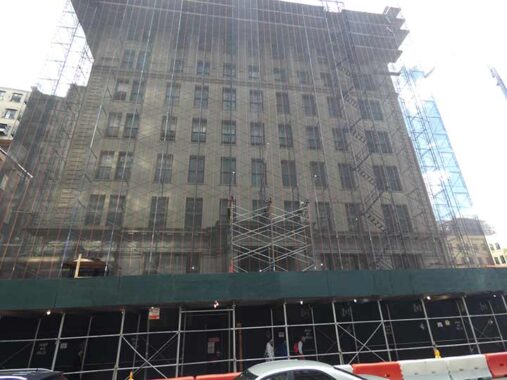
I graduated from St. Francis College on Remsen Street in 1980 with a degree in sociology I never used; I was an indifferent student and none of the classes really interested me. As my father always lamented, I was clumsy with my hands and so entering a trade like plumbing or electrics wasn’t really in the cards either. I volunteered with the school paper and though I eventually edited The Voice, I was more interested in printing, the letterforms and layouts than journalism, and so entered a 40 year career in all aspects of publishing, writing, copy editing, mechanicals, typography, proofreading; I could always read and write well. It doesn’t pay well, though, and copy editors and office grunts are always first fired during money squeezes.
A few years ago St. Francis sold its Remsen Street properties and rented three floors above the old Macy’s/A&S building on Livingston Street a few blocks away. In 2025, most of the buildings were being torn down or converted to residential, including the Frank and Mary Macchiarola Academic Center built in 2005. Shown here is #176 Remsen, built in 1914 [Frank Freeman, arch.] as the headquarters of Brooklyn Union Gas. The front entrance of this building led to the College’s chapel. St. Francis purchased this building in 1962 and it served as the main school for six years until the “new” building at #180 Remsen, now demolished, opened in 1968, seven years before I arrived.
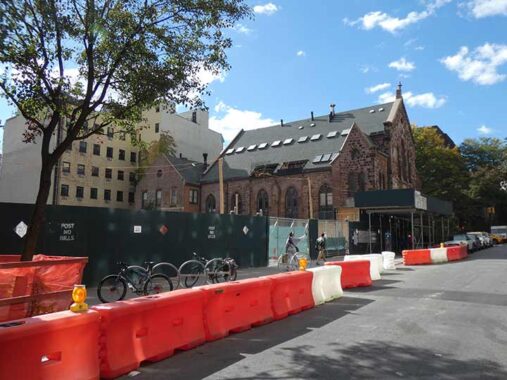
A temporary view of the eastern wall of 99 Clinton, a former Gothic church at the corner of Clinton and Remsen and adjacent to SFC has opened up until the new Remsen Street buildings are completed with an estimated 2029 opening date. The building features pricey, albeit dark, apartments that sell for millions. It started out in the mid-1800s as the First Presbyterian Church, later (1882) the Second Presbyterian and then Spencer Memorial. The church disbanded in 1994 and the building was converted to residences.
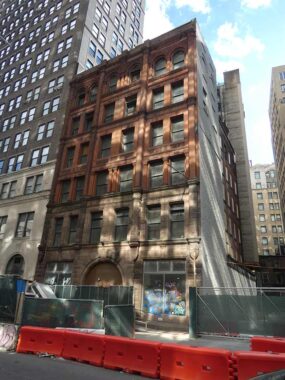
#186 Remsen has Landmarks Preservation Commission protection and won’t be razed. The Romanesque-Queen Anne Franklin Building [Parfitt Bros. 1887] is still there, albeit in tough shape. The Parfitts also designed the Grosvenor and Berkeley Apartments on Montague Street, as well as many other buildings in “brownstone Brooklyn.”


I always had a soft spot for the neoclassical, compact #65 Remsen, with its bronze entrance, limestone pediment, casement windows and etched glass house number. I always assumed it had been a bank, but the LPC report for the Borough Hall Skyscraper District is silent on that. There is still a sign for Remsen Graphics, though that business has relocated to #52 Court.
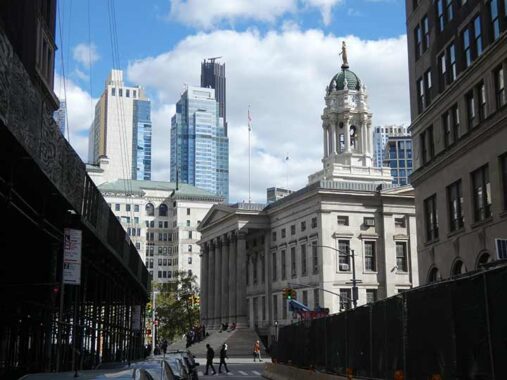
Every day after leaving school, I was treated to a view of Brooklyn’s Boro Hall (before 1898 its City Hall) which until a few years ago was the only tall building in the view. Multiple skyscrapers (though not in the Boro Hall Skyscraper District) have arisen since the 50 years I was in attendance.
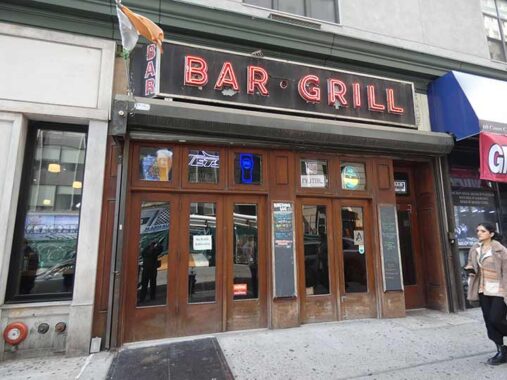
O’Keefe’s Bar & Grill oddly does not include its name in its neon sign and the bar on the premises at #62 Court didn’t either, back in 1940. Its website says it’s been open for 45 years (in 2026, since 1981) but I frequented it before that when I was in school a couple of blocks away. In 1978, I watched the Yankees defeat the Red Sox 5-4 here, in the ‘play-in’ game after the two teams had tied at the end of the regular season. I spent more time in here than I should have, especially late nights a couple hours before my first scheduled class (what’s with classes at 7AM, anyway)
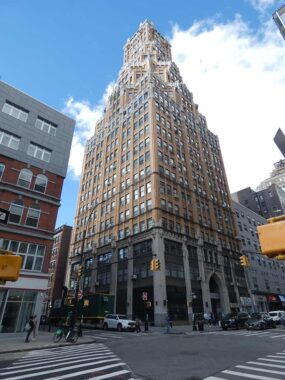
Till recently, the neo-Gothic #66 Court at #75 Livingston Street, with its complicated setbacks near the top, was the tallest building on Court Street. The ground floor is a visual treat with its limestone base and decorative metal infill. It was built in 1928 and was the Brooklyn Chamber of Commerce Building.
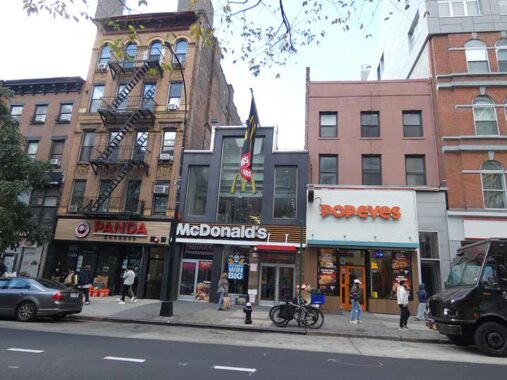
Fast food franchises galore on Court between Livingston and Schermerhorn. Till 2024, the Panda Express, left, was home to the veteran Queen Italian restaurant. The New York Sign Museum in East New York was able to save its classic neon sign. It had been founded as a pizzeria in 1958.
From 1978-early 1981 I worked at the now-demolished Brooklyn Business Library, which stayed open till 9 PM, and occasionally I would eat at this McDonalds before heading home to Bay Ridge.


The Cnanin Building, #105 Court at Schermerhorn, falls outside any landmarked district, so I don’t have much detail on it. However I have a personal collection. I had a job on the ground floor here in a passport photo studio in 1978, developing pictures and sweeping the floor, where the Chase branch is now. Through most of the 20th century, Court Street, its parallel streets and the area south of Brooklyn Heights had a working class atmosphere. All that changed in the late 1980s when new money began to infuse the neighborhood.
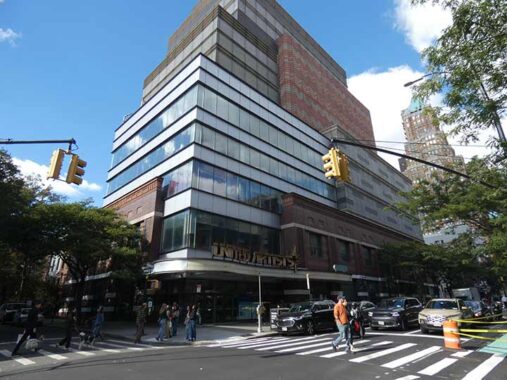
Across the street, I’m not sure when this behemoth, #106 Court, opened: it was the 1980s or 1990s. Both of its anchor tenants have left and the building is mostly empty. The Barnes and Noble Books superstore on the Schermerhorn end helped put the much loved Book Court a few blocks away on Dean Street out of business, while a 2022 lease disagreement closed the Regal UA Court Street & RPX movie theater.
Daniel Stedman tweeted, “Personal fave movie theater is closing. I never saw a movie there without someone shouting and/or food being thrown at the screen. I truly will miss this landmark.” [Brooklyn Reporter]
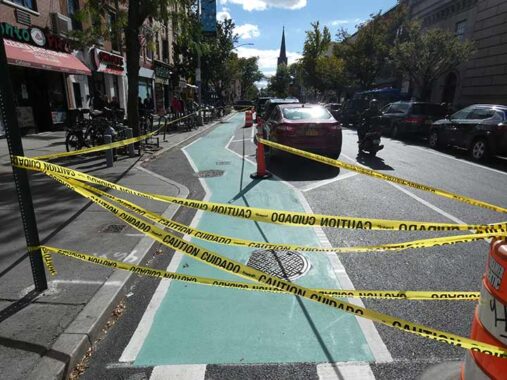
Beginning at Atlantic Avenue, Court Street has been reduced from two southbound traffic lanes to one, as its new bicycle lane opened soon after my visit.
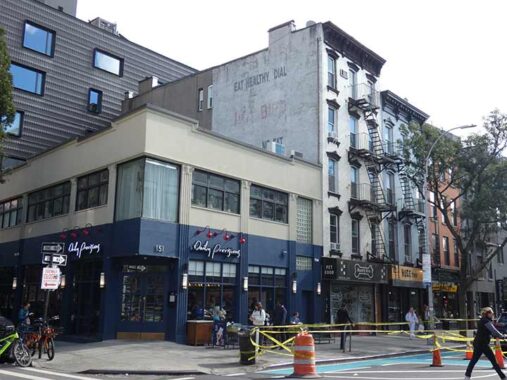
If you look carefully on the white square you can see the last fading ad for the Hot Bird chicken franchise. It originated in the mid-1970s in Brooklyn, with three prominent, yet simply designed, painted ads scattered around western Brooklyn.
The barb-b-que franchise clucked its last in the 1990s, leaving behind some large painted signs, a plain white, red and black ad on Court Street south of Atlantic Avenue, shown here; one on a now-demolished building facing Vanderbilt at Dean Street; and another on Clinton Avenue just north of Atlantic. The Hot Bird name was revived below that sign as a Clinton Avenue bar that opened in a former auto repair place:
Now the bird is back – in a way. An old auto shop beneath one of the yellow signs has been transformed into a new business. But the new Hot Bird will be a bar, not a chicken joint, says owner Frank Moe, who also operates the Fort Greene bar Rope. “Just because the location is right under the old sign, I decided to name it after that,” he says. WSJ
That was in 2014: now the building it was located in has been torn down. The bar closed in 2018. Sick transit, Gloria!
On the next few blocks on Court Street I’ll note sidewalk aignage that interested me. According to its website, the franchise Daily Provisions offers “an all-day menu that fits the many needs of our hungry neighbors, with Coffee, Crullers and B.E.Cs in the morning, made-to-order sandwiches, salads, and seasonal soups in the afternoon, a dinner menu inclusive of Roast Chicken and classic sides, and an array of bakery favorites.” The restaurant has several locations around town.
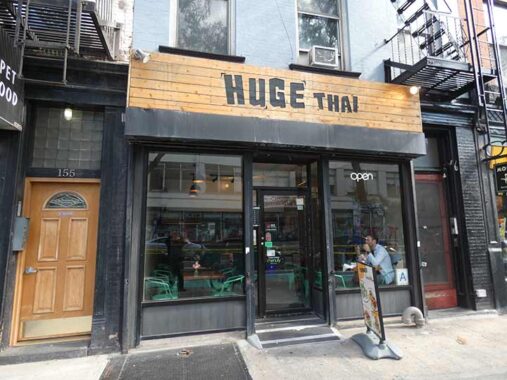
Huge Thai, #157 Court Street, features a wood paneled sign with the words stenciled out in black.
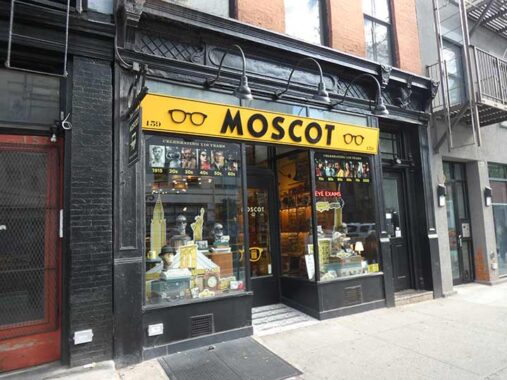
Sol Moscot, #159 Court, was founded on Rivington Street on the Lower East Side in 1915 after founder Hyman Moscot started selling eyeglasses from a pushcart in 1899. It now has several locations around town, all marked by distinctive yellow signage and lettering in what looks like the Kabel or Futura font (but isn’t either). I was hoping those gooseneck lamps were older, but they don’t show up on the 1940 tax photo.
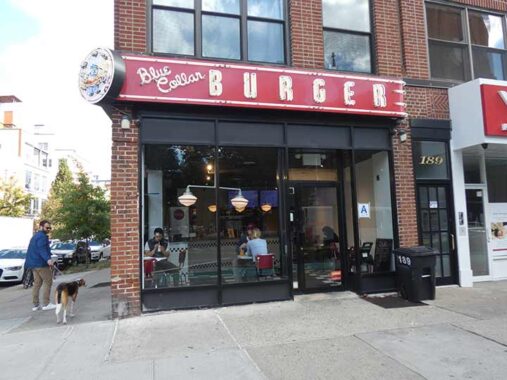
Burger joints (one of the franchises is actually called “Burger Joint”) seem to be a dime a dozen these days, but I rarely get a bad burger and I doubt I would have at #187 Court at Bergen Street; I’ll have to stop in Blue Collar Burger next time I’m around. For now I was attracted to that retro neon sign, which lights up in white at night.
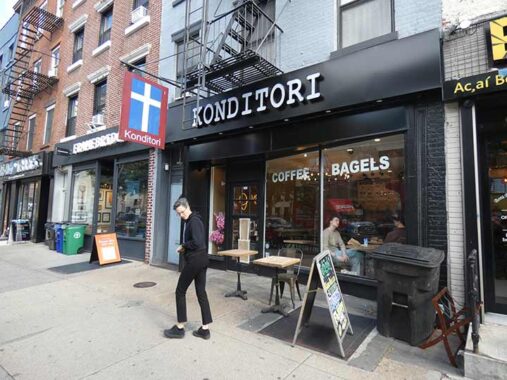
My initial thought was that “Konditori,” #201 Court, was a Greek word but it ultimately derives from the German Konditorei, “a specialized café and shop found in Germany, Austria, Switzerland, and Scandinavia that focuses on selling high-quality cakes, pastries, tortes, and confectionery.” The Konditori chain, though, bills itself as a “Swedish espresso bar” and the Swedish flag is displayed.
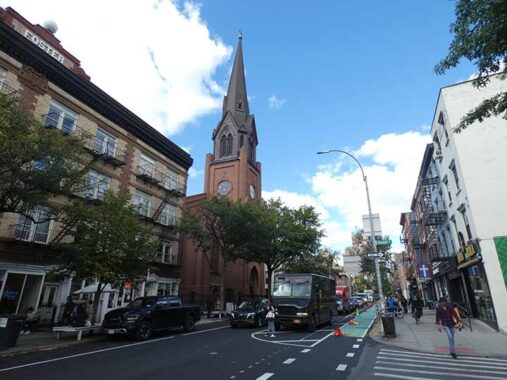
Before leaving Court Street I looked north toward St. Paul’s Roman Catholic Church: more properly, St. Paul’s, St. Peter’s, Our Lady of Pilar Church, a very old church built in 1838 by Gamaliel King on land formerly owned by a furrier, Irish immigrant Cornelius Heeney, who served a a guardian to a boy named John McCluskey, who later became the USA’s first Cardinal. While Heeney donated some of his property to this church, he also donated some of his Manhattan Island holdings so that St. Patrick’s Cathedral in midtown could be built, and also donated pews and gallery fittings to St. Peter’s on Barclay Street in lower Manhattan – thus, Heeney had a hand in some of NYC’s oldest extant Roman Catholic buildings. Heeney is interred in the churchyard here.
“Angela’s Ashes” author Frank McCourt was baptized here in 1930 before his family returned to Limerick, Ireland in 1934.
I will need to do a new full-length Court Street walk: my previous one was in 2008.


Bergen Street begins modestly at Court, with brick and recently re-sided two and three story residences.
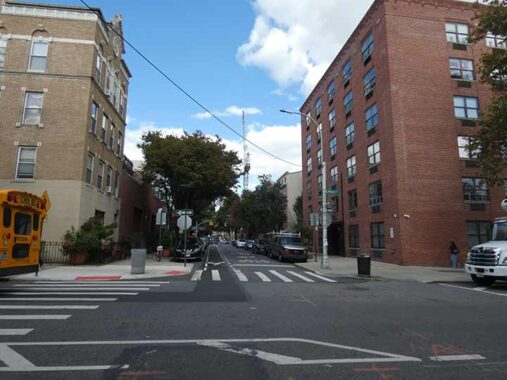
This neighborhood between Smith Street, Atlantic and 4th Avenues and Union Street was once a part of Gowanus but was renamed by real estate concerns in the 1970s after the prominent Dutch landholding family the Boerums. Boerum Place begins as a trickle at Bergen Street, a southbound one-way street.It was expanded into a multi-lane approach to the Brooklyn Bridge in the 1950s. There is also a Boerum Street in East Williamsburg.
More on Boerum Place on this FNY page.
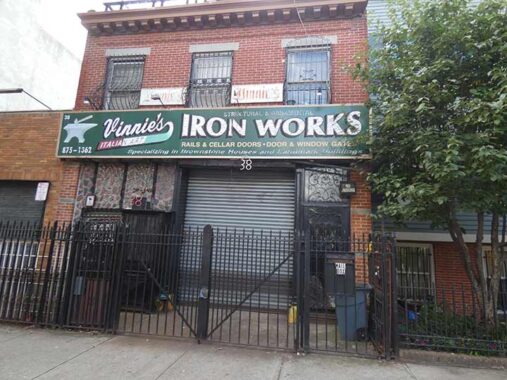
Vinnie’s Italian Art Iron Works, #38 Bergen Street, established in 1963 by Vincent Pampillonia, harks back to Boerum Hill’s industrial past. “For 48 years, Vinnie’s Italian Art has been specializing in the restoration and recreation of ironwork that can mostly be found in countless brownstones and landmark buildings throughout Brooklyn and Manhattan.” The iron works is accompanied on the south side of Bergen Street by a row of handsome woodframe buildings, an increasing rarity. Its green and white sidewalk sign is rendered in the Optima font.
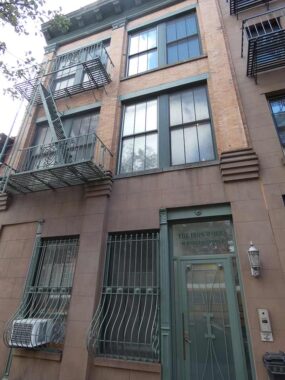
Both #46 (seen here) and 44 Bergen, a few doors down, are former iron works buildings converted to condominiums. Their former use is painted in the glass transoms above the doors.


Given its wide entrance, #48 Bergen was likely once a stables. It still has its Belgian block sidewalk entrance.
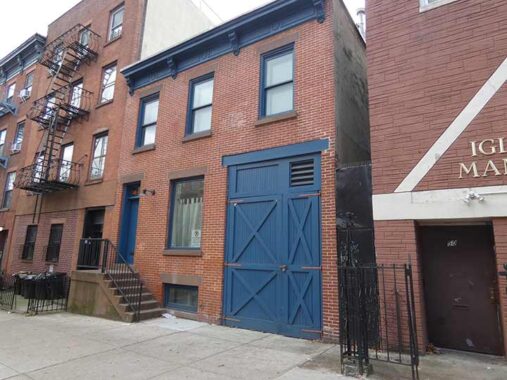
#52 Bergen was once the Schwartz Mattress factory, according to its 1940 tax photo. To its right, the Spanish language church at #50 replaced the Brooklyn Putty Works and Diamond Paint Co.
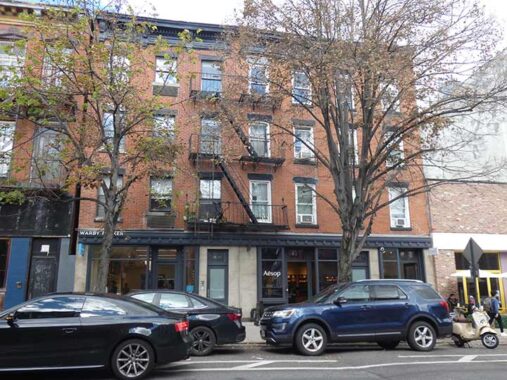
I always liked residences-above, storefronts below urban template though I have never lived above a store. In this case, the stores are the Warby Parker eyeglasses chain and Aesop Australian luxury cosmetics brand, at #53-57 Bergen.
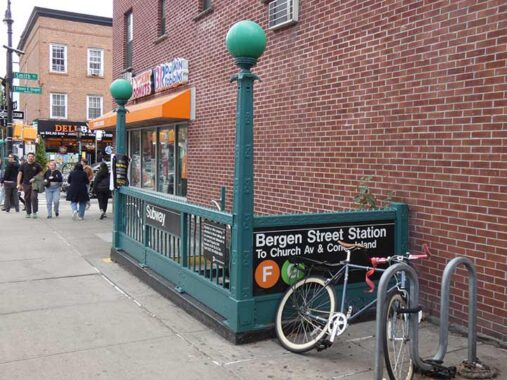
Subway entrance on Smith and Bergen Streets. The lamp stanchions were manufactured for IND stations in the 1930s, but the style has been adopted for use at BMT and IND stations as well. Green globes mean that entrance is open 24/7.
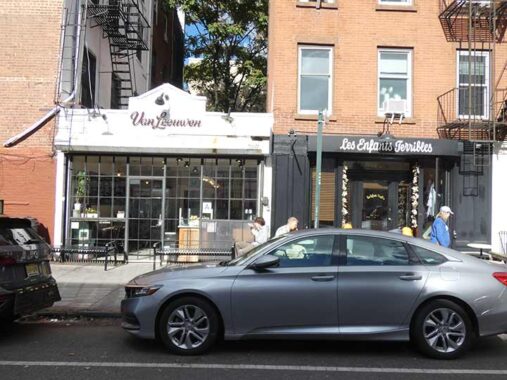
“Artisanal” is a word you will see frequently in northern and western Brooklyn; it’s simply a highfalutin’ word for “homemade.” At first I thought Van Leeuwen ice cream chain was named for the guitar player and composer in the Dutch group The Shocking Blue, Robbie Van Leeuwen, but that was over 50 years ago, half a century! Actually this is an artisanal ice cream palace at 81 Bergen Street near Smith, that has other branches in Greenpoint and the East Village, and they also sell from roving trucks, owned by Ben and Pete Van Leeuwen. The chain has been adding locations with the latest in the renovated LIRR corridor in Penn Station.
Meanwhile, Les Enfants Terribles is, when you get down to it, a barber shop, named for the 1929 Jean Cocteau novel.
East of Smith Street, Bergen Street enters a couple of Landmarks Preservation Commission historic districts. This one is the Boerum Hill Historic District Extension.
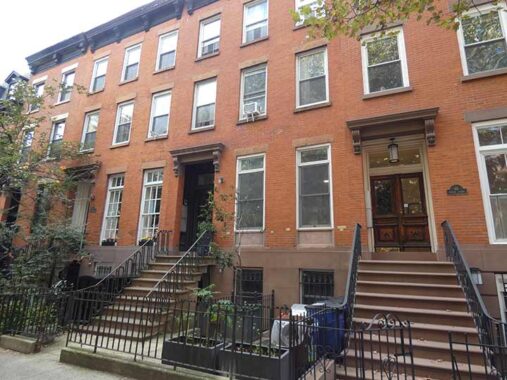
#98-102 Bergen Street; according to the LPC report, “[part of a] group of five brick and brownstone Italianate-style row houses (96 to 104 Bergen Street) developed by Samuel Gerritsen between 1857 and 1861 from the last piece of the farmland Gerritsen and his wife had owned since the 1820s. These five were designed as residences for local merchants and business people as Boerum Hill developed southeast from the East River ports and Atlantic Avenue commercial corridor.”
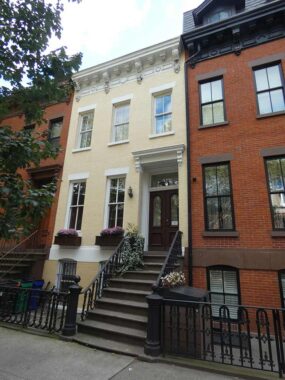
I selected #110 Bergen, as its light yellow exterior stands apart from its brick-clad brothers. “No. 110 Bergen Street is one of a group of seven Italianate-style brick row houses (106 to 118 Bergen Street) developed and built by Joseph C. Billin in 1867. These seven were designed as residences for local merchants and business people as Boerum Hill continued to develop south of the Atlantic Avenue transportation and commercial corridor.”


A pair of street signs on corner buildings at Hoyt and Bergen Streets, one chiseled in concrete, another on a metal sign. Before street signs on poles became the accepted method of indicating streets, they were marked in signs on buildings. This is still the standard practice in may locations in Europe and elsewhere in the world.
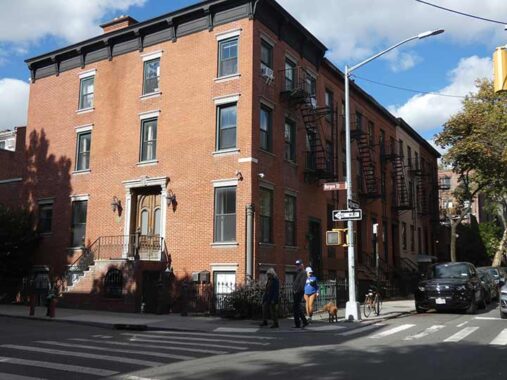
The corner building, #146 Hoyt, “is one of a group of five brick row houses (138 to 146 Hoyt Street) designed and built by John H. Funk in 1848 in a modest Greek Revival style. These five were among the first houses on the block as Boerum Hill developed eastward from the East River ports.”
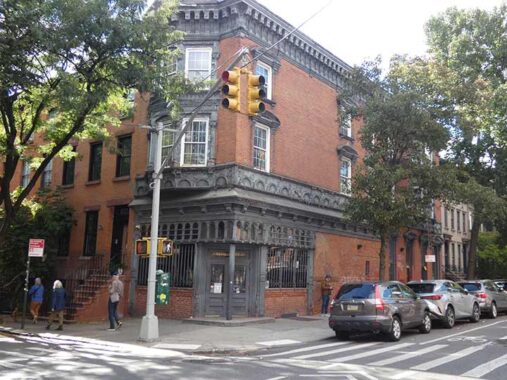
148 Hoyt Street at Bergen, one of Boerum Hill’s masterpieces. According to the Boerum Hill LPC designation report, it was constructed in 1851 and underwent renovations in 1881 that gave it its present appearance. The windows that face out over the street are known as oriels.
The Brooklyn Inn, which occupies the first floor, has been there since the 1880s and boasts an oak bar dating from the 1870s. Interior views are available at the link. Here is a review from January 2026:
The bar’s history has been meticulously documented by local historian and Brooklyn Inn regular Joel Shifflet in his book, Hoyt and Bergen Streets, a copy of which is available on site for patrons to browse. Originally a house, the building was converted into a bar by Anton Zeiner in 1885, who financed the endeavor with the help of the German-American Otto Huber Brewery. Much of the interior woodwork was added in 1892 after Zeiner’s death by his wife, Marie, who sold it to Otto Huber in 1896. Later, another German-American family, the Heissenbuttels, took control and renamed the bar the Exchange Cafe, and ran it through the Prohibition era. Writing in the Lewiston Tribune of Lewiston, Idaho, Martin Heissenbuttel’s great-grandson, Marty Trillhaase, described how the Heissenbuttels served beer, spirits and clam chowder downstairs while they raised their two children on the floor above. Newspaper clippings from the Brooklyn Eagle reveal that the Heissenbuttels kept it open as a speakeasy during prohibition and were subject to a police raid on January 15, 1929, which led to the bar’s eight-month closure.
East of Hoyt, Bergen Street enters the Boerum Hill Historic District, one of the oldest as it was designated in 1973. Charmingly, the older the historic district, the lower tech the reports are; the 1973 report is typewritten, not typeset.


Amazingly nearly the entire block of Bergen Street between Hoyt and Bond Streets on its north and south side consists of simple three-story attached brick residences, built for working families, nay of whom worked on the waterfront. Today they sell in the millions. They were built in groups by different developers from the 1850s through the 1870s and exhibit subtleties in details.
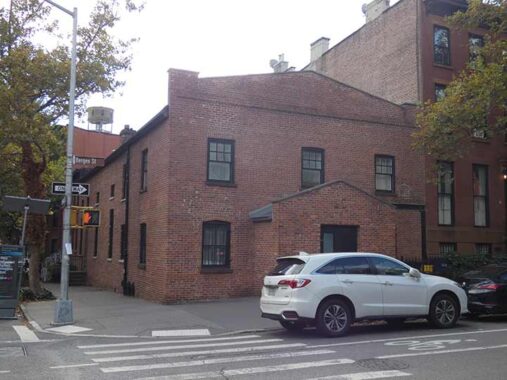
What had been the Sacred Heart Chapel, #192 Bergen at Bond Street, was built as a factory in the 1920s and converted to ecclesiastical use, at first St. Cyprian’s Protestant Episcopal Church. It is now a private home, according to Montrose Morris (Suzanne Spellen) in Brownstoner.
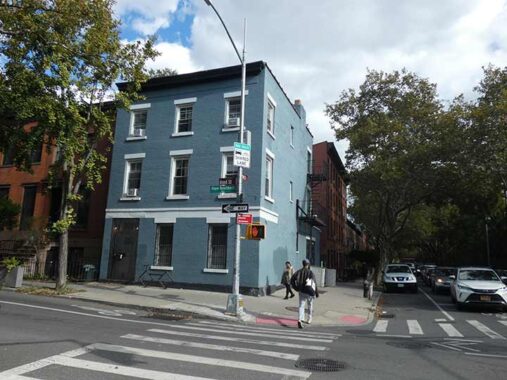
And just like that, at Bond Street, Bergen Street enters its third separate historic district, Boerum Hill Extension, and there was still another one before the end of my route. As readers know I like compact residential brick construction and #189 Bergen/#151 Bond fits the bill.
This brick, Greek Revival-style corner row house with alterations, originally built with a commercial ground story, was constructed in 1851 for Abraham Knox at a time when the neighborhood was being developed with row houses in response to transportation improvements in the area and the growth of industry along Gowanus Creek. Knox was a local landowner who, aside from developing his property, was in the business of making barrels and casks. The building displays features common to the Greek Revival style as found on modest, working-class row houses, such as a molded cornice above a plain brick fascia on the main facade and a dentil course below the rear roof gutter. The storefront has been converted to residential space. [LPC Report]
In the 1940s, a barber occupied the now-deleted storefront.
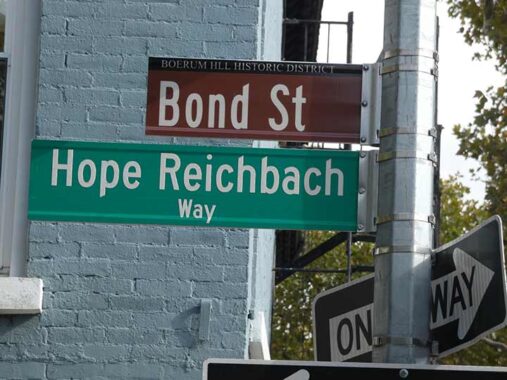
I have been paying more attention to honorific street signs as more and more are popping up (as a NYC chronicler, I’d like one of my own in Little Neck and have mentioned it to people who could get it done. The catch is, you have to be dead first).
From the Irrepressible Gil Tauber’s Oldstreets:
Hope Reichbach (1988-2011) was an aide to City Council Member Stephen Levin. She was on the threshold of a promising political career when she died of a mysterious drug overdose at the age of 22. While still in high school, where she had been an outstanding student and athlete, she successfully sued the Department of Defense (DOD) for its tactics in the military recruitment of people under 18 and the misuse of their personal data. As a legislative aide, she opposed cuts in city funding for local child care programs; and helped galvanize public support for important street safety measures. Since her death, her parents helped form the Hope Reichbach Fund, which partners with Brooklyn-based non-profits to provide paid internships for college students in New York City who are eager to work in the social justice field. (Levi
More on Hoyt and Bond Streets on FNY’s Nevins on Sunday, 2009
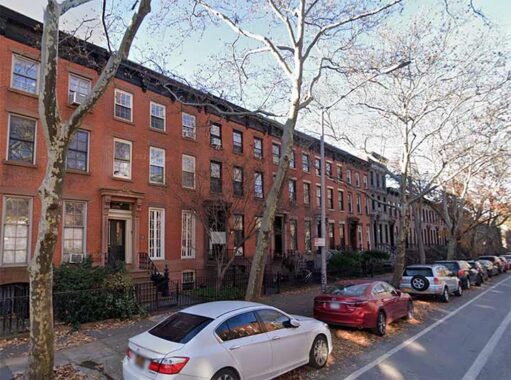
On Bergen between Bond and Nevins Streets we have another nearly unbroken line of Italianate brick row houses, some two stories, others three. From the Boerum Hill Extension LPC Report:
Bergen Street between Bond and Nevins streets is a residential block lined with primarily intact, modest Italianate-style row houses with stone or brick facades constructed by local builders primarily between 1855 and 1872. Originally occupied by working and middle class families employed in the neighborhood’s industries, the buildings are set back from the tree-lined street with stone stoops, paved areaways, and planting beds enclosed by low iron fences or concrete walls. The consistent cornice heights of the predominantly 2- and 3-story buildings with basements form a strong horizontal emphasis while the evenly spaced fenestration, projecting stone entrance lintels, and stone stoops provide the street with a steady rhythm of visual interest. Cornices or stoops have been removed from some row houses but this does not significantly alter the block’s consistent character. This block of Bergen Street predominantly features concrete sidewalks and stone curbs, with a few patches of historic stone paving.


One way of memorializing neighborhood standouts is an honorary street sign. Another way is a memorial garden. The David Foulke Memorial Garden, founded in 1971 a couple of doors away from Nevins, is in place of an empty lot in which had stood two rowhouses that, judging by the 1940 tax photo, had seen better days even that far back. It was named for a neighborhood resident who had performed good works such as organizing children’s parades, October festivals and Christmas caroling.
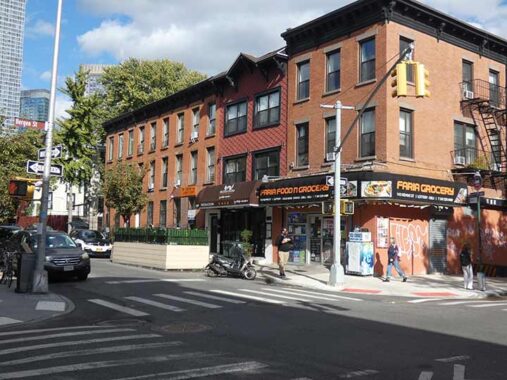
The narrow Nevins Street has a very small commercial district at Bergen Street.
AI robot: Faria has multiple meanings depending on its origin: as a popular female name in Arabic/Persian/Indian contexts, it means “victorious,” “noble,” “charming,” “beautiful,” “kind,” or “one who brings joy”. It can also be a Portuguese surname derived from a place name meaning “ford” or “passage,” or an Italian/Greek topographic name related to a “lighthouse,” while an unrelated Spanish word “fario” means “luck.”
Here, Bergen Street marches east out of various historic districts until entering a fourth one several blocks east in Prospect Heights.
In Part 2: eastward to Prospect Heights
Check out the ForgottenBook, take a look at the gift shop. As always, “comment…as you see fit.” I earn a small payment when you click on any ad on the site.
2/4/26