
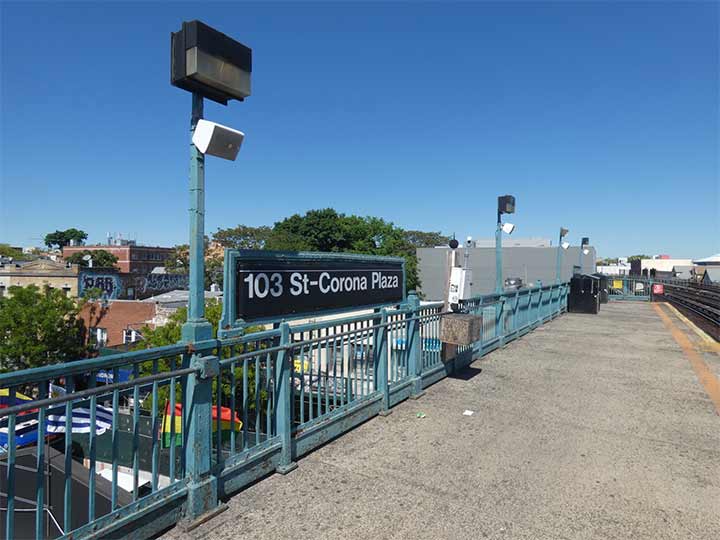

THE platform lamps seen here at the 103rd Street station on the IRT Flushing Line (known as the 7 train) are interesting, as the sodium fixture, day burning here, was installed on pre-existing poles that formerly carried incandescent lighting. The original lamps, bulbs under a heavy “cowl,” show up in the background in this photo on NYC Subway from 1972.
The IRT Flushing Line opened in stages between 1915 and 1928. The stations between Grand Central and Vernon-Jackson opened in 1915. Meanwhile, in Queens, the Hunters Point and Court House Square stations opened in November 1916, and the elevated stations out to 103rd/Corona Plaza in April 1917. There were 3 further extensions: to 111th Street in October 1925; Willets Point Boulevard (modern signage erroneously leaves off the “Boulevard”, as the actual Willets Point is at Fort Totten) in May 1927; and finally, an underground station on Main Street on January 2, 1928. The line was extended west two stops to Times Square by 1927. The Flushing Line expanded yet again, to the West Side Javits Convention Center, in September 2015.
I have featured this station often over the years and doing so today because the MTA is finally updating all Flushing Line #7 stations to modern standards. That means higher windscreens, and replacements of the yellow sodium fixtures and old stanchions with new LED lighting at 52nd, 69th, 82nd and 103rd Streets. In a few months’ time, this photo will not reflect the state of the station.
Check out the ForgottenBook, take a look at the gift shop. As always, “comment…as you see fit.” I earn a small payment when you click on any ad on the site.
5/25/26
5 comments
The #7 station at 111th Street is the only current elevated station with two levels. The top level contains a single bypass track that #7 express trains use, Manhattan-bound in the AM peak and Main Street-bound in the PM peak. There is no platform adjacent to that track.
Years ago Manhattan elevated lines on 2nd, 3rd, and 9th Avenues featured a number of single-track express stations above the local platforms, the difference being that express trains stopped there, above the local tracks. Stairs connected the local and express platforms. There were two platforms astride the single track. The stations were known as “humps” because the express tracks went up and then down, because the street was typically not wide enough to accommodate three tracks and two wider island platforms. Thus, express tracks went up to save horizontal space, and the up and down motion aided braking and acceleration as well.
The last such stations were on the Third Avenue elevated, which closed in May 1955. Stations at 9th, 23rd, 42nd, 106th, and 125th Streets were humps.
Those pole mounted light fixtures are commonly known as wall packs.
W 8th Street station in Brooklyn is 2 levels; Culver on 1 level, Brighton on the other
I stand corrected. Thank you for pointing out my omission.
you’re welcome.. Actually a light went off in my head and I guess Queensboro Plaza would fit your description. I only used or went through there umpteen times in my life, lol
But on another note I dont think you consider Broadway Junction one since one just crosses over the other, no station involved