
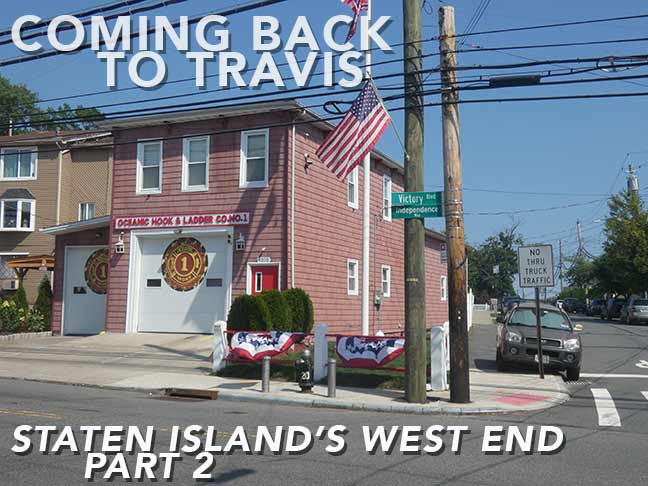

DURING the Forgotten New York era, I’ve only discussed Travis, Staten Island, in depth twice, in 2006 and 2015. Thus, I decided a repeat visit was more than warranted in July 2026, and I hope to touch on a couple of developments there since those earlier occasions. I’m sure I visited Travis earlier than 2006, because beginning in the 1970s I took bus rides all over Staten Island and Travis must have been the destination one one or two occasions. This time, I walked Victory Boulevard with a couple of detours.
Travis is about as far west as you can get in Staten Island, at the west end of Victory Boulevard. Just as Proctor and Gamble made Mariners Harbor a company town for many years, so did the American Linoleum Company in Travis between 1873 and 1931; the industry became so identified with the region that the town became known as Linoleumville during that time. After the company moved to Philadelphia, residents voted to rename the town for early settler Captain Jacob Travis.
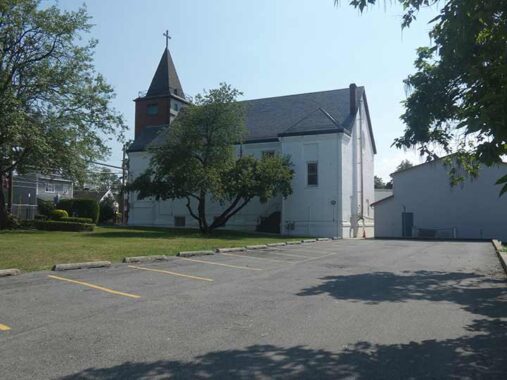


In 2015, St. Anthony of Padua is Travis’ Roman Catholic church, still occupying its original 1908 building. The steeple was repaired after it was damaged in a lightning strike in 2012 (article paywalled). The church merged with Our Lady of Pity in Bulls’ Head, which had been founded in 1913. An attractive grotto including the Stations of the Cross (a series of fourteen images depicting Jesus Christ on the day of his crucifixion and accompanying prayers) faces Victory Boulevard up to Burke Avenue.


In front of the church, Travis’ World War II memorial stands on Victory Boulevard off Shelley Avenue. Eight area residents who perished in the fighting are memorialized on this simple concrete stele. Dedicated on June 27, 1948, its original bronze globe on top has been lost.
Frank H. Ball (1915–1945)
Frank S. Tokarzewski (1920–1946)
Michael P. Rogolewich (1924–1944)
John S. Crabb (1909–1945)
Andrew R. Kovalsky (1918–1944)
Anthony W. Deering (1924–1944)
Joseph M. Killimayer (1919–1942)


Nearby, an interesting situation exists with two streets that dead end, Prices Lane (from Cannon Avenue) and Burke Avenue (from Victory Boulevard. From these maps from 1917 and 2026, you can see that the dead end close to each other, but don’t meet. It’s interesting that it’s been that way for over 100 years…


….but I do like the narrow pedestrian passage that lets nonmotorized traffic to use the two streets that greet but don’t meet.


Like Broad Channel in Queens, Travis is remote enough to still maintain its own volunteer fire department, Oceanic Hook & Ladder Co. Number 1, Victory Blvd. and Burke Avenue. FDNY historian Ed Wilmarth:
Organized on April 17th, 1881, Oceanic Hook & Ladder Co. 1 is historically significant in many ways. Oceanic is the oldest continuously active firehouse in all of Staten Island and one of the oldest in all of NYC still responding out of their original quarters. They are the oldest active volunteer fire company in all of NYC. They are one of only 9 remaining active volunteer fire companies in NYC and one of only two remaining on Staten Island. They were originally part of a group of fire companies that made up the North Shore VFD, which was disbanded on October 1st of 1905 when the FDNY took over fire protection for the borough of Richmond, however Oceanic remained in service. Their firehouse was originally located at 29 Meredith Ave and was moved by horse to its current location of 4010 Victory Blvd in October of 1902.
The FDNY maintains Squad 8 at 3735 Victory Boulevard about one mile to the north.


It’s hard to photograph the prosaically named Staten Island Christian Church at #3984 Victory Boulevard at Church Avenue because it’s nearly completely surrounded by foliage. When street scenes photographer Percy Loomis Sperr photographed it in 1932, it was the Dickinson Methodist Episcopal Church. You can see that its appearance has been completely streamlined in the decades since. The church was built in 1871 at a cost of $3000 and was sold to Staten Island Christian in 1974. Interior photos are available at the church’s Instagram page. Photo: Urban Archive


There are quite a few dead ends in Travis, including Towers Lane, which according to 1940s.nyc had one house on it then; today it’s mostly lined with homes built during the last 40 years or so. Travis itself was something of a dead end before the West Shore Expressway was built in the 1970s: Victory Boulevard is the main way in, with Travis Avenue connecting the area to Richmond Avenue in New Springville/Staten Island Mall, and Meredith Avenue crossing the railroad to Chelsea, largely industrial but now with a shopping mall and a humungous Amazon warehouse.
Cannon on Cannon
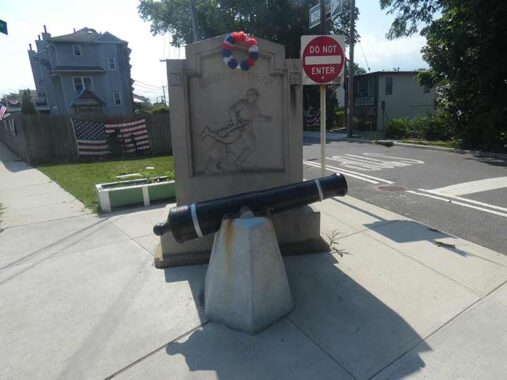


Cannon Avenue, which accepts northbound traffic only, diverts from Glen Street at Parish Avenue and meets Victory Boulevard at Travis’ World War I memorial. It formerly extended past Glen street but that section was obliterated by the west Shore Expressway. Today, Meredith Avenue is the only road south of Travis and South Avenue that connects Travis with the Chelsea area further west.
At the intersection of Victory Blvd. and Cannon Avenue, named for a prominent local French Huguenot family, is a World War I memorial consisting of a small cannon and a stone marker depicting a gun-toting doughboy. The cannon was found decades ago and likely dates to the Revolutionary War, when British soldiers were billeted in the area.
A doughboy goes “over the top” on the memorial face.
ForgottenFan James Sarlo:
I am an avocational historian from Staten Island. I am currently working on a book about Staten Island’s Revolutionary War history. Specifically, I’m creating a historic-archeological reference guide detailing the locations of Staten Island’s forgotten British forts. (My book is entitled The Lost Redoubts. Staten Island’s Forgotten British Forts.)
|
As part of my research I looked into the origins of the gun barrel located at the W.W. I memorial. The gun was unearthed onthe north side of the Sylvan Grove Cemetery{Ye’ Old Burial Ground} when homes where being constructednearby. Itook several photos and detailed measurements of the gun and forwarded that information to a vintagecannon restoration company . They confirmed that the gun barrel is actually a Civil War era 6 pounder. After the Civil War it was quite common for barrels to be donated to towns and they were often displayed in cemeteries. This gun may have been displayed on the Cannon family grave, or as part of a memorial for the Grand Army of the Republic Veterans†entombed in the Sylvan Grove Cemetery.
|
During the Revolution Travis was known as New Blazing Star, and was named so after the ferry landing that was located at the end of present day Victory Blvd. Several Loyalist units were station in the area during the course of the British occupation. My research indicates that the hill top at the “Ye Old Burial Ground” was where a redoubt {fort} was once located. In August of 1777 a skirmish was fought at this site between Rebel and Loyalist units. This action was a part of the battle of Staten Island also known as General Sullivan’s Raid.
|
I hoped that the cannon was an artifact which would reinforce the historic importance of the Burial Ground, and was disappointed to discover otherwise. I haven’t been able to discover the origins of the false cannon legend, but I almost certain that the history of the area mainly lead to the misassumption.


Travis, at present, is the site of Staten Island’s only freight railroad, the Travis Branch of CSX. It runs from Howland Hook in Mariners Harbor south along the Arthur Kill and serves New York Container Terminal at Howland Hook, the Department of Sanitation’s Fresh Kills Transfer Facility, Visy Paper and VanBro Corp.
The city intends to reactivate the North Shore line of the SIRT which runs from Howland Hook to St. George, not for passenger traffic, but for freight. The line connects to RRs in New Jersey via a recently reactivated bridge crossing the Arthur Kill from Mariners Harbor.
ABOVE: The Travis Branch crosses Chelsea Road near the West Shore Expressway.
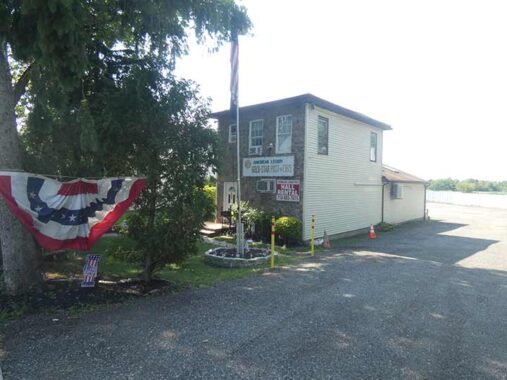
American Legion Post 1365 on Cannon Avenue. Last time I swung past, on the lawn there was a mailbox converted into a flag disposal receptacle. American flags should not be merely discarded; from the Veterans of Foreign Wars, here is what is generally done with ragged or old flags:
1. The flag should be folded in its customary manner.
2. It is important that the fire be fairly large and of sufficient intensity to ensure complete burning of the flag.
3. Place the flag on the fire.
4. The individual(s) can come to attention, salute the flag, recite the Pledge of Allegiance and have a brief period of silent reflection.
5. After the flag is completely consumed, the fire should then be safely extinguished and the ashes buried.
6. Please make sure you are conforming to local/state fire codes or ordinances.
This is also the Blazing Star Post #1574 of Veterans of Foreign Wars. The name Blazing Star, as associated with Travis, is somewhat confusing. Rossville, further southwest along the Arthur Kill, was once called Blazing Star because a ferry ran to New Jersey from a tavern with that name during the colonial era. Later, another ferry was established from the foot of Richmond Turnpike, named the “New Blazing Star” ferry. That’s probably where this post got its name.
I hope to return to the Travis/Fresh Kills Park area within the next few months, so hopefully it won’t be another decade wait till FNY describes Travis again.
Check out the ForgottenBook. As always, “comment…as you see fit.” I earn a small payment when you click on any ad on the site.
8/22/26
4 comments
“The city intends to reactivate the North Shore line of the SIRT which runs from Howland Hook to St. George, not for passenger traffic, but for freight”.
If this is true then it will cost millions of dollars since the North Branch branch is in sad shape.
Since I have heard nothing lately, I amended the text.
Not only is the North Branch in sad shape, but the RoW runs through a lot of businesses’ property now once you get beyond Port Richmond.
people love to use the mouths of cannons for trash receptacles