
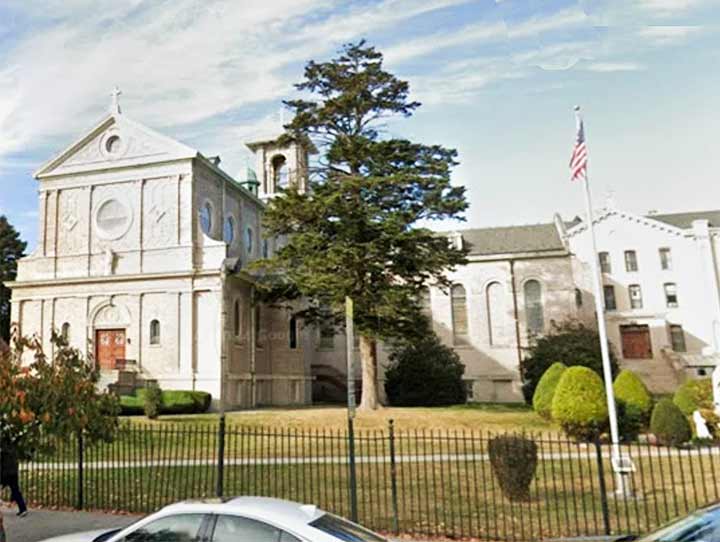


On a scenic bluff overlooking The Narrows, 19th century Bay Ridge was a refuge from city life with the views and breezes from this vital waterway. Insititutions valued such places even as urbanization approached and then enveloped them. In the summer of 2026, the Sisters of the Visitation announced that the 7.5-acre Academy of the Visitation was sold for $42 million to developers in a quick end to a storied property beloved by neighbors.
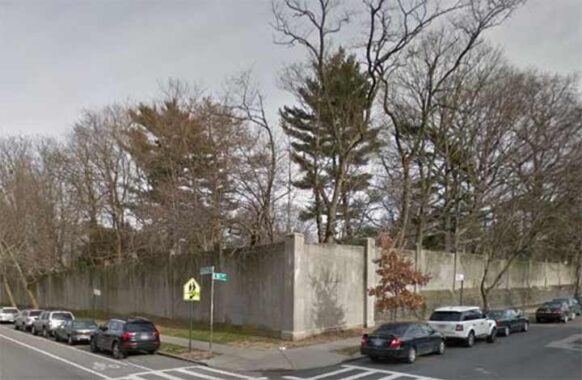
Because of its size and long history, many residents assumed that the Academy of the Visitation would eternally represent the Roman Catholic Church in Bay Ridge, and Google Maps erroneously colored its superblock in green, marking it as Monastery Square, seemingly a park despite the 20-foot wall and “no trespassing” signs. It would have been an ideal park with its hills, mature trees, and pond. At this time, we are left guessing how this site will appear in the near future.
Facing Ridge Boulevard, the street grid’s equivalent of 2nd Avenue is a Renaissance Revival church built in 1913 as the face of an all-girls parochial school that functioned until 2024, when its student body was at 100, and only two sisters were residing in the convent. The closing of the school was a harbinger of this year’s sad news. Could this church be landmarked? Seems like an ideal candidate but this designation is not a guarantee of protection against arson and neglect.
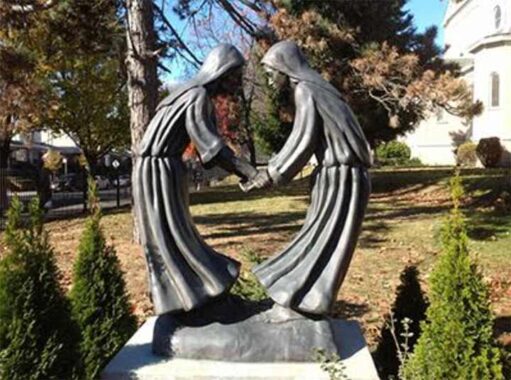
The order of nuns that operated this convent and school was founded in 1610 by saints Francis de Sales and Jane Frances de Chantal. Their namesake is from the gospel of Luke, who wrote about Mary visiting her cousin Elizabeth who was pregnant with John the Baptist. On the grounds of the Visitation Academy is a sculpture of the two Christian matriarchs by Canadian sculptor Timothy P. Schmalz, who has a sizable portfolio of Christian sculptures.
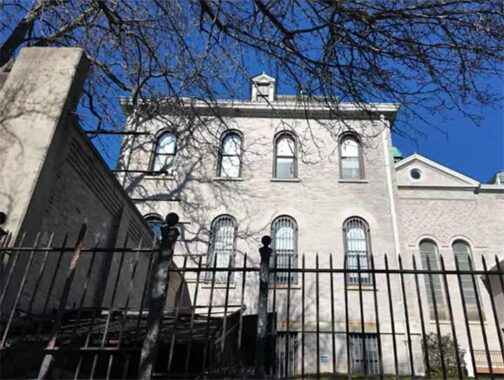
Before the arrival of the sisters to this property in 1903, it was the Kings County Home for Inebriates, chartered by the state as an asylum for chronic alcoholics. At the time, the temperance movement was sweeping the nation and the public was supportive of public measures that sought to curb alcoholism. The 15-acre Barkaloo property was selected by the institution’s trustees for its “advantage of the sea breezes… easily accessible from the city without being near enough to attract too many visitors. Architect Ebenezer L. Roberts designed the facilities in an Italianate style, which were later preserved by the sisters.

A map of the area from 1873 shows a proposed railroad running past the Home for Inebriates, with the southern side of Bay Ridge labeled as Fort Hamilton for the nearby military base. State Road was the western extension of Kings Highway, which was later absorbed into the street grid, leaving a few remnants that we’ve documented.
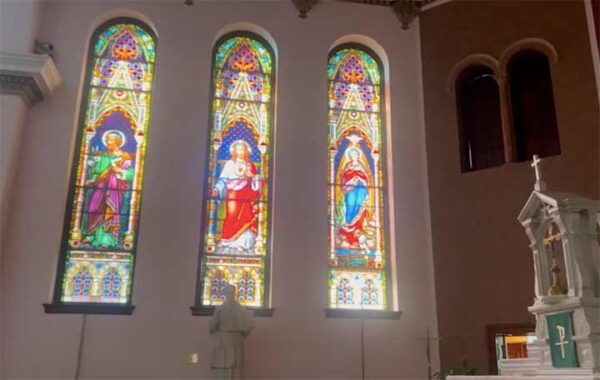
Over time Brooklyn voters resented having to finance the institution and sentencing individuals for “no worse crimes than a fondness for a strong drink,” as described in an 1895 article in the Brooklyn Daily Eagle. In 1894 state lawmakers cut off its primary source of funding. Following an unsuccessful lawsuit to survive, the asylum’s charter was cancelled in April 1898. The Sisters of the Visitation moved into the former asylum in July 1903, leaving behind their convent in Clinton Hill which is now the site of Saint Joseph’s University. The former asylum became a convent and a Catholic girls’ high school. What will happen with the religious artworks? Usually the Church takes them to storage with the goal of having them installed at another church building.
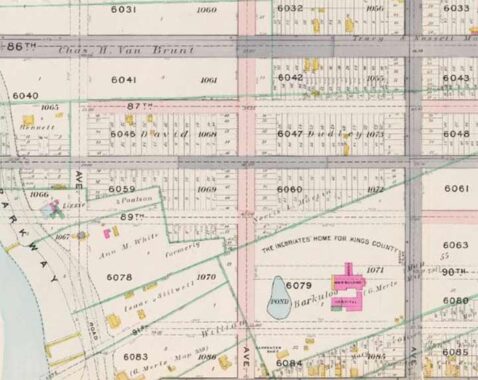
The oldest feature on this property is the pond, as seen on this map from 1898. The grid-defying property was first settled by William Harmans Barkaloo in 1725. Among the Dutch settler families of New Netherlands, the Barkaloos hopped around New Amsterdam, Flatlands and Gravesend before settling at Bay Ridge, at the time part of the Town of New Utrecht. The last name originates from the Dutch village of Borculo.
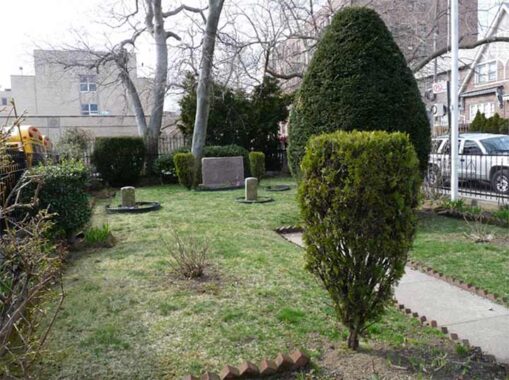
Kevin wrote about them in 2016, noting it as one of Brooklyn’s smallest cemeteries. Its last interment was in 1848, and family members lived in Bay ridge into the early 20th century.
The natural feature on the property that piqued my attention is the pond on its western side, hidden from public view by the wall. It features a fountain in its center, a statue of an angel and the crucified Jesus decorate the pond. Located atop the glacial terminal moraine, Bay Ridge had other kettle ponds which were filled after the neighborhood became part of New York City.
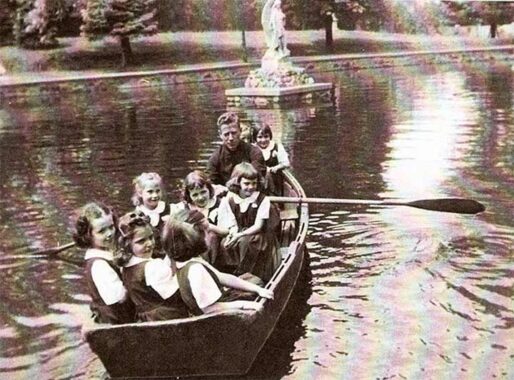
Over the past century, the academy used this pond for rowing and ice skating, as seen in this photo from an alumni group on Facebook. Visitation Academy is not the only private school in Brooklyn to have an on-campus pond. Nearby Poly Prep has two ponds. With the exception of cemeteries, no property in this city is eternal, and I would not be surprised if Fort Hamilton, after two centuries of military use, is also going to face redevelopment in my lifetime.
Sergey Kadinsky is the author of Hidden Waters of New York City: A History and Guide to 101 Forgotten Lakes, Ponds, Creeks, and Streams in the Five Boroughs (2016, Countryman Press), adjunct history professor at Touro University and the webmaster of Hidden Waters Blog.
Check out the ForgottenBook (HarperCollins, 2006), as well as Forgotten Queens (Arcadia, 2013). I also have a chapter in the anthology “New York Calling: From Blackout to Bloomberg” (Reaktion, 2007). As always, “comment…as you see fit.” I earn a small payment when you click on any ad on the site.
8/24/26
2 comments
Is there no way this property can be saved ??
There is a convent at 22-04 Parsons Blvd. in Whitestone that houses senior aged nuns. It is leased to the Sisters of Mercy by, I believe, the Redemptorists order of priests.
This beautiful piece of property is about 2.2 acres with no pond or wall. But it does have a real nice fence.