
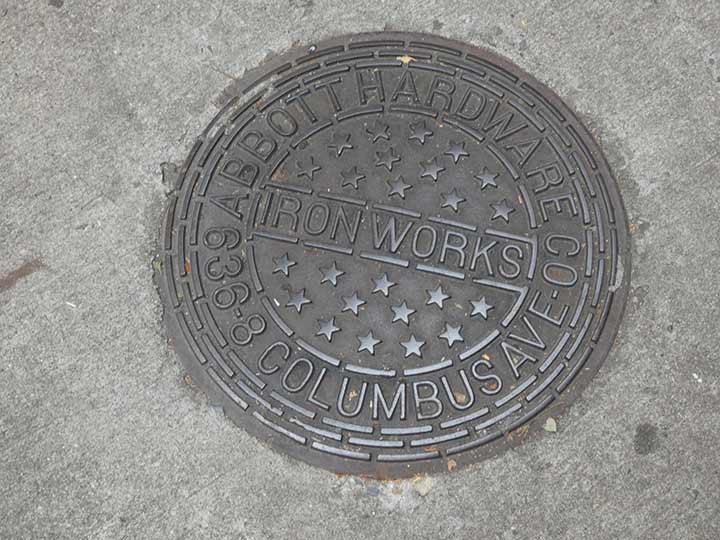

YOU know what can be a key indicator of where things were in the New York City of long ago? Manhole covers and coal chute covers. There’s a hidden city beneath the city. Sewers, electrical wiring, water mains, traffic and train tunnels all pulse and vibrate under your feet as you walk the five boroughs. Other than steam-belching vents, manhole and coal chute covers are the only visible reminder of this underground subcity. If you walk past them without noticing, you’ll miss a lot of delicate cast-iron artwork and, just maybe, a hint of the past history of New York City. I knew this in the early days of Forgotten NY, when I devoted a page to them, and perhaps it’s time for me to start noticing them once again. That page was written after I participated on a tour constructed by historian Diana Stuart, the self-styled “manhole cover lady.” Not much has been heard from her the past 20 years, so I hope she is still alive and well.
One of the coal chute covers I photographed for that page remains on St. Luke’s Place between 7th Avenue South and Hudson Street. Drilling down a bit on Abbott Hardware and Iron Works, I found two separate businesses of the late 19th and early 20th Centuries. According to the Indispensable Walter Grutchfield, Matthias Stuart (1829-1886) founded the iron works, which was in business at 137 8th Ave., 636-638 Columbus Ave., 322 W. 21st St., 116 W. 22nd St., 20 W. 22nd St., and 31 Union Square from 1889 to 1956. After his death in 1886, nephew Richard Henry Abbott and sons Philip Henry Abbott, Charles I. Abbott and Reuben Finch Abbott carried on the business.
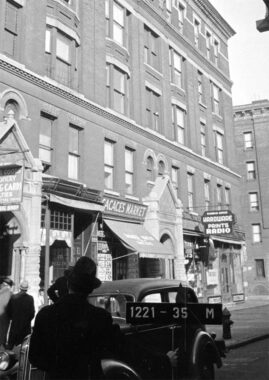
The Abbott Hardware store, meanwhile, was located at #636-638 Columbus Avenue between 1903 to 1935. The hardware store seen in this 1940 tax photo from the Municipal Archives was likely a successor store to Abbott Hardware. Note the shadows cast by the 9th Avenue El, which would go out of business in 1942 except a short spur connecting the Polo Grounds with the Jerome Avenue El that remained open until the NY Giants vacated the Polo Grounds following the 1957 season. A high rise apartment building, with medical offices and other businesses on street level, stands in this location today.
Every piece of infrastructure in NYC has a story behind it!
Check out the ForgottenBook (HarperCollins, 2006), as well as Forgotten Queens (Arcadia, 2013). I also have a chapter in the anthology “New York Calling: From Blackout to Bloomberg” (Reaktion, 2007). As always, “comment…as you see fit.” I earn a small payment when you click on any ad on the site.
9/25/26