
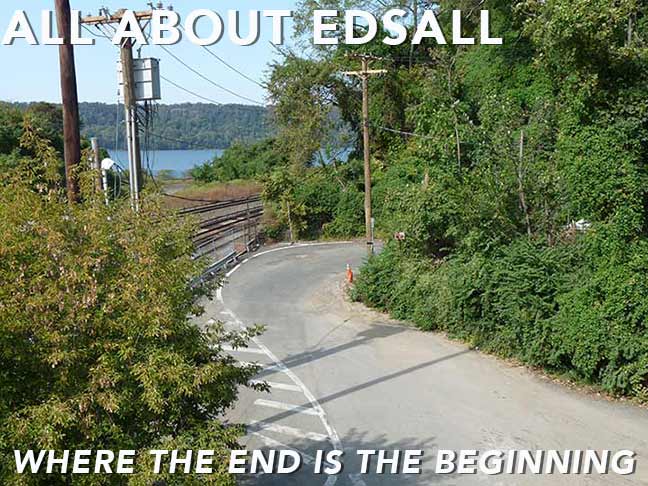

SPUYTEN Duyvil’s Edsall Avenue, adjoining the Harlem River at the Spuyten Duyvil Metro-North station, is among New York City’s oddest streets. Like a Mobius strip it has no clear beginning and end, though both could be said to be at the point where Johnson and Palisade Avenues meet near the underbelly of the Henry Hudson Bridge. According to late Bronx historian John McNamara in “History in Asphalt,” the road takes its name from Thomas Henry Edsall, an author who resided in an estate overlooking Spuyten Duyvil Creek (later dredged to join the Harlem River) who published “The History of the Town of Kingsbridge” in 1887. He was a scion of a Dutch landowning family that sold its lower Bronx holdings to the Morris family in 1681.
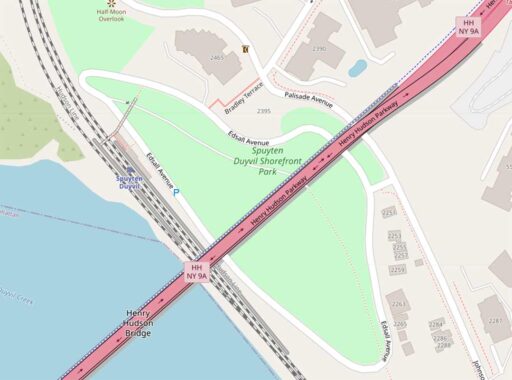
Edsall Avenue is roughly circular. Traffic enters it at the Johnson-Palisade “junction” and must turn right, traveling to the Spuyten-Duyvil Metro-North station, created during a track realignment-electrification project in 1906. Traffic can then circle back to the entry point.
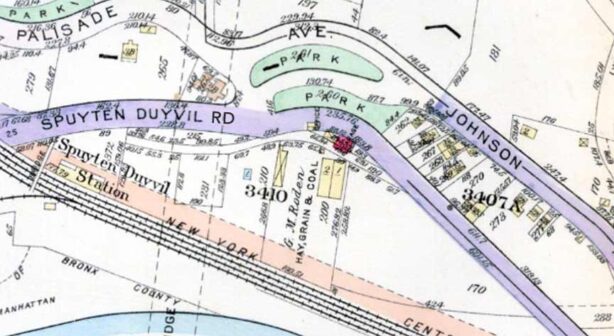
This 1923 map shows that only half of Edsall Avenue was in place, just the northern section that contained a path to the railroad station. It was then called Spuyten Duyvil Road, which later became sections of Edsall and Ewen Avenues (the latter has since been paved over ande is now part of the John F. Kennedy Educational Campus.) By the mid-1930s the road has assumed the Edsall Avenue name and attained its full length, surrounding Spuyten Duyvil Shorefront Park (which remains mostly undeveloped), in later decades.
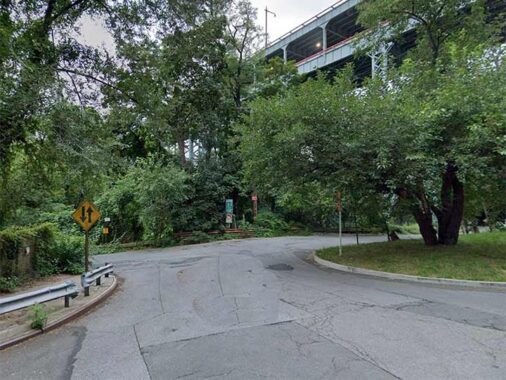
Neither Palisade, Johnson nor Edsall Avenues are marked by Department of Transportation signage (as of 2026) at this “junction point.” As you can see by the 1924 map, this junction used to be more complicated, with parkland on either side of Johnson Avenue, but it was simplified at a later date. Signs do point to the Spuyten Duyvil station.
Spuyten Duyvil is tucked into the corner of the Bronx at the Hudson and Harlem Rivers, first stop beyond Marble Hill. It has been known as Speight den Duyvil, Spike & Devil, Spitting Devil, Spilling Devil, Spiten Debill and Spouting Devil, among other spellings. In Dutch, “spuyten duyvil,” the mostly-accepted spelling these days, can be pronounced two ways; one pronunciation means “devil’s whirlpool” and the other means “spite the devil.”
In Washington Irving’s Knickerbocker History, a Dutch bugler vows to swim the turbulent waters of (then) Spuyten Duyvil Creek where it meets the Hudson during the British attack on New Amsterdam in the 1660s “en spijt den Duyvil,” or in “spite of the devil.” The Lenape Indians inhabited the land for hundreds of years before Europeans arrived; they called the banks of the creek “shorakapok” or “sitting-down place”. After a few hundred years, the name has been pared down and exists as a street name: Kappock (pronounced kay’ pock).


Besides the street “junction”, Edsall Avenue has two other connections to the outside world. One is the path to the Spuyten Duyvil station, which, like neighboring Marble Hill, has a marvelous view of not only the Hudson River but also the Henry Hudson Bridge, which spans atop it.


Additional photos from Spuyten Duyvil RR station. In fall 2020 I surveyed extensively in the area and got plenty of shots.
More photos of Spuyten Duyvil Station available at NYC Subway. In 2013, a tragic derailment occurred near the station that claimed 13 lives.
The other connection Edsall Avenue has to the rest of the Bronx is a step street called Bradley Terrace.
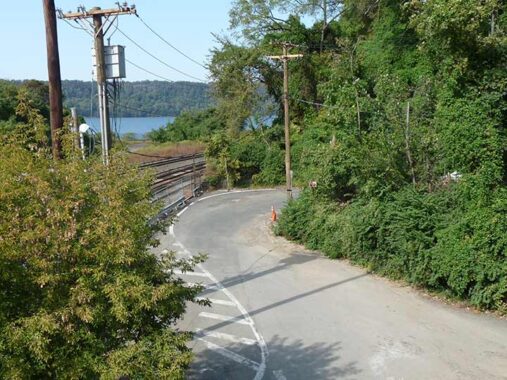
Edsall Avenue presents a rural aspect as it winds uphill from the railroad station.
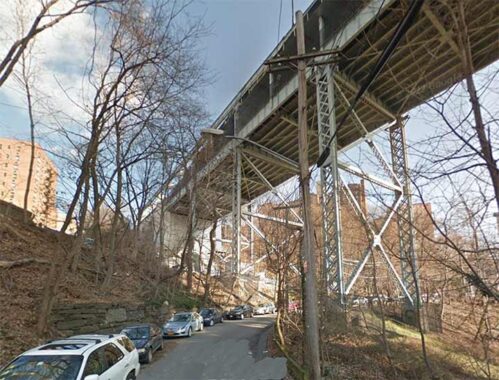
The avenue’s passage beneath the Henry Hudson Bridge can be best photographed in winter, when heavy foliage doesn’t get in the way. The original single-deck steel arch structure was built for the Henry Hudson Parkway Authority by the American Bridge Company at a cost of $4,949,000 and opened to traffic on December 12, 1936. The upper level was opened two years later.


There are seven dwellings with Edsall Avenue addresses, just east of the “junction point.” But, to get to them, motorists must circle around past the train station then loop back. The addresses are #2251, 2253, 2255, 2257, 2259, 2263 and 2265, with the latter the most notable as it’s home to Spuyten Duyvil String Instrument Repair, specializing in guitar, ukulele, and fretted instrument repairs.
Check out the ForgottenBook (HarperCollins, 2006), as well as Forgotten Queens (Arcadia, 2013). I also have a chapter in the anthology “New York Calling: From Blackout to Bloomberg” (Reaktion, 2007). As always, “comment…as you see fit.” I earn a small payment when you click on any ad on the site.
9/26/26