
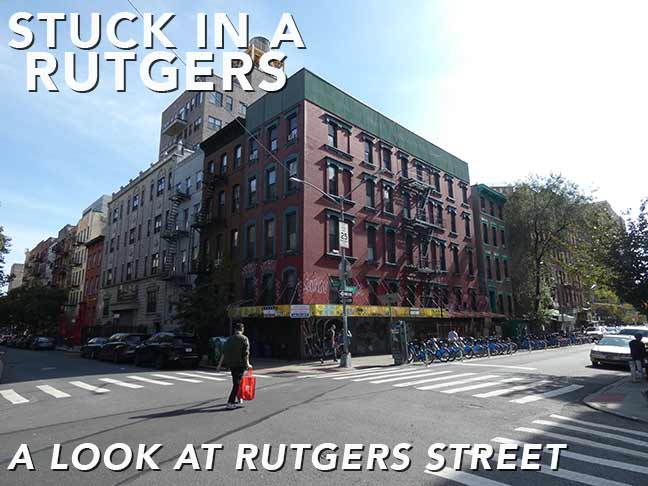

BEFORE heading off to see the recently reopened section of East River Park (on an upcoming FNY post) I decided to check out Rutgers Street, because I had never walked its short length before, as well as nearby Gouverneur Hospital. Rutgers Street begins at Straus Square, where Canal and Essex Streets and East Broadway meet, and runs down to the East River.
The street takes its name from Henry Rutgers (1745-1830), a captain in the Revolutionary Army who held meetings of the Sons of Liberty. The descendant of Dutch colonials who arrives in the New World in 1636 and whose brewery and mercantile business was so successful that the family was able to amass large holdings on Manhattan Island’s Lower East Side. Queens College, on a vast campus in New Brunswick, NJ (also Newark and Camden) was established in 1766 and closed in 1816. Upon its 1825 reopening it was renamed for Henry Rutgers, who had donated a $200 bell that still hangs on the campus’ oldest building, Old Queens. Henry Rutgers also made a $5,000 grant to the school, which was real money in 1825. At Rutgers College’s centennial in 1925, it became Rutgers University. Nearby Catherine Street was also named for a Rutgers, a predecessor of Henry.
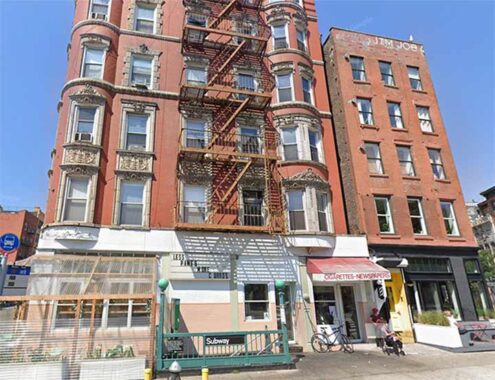
There’s a short section of Rutgers opposite Straus Square between Canal Street and East Broadway. There are no addresses on it, though, as the building on the left with the great bay windows is #162 East Broadway, and the building on the right is home to the coffee shop Little Canal at #26.
The corner restaurant on East Broadway is vegan Mexican restaurant Jajaja, which I imagine is pronounced “hahaha.” The exterior sign says: “Less pants, more churros.”
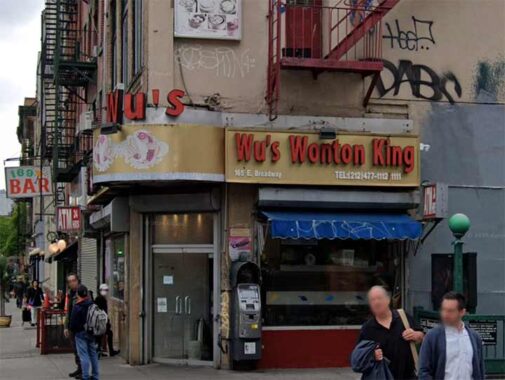
I remember Wu’s Wonton King, #165 East Broadway, from way back in 2005 when its former identity as the Garden Cafeteria (seen on this FNY page), patronized by Isaac Bashevis Singer, was briefly revealed.


A playground and a school building on Henry Street between Rutgers and Jefferson Streets are named for Jacob Joseph. In actuality they are named for two Jacob Josephs; the school for the first Jacob Joseph (1840-1902) who served as chief rabbi of New York City’s Association of American Orthodox Hebrew Congregations, a federation of Eastern European Jewish synagogues; and the playground for Captain Jacob Joseph (1920-1942), a great-grandson of the rabbi, who was killed in action in World War II at Guadalcanal.
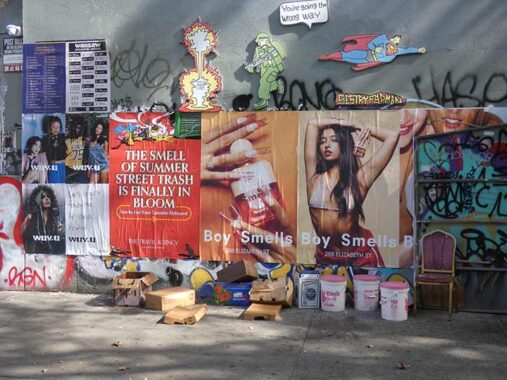
Well, that got my attention, on Rutgers next to Wanton King. I thought this was a deodorant brand, but instead, the company makes “highly spirited scented candles, fine fragrance, perfume, body mists & washes and lotions.”
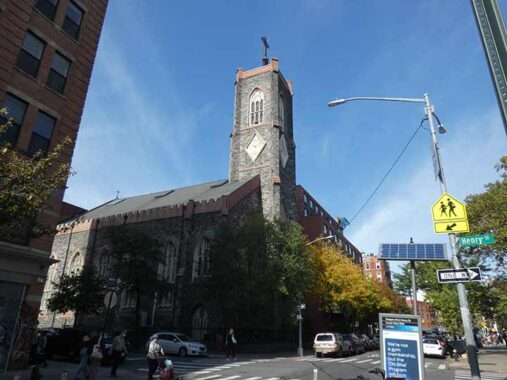
At Rutgers Street we come to yet another very old, but repurposed, church building. The present St. Teresa Roman Catholic Church was built in 1841 as the First Presbyterian Church of New York. The church is made of handsome Manhattan schist. The plot where it stands was donated by Henry Rutgers himself in 1798. Within a few years, immigration from Ireland surged in the area, as the Irish fled from the Great Potato Famine. Rutgers Presbyterian sold the building to the Catholic diocese of New York in 1863.
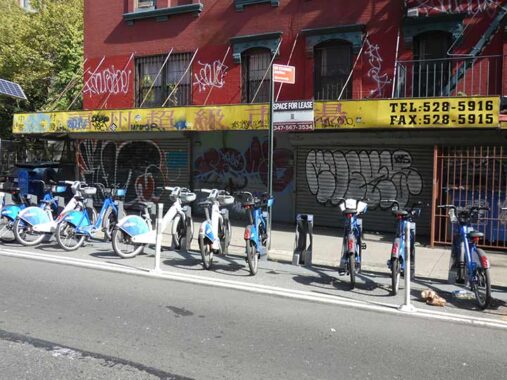
I’d like to know the significance of red and yellow in Chinese orthography or tradition, as so many sidewalk signs in Chinatown and environs are rendered in those colors. The sign has been in place for quite awhile at Rutgers and Henry Streets, as the fax number exhibits.


Lower East Side People Care Garden, one of more than 550 community gardens in Manhattan, sits in place of #25 Rutgers Street between Henry and Madison Streets. In 1940, #25 housed a pool hall and a dentist.


The block of Rutgers between Henry and Madison is superficially little changed since the early 20th century though of course the businesses and faces have changed. “Hello Human,” #24 Rutgers, is an art gallery and events space.
Founder Jenny Nguyen, proprietor of the five-year-old membership-based strategy and public relations company Hello Human, describes the venue as a new type of creative infrastructure that is built around a core challenge for designers: finding space to exhibit what they make. For a fee, Hello Human’s members are able to rent out the front gallery space by the week and use it for whatever they wish.
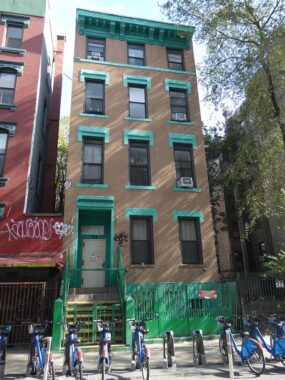
I liked #23 Rutgers because of the lime green paint job on the fencing, steps, roof corbelling and window lintels. In 1940, like its next door neighbor #25, it hosted a dentist office. In the days before fluoridation, tooth decay was much more common.
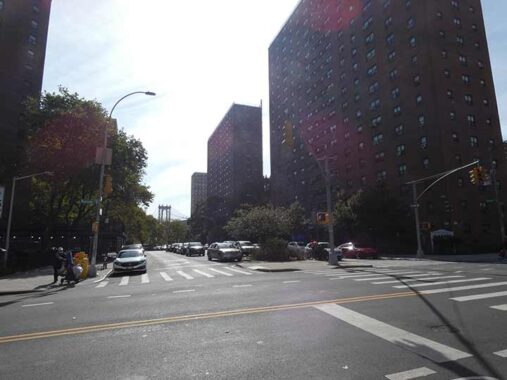
Between Madison and Cherry Streets, Rutgers Street gains a center median as it is sandwiched between the LaGuardia (Little Flower) Houses (left) and Rutgers Houses (right), built in the 1950s.


Midway between Madison and Cherry Streets, you can detect the “ghost” of Monroe Street. In the Lower East Side projects, former streets were often used for driveways and walkways.
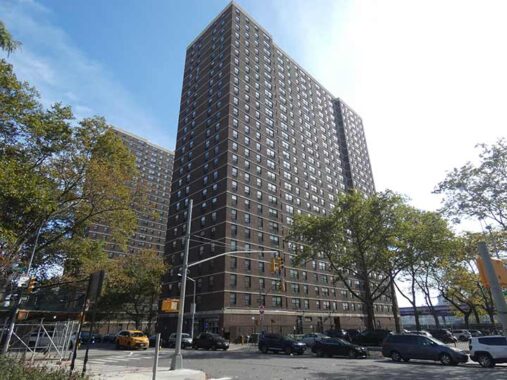
#265 (front) and #275 (rear), one of two high rise apartment buildings at Rutgers and Cherry Streets, built in 1979.


Between Cherry and South Streets, Rutgers narrows again to one lane and becomes Rutgers Slip. “Slip” seems to be a unique appellation to streets in NYC, because Manhattan used to have a unique feature: man-made inlets, mini-harbors where cargo-laden sailing ships could sail in and unload goods, and the aroma of coffee beans, spices, nutmeg and condiments filled the air. Manhattan Island’s edges were swampy; the Dutch expanded the island into the East River by landfill, but originally left the inlets, or ‘slips’ for docking. Lower Manhattan’s “slips” hark back to that era.


Gouverneur Hospital, #621 Water Street, was constructed, designed by John R. Thomas, in 1901 and served the lower east side until 1961. A new Gouverneur Hospital opened in 1972 on Madison and Jefferson Streets. The original place has had periods of abandonment but it now serves as assisted living housing for low income and special needs residents. The distinctive, covered-U shaped verandas remain in place. It was believed, when they were added in 1909, that tuberculosis germs bred in sharp corners and so many hospitals had curved verandas and els. In addition, fresh air was a prominent curative method in the 1890s-1900s, but NYC air quickly became too polluted soon after Gouverneur opened for that to work very well.


Gouverneur Street


Gouverneur Slip East
Gouverneur Street and Gouverneur Slip East and West are three of the six New York Streets called “Gouverneur,” along with Gouverneur Lane further south in the Financial District; and Gouverneur Place in Morrisania, Bronx and Gouveneur Avenue south of Van Cortlandt Park. Sanna Feirstein (“Naming New York” and Henry Moscow (“The Street Book” could not agree on which Gouverneur the Manhattan streets honor. According to Moscow, it’s Abraham Gouverneur (1671-1740), a prominent merchant and Speaker of the New York General Assembly and ally of Governor Jacob Leisler, an early rebel against British colonial rule who was hanged. Feirstein later countered that the streets recall Abraham’s nephew Nicholas Gouverneur (1753-1802), president of the Bank of New York. In the Bronx, historian John McNamara claims in “History in Asphalt” that the Bronx’s two Gouverneurs were associated with the family of Gouverneur Morris (1752-1816), political leader, diplomat, U.S. Senator, and American ambassador to France, and who was on the three-man commission that plotted Manhattan’s street grid system in 1811. For a detailed bio of Gouverneur Morris, see Ian Frazier’s “Paradise Bronx.”
Check out the ForgottenBook, take a look at the gift shop. As always, “comment…as you see fit.” I earn a small payment when you click on any ad on the site.
12/6/25