
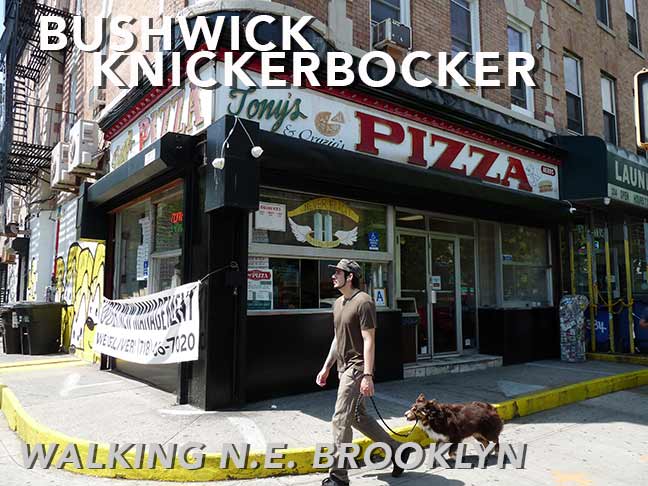

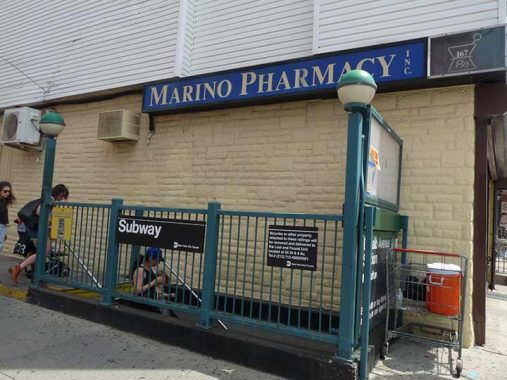
MUCH of the spring and into the summer I wasn’t feeling particularly well with occasional gastro issues and a bad back, but I did get out now and then until July when things turned around and I was able to do some more walking. I have a big backlog of photos thanks to Sergey Kadinsky stepping up and doing several weekend longforms, giving me some “time off.” The curtain briefly lifted in early May, when I got an L train to Bushwick and walked along its titular avenue, then along Knickerbocker (I enjoy saying Dutch names like Bushwick and Knickerbocker) before scurrying to the L train back to Manhattan and Penn Station.

Though the much smaller in area Welling Court in Long Island City gives Bushwick a run for its money, Bushwick has become NYC’s capital of ingenious and colorful “street art” that is much superior than the usual spray can scrawlings. Many of the artworks are sponsored by an organization called the Bushwick Collective, founded by Bushwicker Joe Ficalora. There is a concentration of artworks at Wyckoff Avenue and Troutman Street, about a mile away from this subway exit at Bushwick and Montrose Avenues.
Like many of Brooklyn’s busiest roads Bushwick Avenue began as a Native American trail that took shape as a colonial pathway. The Old Bushwick Road first appears in documentation in 1640 when it was “the road from the kill”; Boswijck, or “town in the woods” was a town established by Peter Stuyvesant in 1661, with the Old Bushwick Road its main artery.
In that remote era, the Old Bushwick Road proceeded from a connection to today’s Woodpoint Road and Metropolitan Avenue (which was laid out much later, in the 1810s) following today’s Bushwick Avenue in general south to today’s Menahan Street, when it jogged to the east and ran in the roadbed of today’s Evergreen Avenue, accounting for that avenue’s slight aberration from the grid. Beginning at today’s Putnam Avenue it ran straight southeast, through what is now Evergreens Cemetery, to the old Jamaica Turnpike, today’s Jamaica Avenue. That last section has been completely eliminated. When the overall street grid was laid out in the 1860s, sections of the Old Bushwick Road were included in Bushwick and Evergreen Avenues, but long stretches were completely lost.* A bend in Old Bushwick Road still remains as Bushwick Place between Meserole and Boerum Streets just east of Bushwick Avenue.
In the colonial era Bushwick was a farming community where Dutch settlers grew tobacco for the local market. Later, farmers of Scandinavian, French and English descent moved to the area. Bushwick remained rural through the 18th Century. Hessian mercenaries settled in Bushwick following the 1776 Battle of Long Island, and began a long tradition of German influence in the neighborhood.
GOOGLE MAP: BUSHWICK-KNICKERBOCKER
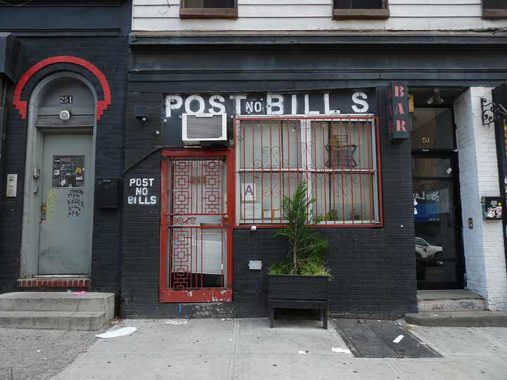
Post No Bills, a bar at #253 Bushwick south of Montrose, takes its name from the common admonition on plywood fences surrounding construction sites to not past ads on the plywood. My question is, why not? Comments are open.
The bar sports a new trend in sidewalk signage: spray paint through stencil letters, Helvetica in this case.

The former (now closed) Zukkie’s (Bicycle) repair shop, a hole in the wall at #279 Bushwick Avenue south of Johnson, sported what was likely a hand lettered sign.
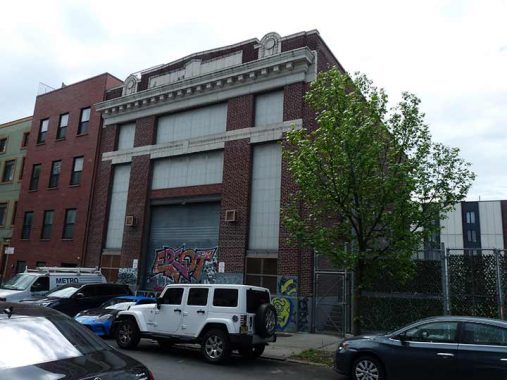
When I spotted this building on Boerum Street south of Bushwick I knew it held some import. A bit of research showed that it was a BMT substation constructed in 1925 to power the then-new BMT Canarsie Line, the present L train.
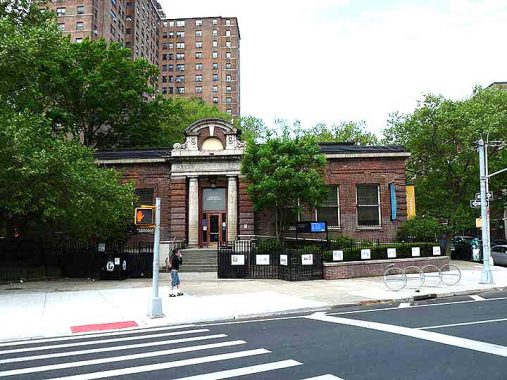
The Bushwick branch of the Brooklyn Public Library sits at a bend in the road at Seigel Street across from PS 112. The handsome, Doric-columned building was part of the Andrew Carnegie library philanthropy program.
The Bushwick branch library, at the corner of Bushwick and Siegel Street. was opened in 1908 when that area was heavily populated by Italian and Jewish immigrants. Before 1903 the Bushwick branch was run out of rented space in a church on Humboldt St. between Johnson and Montrose Avenues. The church burned down in 1903, and the library moved to Siegel St. and soon after into its new building. The building’s architect was Raymond Almirall, who designed the Prospect Park branch and drew up the designs for the original Central library. Almirall also designed, among many other structures, the main chapel in Calvary Cemetery across Newtown Creek a couple of miles away.
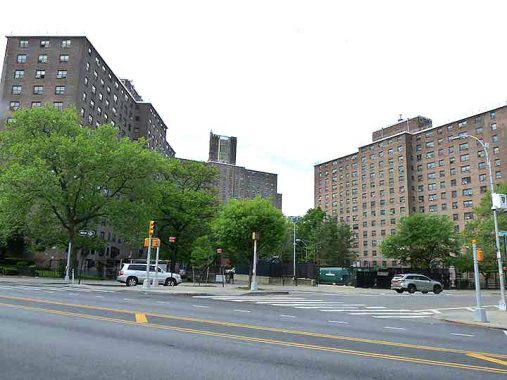
The adjoining John F. Hylan Houses were named for the NYC Mayor between 1918 and 1925. Hylan resided in Bushwick for many years in an attached house on Bushwick Avenue that still stands. He was defeated for reelection in 1925 by Jimmy Walker. His most visible legacy is in Staten Island, whose lengthiest street was named for him in 1923, while he was still mayor. The story goes that he had a dislike for the BMT subway, as he was fired from his job as a motorman on its precursor, Brooklyn Rapid Transit, after being caught reading law books on the job in 1897. The housing project was completed in June 1960.

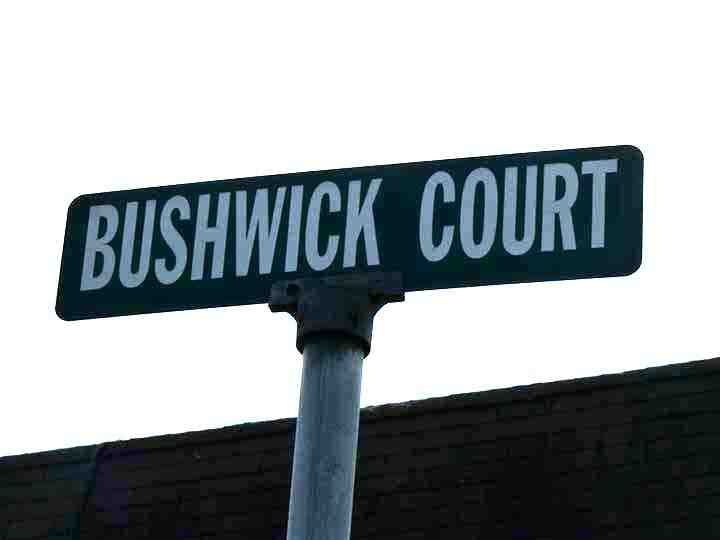
Prosaically-named Bushwick Court, Bushwick Avenue opposite Moore Street, is a relatively new addition to East Williamsburg, with attached homes featuring small “eyelet” windows on the 2nd floor. The court isn’t mapped by The NYC Department of Transportation, hence the nonstandard street sign.

I headed east on Moore Street, which is not named for Clement Clarke Moore (“A Visit from St. Nicholas”) whose ancestral family dwelt in Newtown across the creek, but instead for Thomas C. Moore, who according to Brooklyn By Name was an early 19th Century manufacturer of netting and wire sieves, who resided in the area.
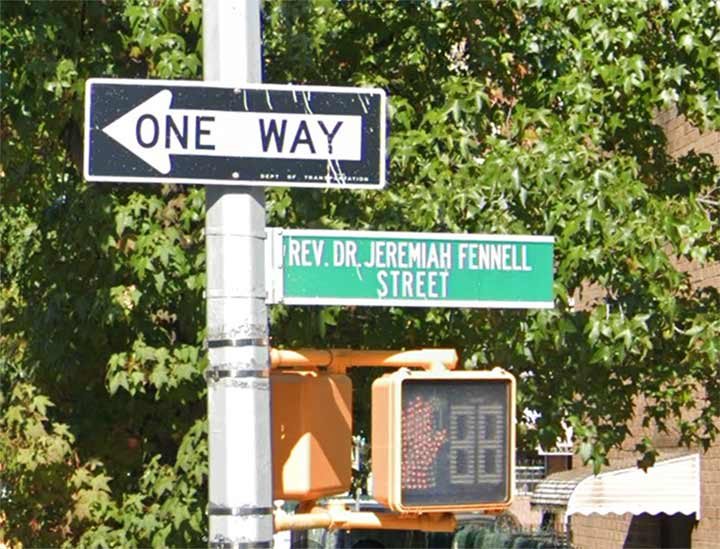
Between Bushwick Avenue and White street, Moore Street is subnamed for the Reverend Jeremiah Fennell:
Jeremiah Fennell (1938-1998) became pastor of Mount Calvary Church in 1966 and in 1978 was appointed Presiding Elder of Liberia, West Africa, where he organized 23 churches. [Oldstreets]
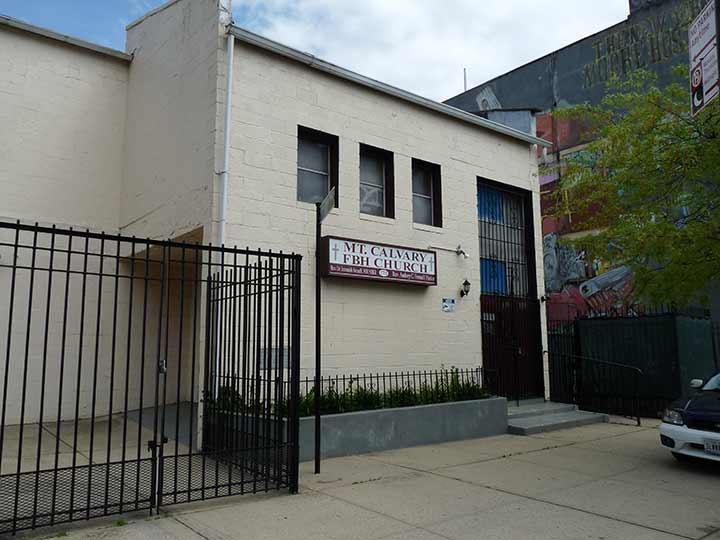
A second sign for Rev. Fennell can be found in front of Mount Calvary FBH Church. The FBH stands for “Fire Baptized Holiness.”
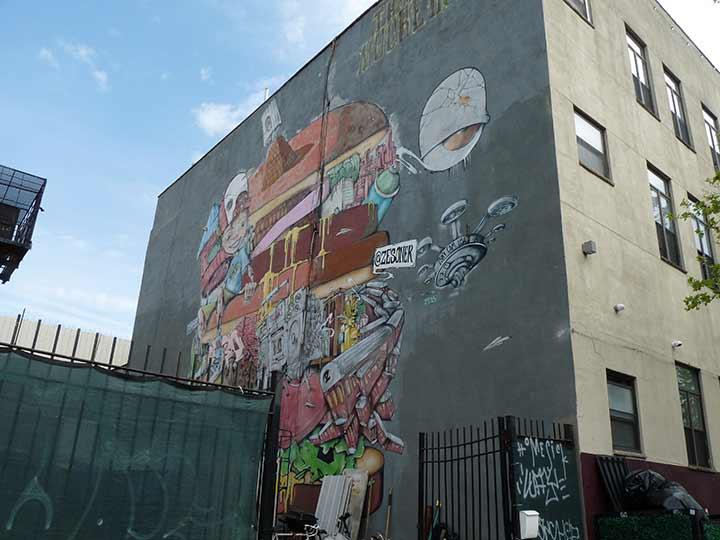


A former warehouse from which all early-20th century detail has been stripped off now serves as New York Moore Hostel affordable lodgings. The interiors seem bright and clean, albeit a bit bare-bones.
It was a great stay. Everything about this hostel is spot on. My room was clean and a joy to stay in. 4 Bed female dorm, not all bunkbeds, spacious. Has lockers. Private clean bath and shower shared amongst us. Quiet this day/night.
Staff are really good. Helpful and polite. The hostel has a homey layout, with furniture, TV, library, dining areas, vending machine and working kitchen.
I highly recommend, good value.
A hostel, according to Merriam Webster, is
an inexpensive lodging facility for usually young travelers that typically has dormitory-style sleeping arrangements and sometimes offers meals and planned activities


Walking Moore Street, there is an interesting mix of industrial scenes, colorful advertising and street art.
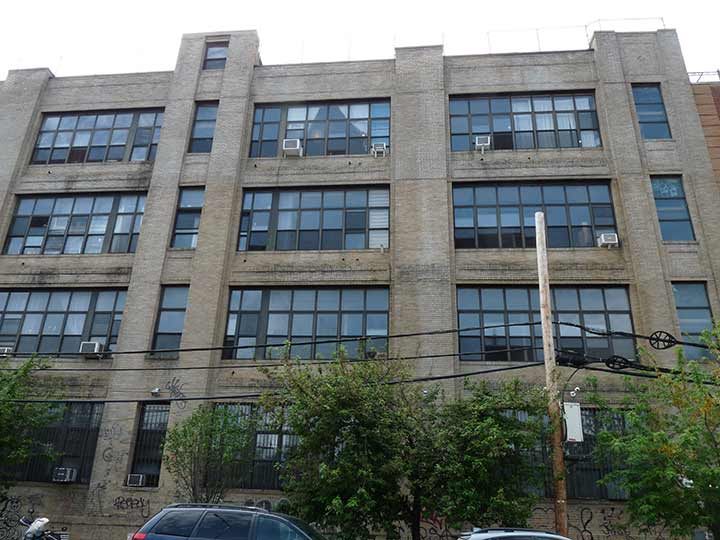
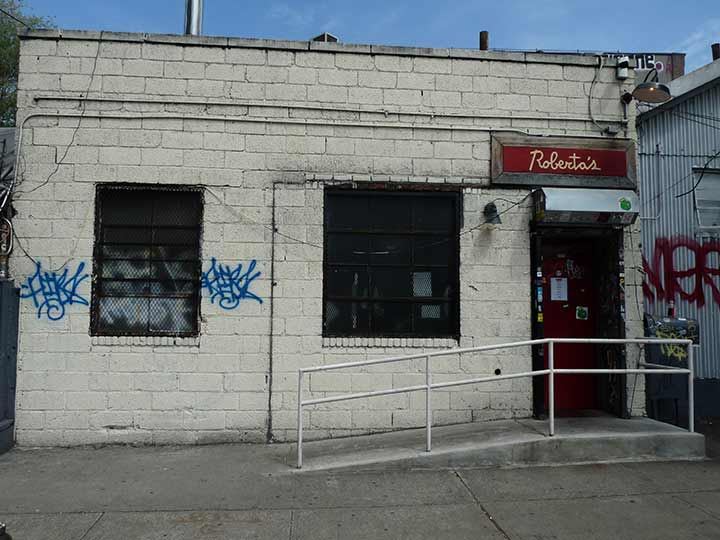

On gritty, dirty Moore Street, with its anonymous warehouses, you would never believe there is a gourmet pizzeria at the end of the block, near Bogart Street. Roberta’s is well-reviewed and homey (though noisy), with a large interior outside patio and even its own proprietary internet radio shack. The pizzeria was carved out of one of those nameless warehouses.
What more can we say about this razor-wire resort that hasn’t already been said? New Brooklyn pizzeria. Rooftop farmer. Erstwhile beekeeper. Bread bakery. Internet radio station. The place is a hillbilly-hipster juggernaut and a bit of a celebrity-chef magnet. Never mind the Clintons. Alice Waters kicked in cash to help grow the garden. And even French mega-chef Michel Bras came by one night to tuck into the fried chicken. It takes about 12 conversations with ten eccentrically clothed individual waiters to finally get one of them to bring you your Mini Famous Original pizza while seated at the outdoor tiki bar on a sunny weekday afternoon, but when it finally arrives, it’s a very good Mini Famous Original pizza, and you’re practically ecstatic. [New York Magazine]
I was interviewed by Mike Edison and Judy McGuire on their internet radio Arts & Seizures show on Sunday, July 17, 2011. Can so much time have passed since then? Sick transit, Gloria! Here’s my show. I’ve never heard the replay: I never listen to my own voice and I dislike being photographed. A bit of the Asperger’s, perhaps.
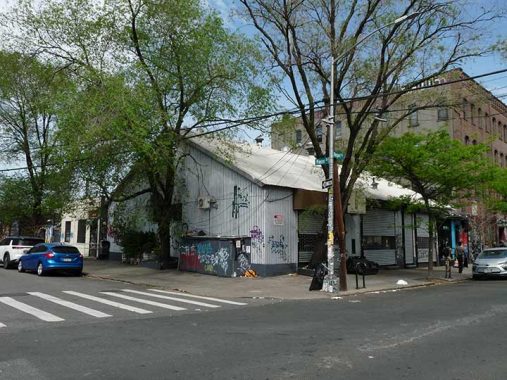
#43 Bogart Street, corner of Moore, looks like a recent addition with its corrugated metal exterior, but a 1940 tax photo indicates it was here that year. It presently harbors liquor store Big Tree Bottles.
Bogart Street is indeed named for the Dutch colonial immigrants whose later descendants included famed actor Humphrey Bogart. I’m not sure “Bogie” was aware of this street. He does appear on a street sign in the Upper west Side.
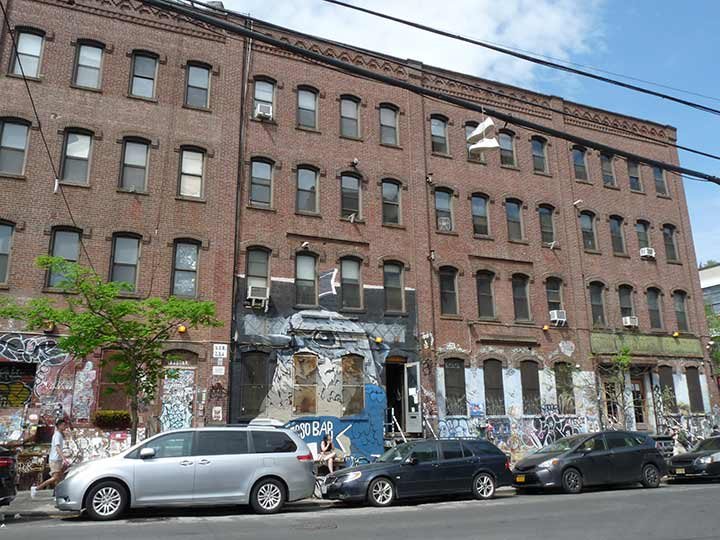
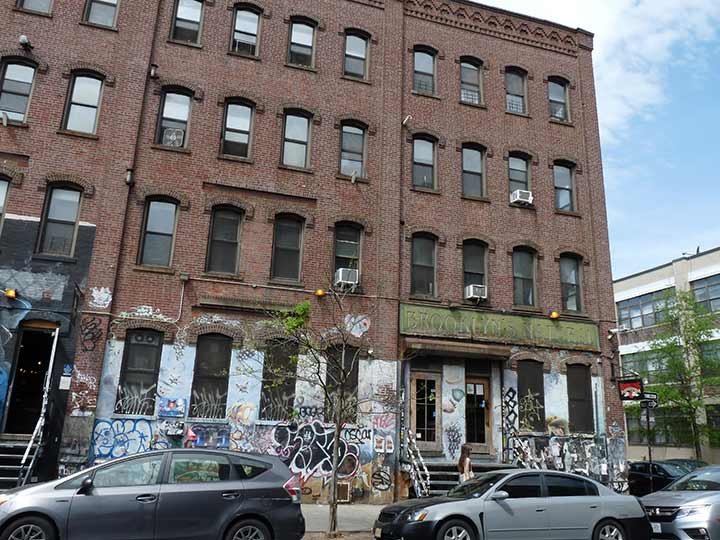
When in East Williamsburg I always check on this stolid 4-story brick building with a ground floor completely subsumed with spray can art, but with some interesting store signage as well. Three eateries/groceries can be found here, Momo Sushi Shack, Swallow Cafe and Brooklyn Natural. At one time it was the factory Williamsburg Stopper Company which I presume produced the rubber stoppers that formerly held water in sinks and tubs. A 1940 tax photo shows it with painted signs for “Consolidated Cork Corporation.” Now that’s alliteration!

I always check on this too. I have no idea what’s behind the wall on the SE corner of Grattan and Bogart but what I do know is that there a pair of glorious wrought iron lampposts behind it, one of which is seen here. This style was never used in NYC, so they must have been brought in from elsewhere.
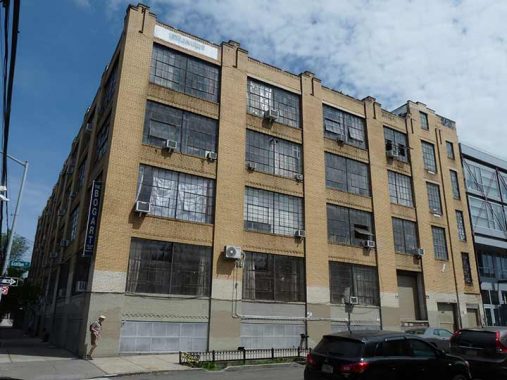
56 Bogart is a gigantic former factory that’s been converted into a four floor wonderland of artist’s studios and galleries [called the BogArt]. Always a good stop on the weekends and throughout the year for events like Bushwick Open Studios which attracts huge crowds of art-lovers and party-goers. Be sure to check out Studio 10, Momenta Art, Slag Gallery, Life on Mars Gallery, Soho 20 Gallery, Theodore:Art, and NURTUREart among other big names that call 56 Bogart home. [On the Grid]

#13 Grattan Street, a.k.a. The AnX (pronounced “annex”) was constructed from 2016-2017. Its website calls it “a state of the art building for artist and galleries / office / production / retail space.” It looks a bit out of place on gritty Grattan, but I imagine in 25 years the entire neighborhood will resemble this building. Just my guess, I won’t see it.
I like the picture windows, but the “x” shaped beams in front of them may be annoying if they interrupt the view out of them.
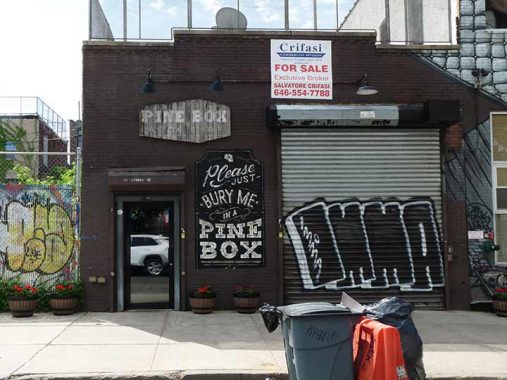
I would never have guessed it but Pine Box Rock Shop, #12 Grattan, is actually a vegan bar and local gathering place. “Back in the day” it was a casket factory, hence the name.

A few doors down, SEY Coffee, #18 Grattan, is also located where a former casket firm, Ocean Casket, was located in a building since knocked down. It’s a gourmet coffee joint, and the prices run high.
I have to say, I have never “gotten” coffee. I like the aroma more than the taste, which I find bitter. I have one or two cups a year, at a relative’s house for Thanksgiving and/or Christmas. My mother had a cup or cups of coffee daily, while my father was a two-fisted tea drinker: he’d have multiple cups per day, two teabags per cup, and would add evaporated milk or Golden Blossom honey to taste.

Semkeh, here since 2020, offers Lebanese cuisine. It has a #53 Morgan Avenue address but actually fronts on Grattan. Just goes to show, you can pretty much find any cuisine you desire here in NYC.
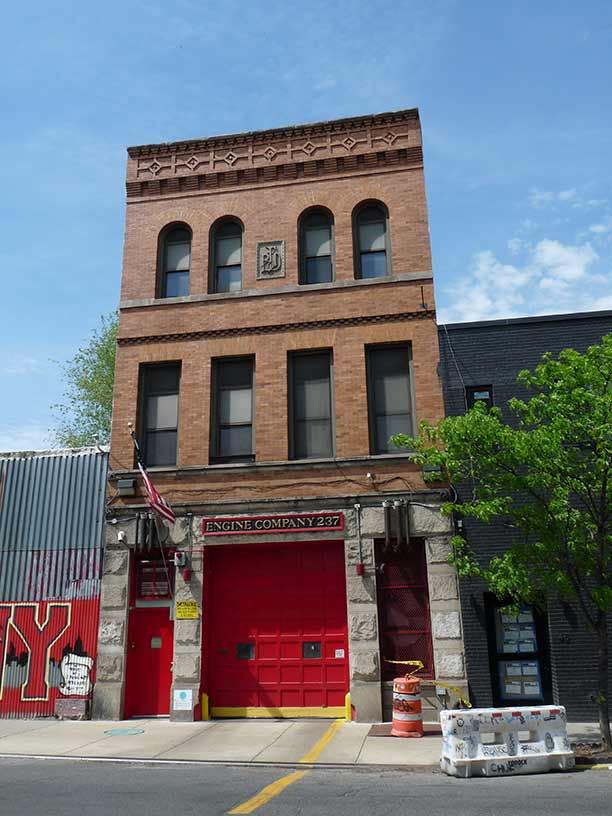

Engine 237, #43 Morgan Avenue just south of Grattan.
I’d do more FNY pages on northern Brooklyn firehouses, since no two seem to be the same and since most were built in the early part of the 20th Century, so they’re architecturally interesting. The Fire Department of New York has a website entry on all engines and H&Ls (here is Engine 237’s page), but seems to be resolute about not talking about the buildings or architects, preferring instead to concentrate on the important work conducted from them. However, the basics can be seen on those pages. Engine 37 was established in the Brooklyn Fire Department in 1895, became part of FDNY in 1898, and was renamed Engine 237 in 1913.
Especially in northern Brooklyn, many firehouses bear evidence of their former membership in the BFD. Engine 237 has this marvelous concrete trigraph with the most amazing letter “B” you’ll find anywhere. I challenge designers to run up a typeface based on these three letters.
The BFD was established in 1869 and continued until 1898, when Brooklyn became part of Greater New York and the BFD was absorbed into the FDNY.
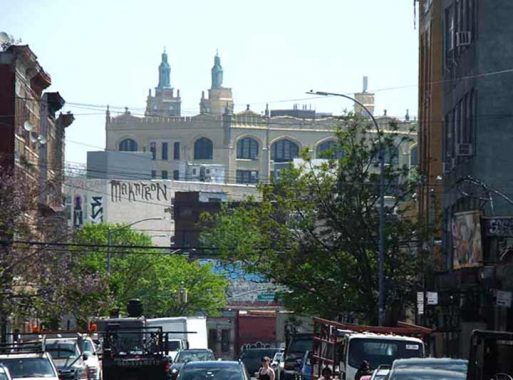
I have a new camera with an improved zoom. Looking east on Thames Street from Morgan, I noticed a pair of structures at the extreme horizon and zoomed in. The building in the foreground is PS 162 at St. Nicholas and Willoughby Avenues, and behind it are the towers of St. Aloysius Church, Onderdonk Avenue at Stockholm Street, visible from across the creek in Maspeth.
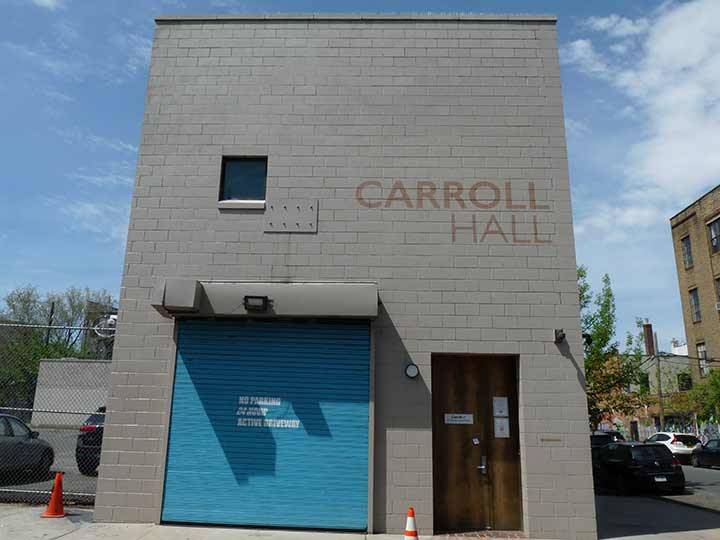
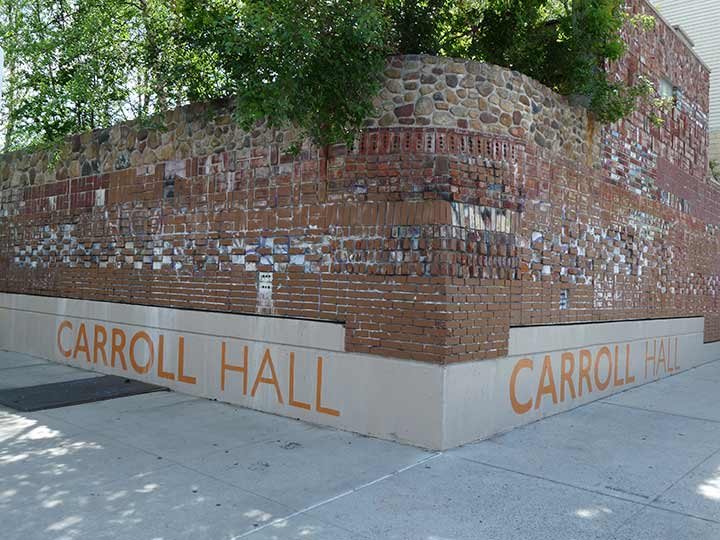
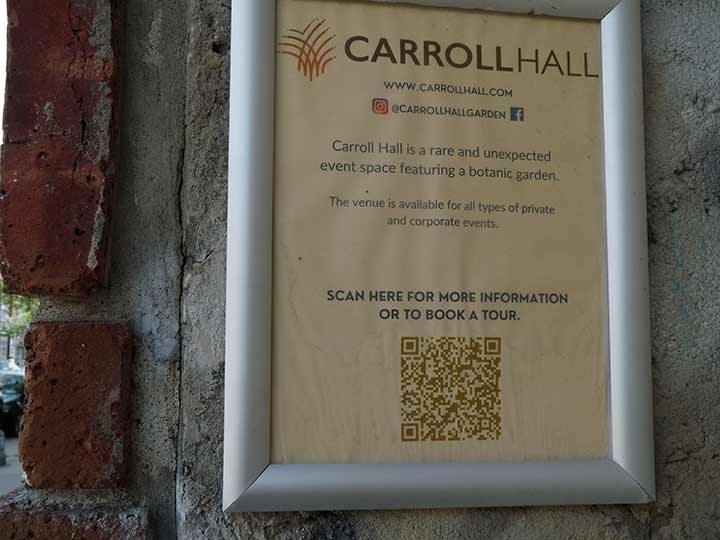
Carroll Hall is a new caterer and event space on Thames Street between Morgan Avenue and Vandervoort Place. The website has some glimpses behind the wall.
Deeply inspired by our family, we created Carroll Hall as a quiet retreat among plant life, birds, insects, and urban wildlife. From our reverence for nature, thought behind the sustainable design, unique visual elements throughout the space, and in the name, our family is present.
Discovery, wonder, and the unexpected are important to us and are strongly represented in the garden and spaces. Fountains flow and collect rainwater; mosaic murals tell stories of underground creatures; moving walls and secret doors set the bar for discovery. We revel in curiosity and hope Carroll Hall rewards yours.
Carroll Hall exists on Lenape land. The site has been farmland, dairy production, ice cream factory, cigar rolling factory and most recently, a refrigerated dairy warehouse in this district of light industry. Elements of recent iterations are used in the current construction: walls of ceramic, brick and rubble, and most of the interior wood is reclaimed from the site. [Carroll Hall]

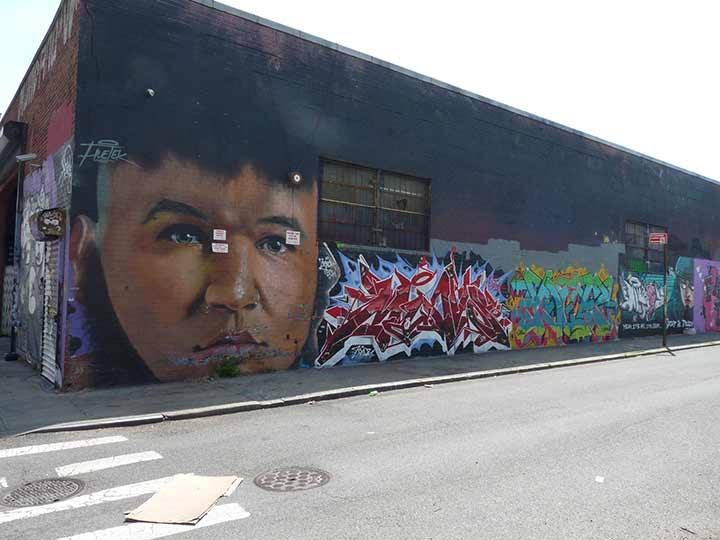
Some more street art samplings, on Thames Street at Morgan Avenue and Vandervoort Place.
Knickerbocker Avenue
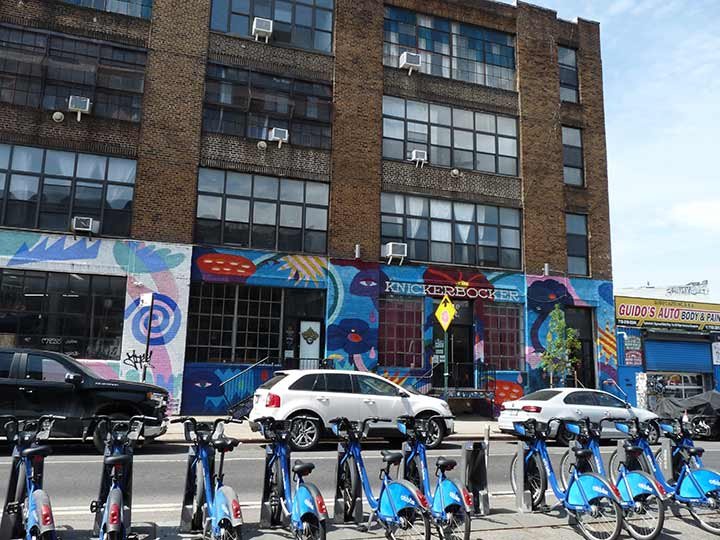
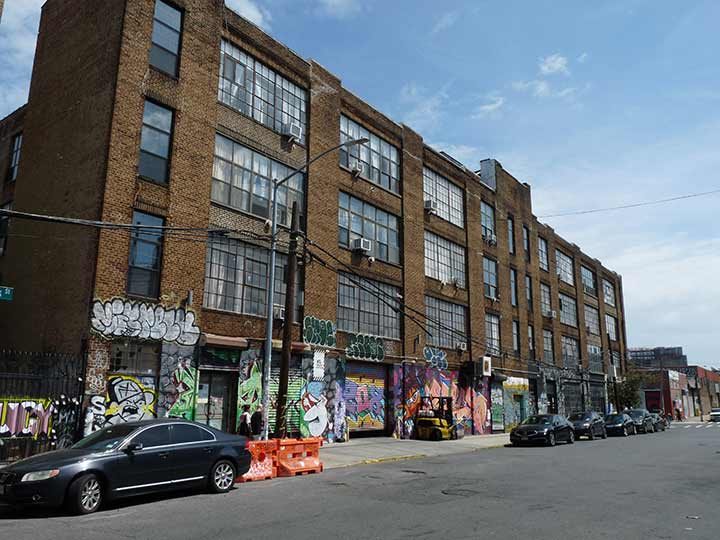

#92-96 Knickerbocker Avenue, NW corner of Thames, is another one of the area’s many massive brick, many-windowed buildings that was probably used for manufacturing as its original purpose but now is populated by many small businesses and perhaps some artists’ lofts, that include Knickerbocker BBQ Bar, Stems Florist and Standard Grooming.
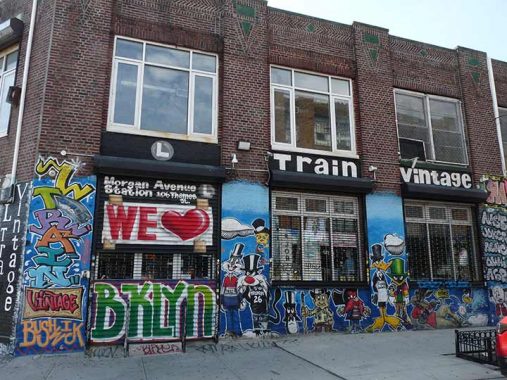
L Train Vintage, #106 Knickerbocker, south side of Thames Street. The nearby L train entrance is at Morgan Avenue and Harrison Place.
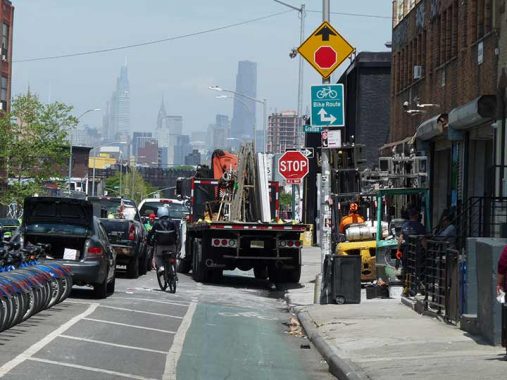
Somewhat hazy conditions, but I was able to identify One Vanderbilt and the Chrysler Building in the Manhattan skyline. Manhattan’s older skyscrapers are losing visibility as newer, taller towers overshadow them.
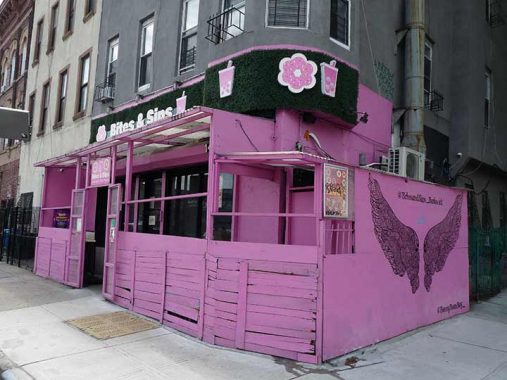
Pretty in pink? Or perhaps magenta. Clearly, Bites & Sips, Knickerbocker Ave. and George Street, believes it is.


I found the nearly obliterated signage above the door at #169 Knickerbocker, at Melrose Street a bit puzzling, but I discovered more about this Bushwick mystery, as well as the shul a few doors down.

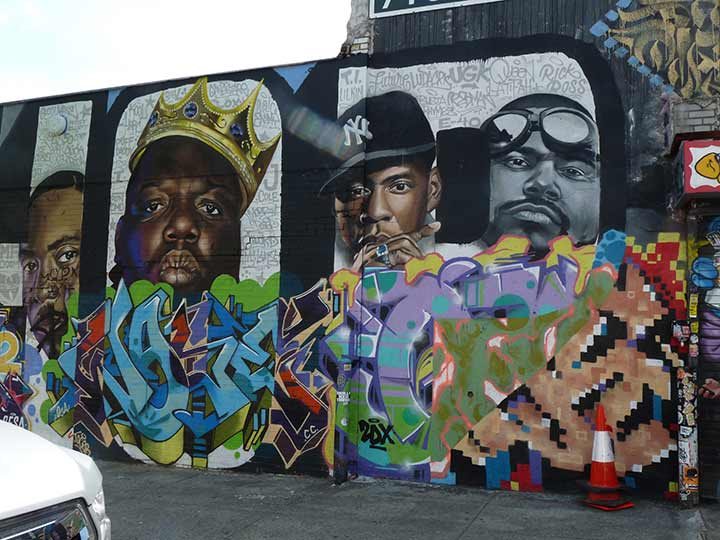
50 Years of Hip Hop mural, Troutman Street at Knickerbocker:
The mural was created by artists from the menaceresa collective, including Meres One and Marie Brittany, and was inspired by the 50 Years of Hip Hop concert at Yankee Stadium in August 2023. The run-up painting was also created with other heavy-hitter artists.
The artists painted a large “run-up” (a type of mural that covers a large area) that features portraits of hip-hop legends and celebrates the genre’s history. Figures such as Tupac, The Notorious B.I.G., Snoop Dogg, Lauryn Hill, Eminem, and Jay-Z are included in the artwork. [Google AI robot]

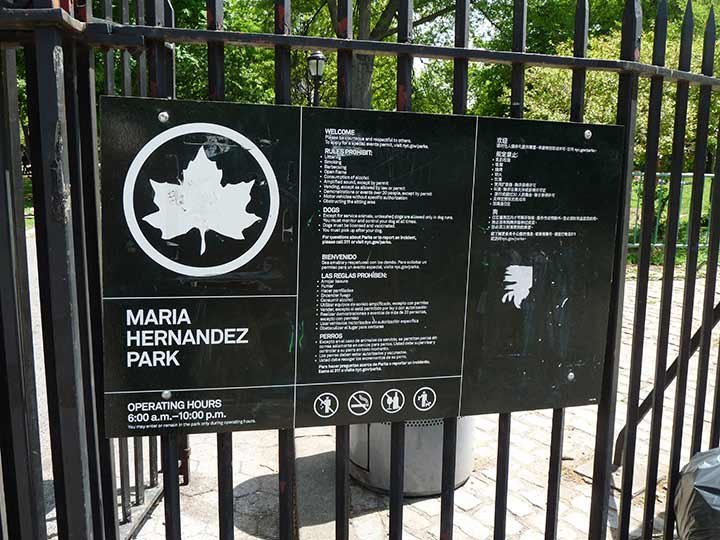

For a brief rest I sat for a bit in Maria Hernandez Park, formerly the prosaically-named Bushwick Park, the neighborhood’s premier green space, bordered by Knickerbocker and Irving Avenues and Starr and Suydam Streets.
In May, same month I visited, Sergey took an in depth look at the park.
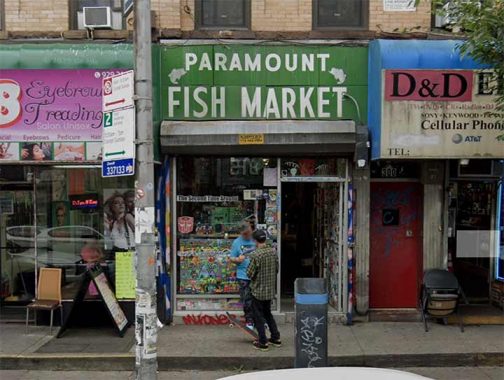
How did I miss this? I did. In any case, Street View has it, a grand old sign for Paramount Fish Market, Knickerbocker south of Suydam. There hasn’t been a fish market for a long time. When thrift shop Second Time Around moved in in 2011, they first installed an awning sign, then uncovered the old sign, and left it up ironically. The Street View is timestamped 2024, and Yelp reports the location has closed, so perhaps the sign has been re-covered already.
1940s.nyc shows a fish market in this location, but not the sign.
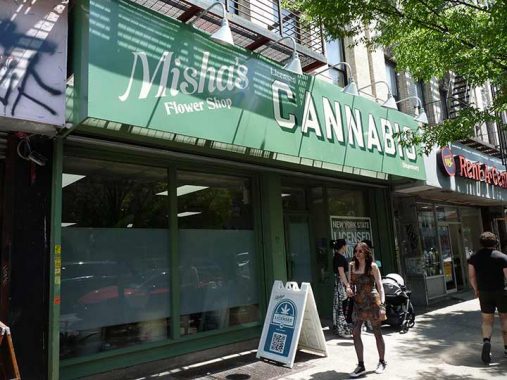
#299 Knickerbocker is Misha’s Flower Shop and Cannabis Dispensary. This handlettered sign bears the earmarks of Noble Signs at the New York Sign Museum. I don’t smoke pot—the stuff stinks— but I recognize it has uses in pain and glaucoma relief and other medicinal purposes.

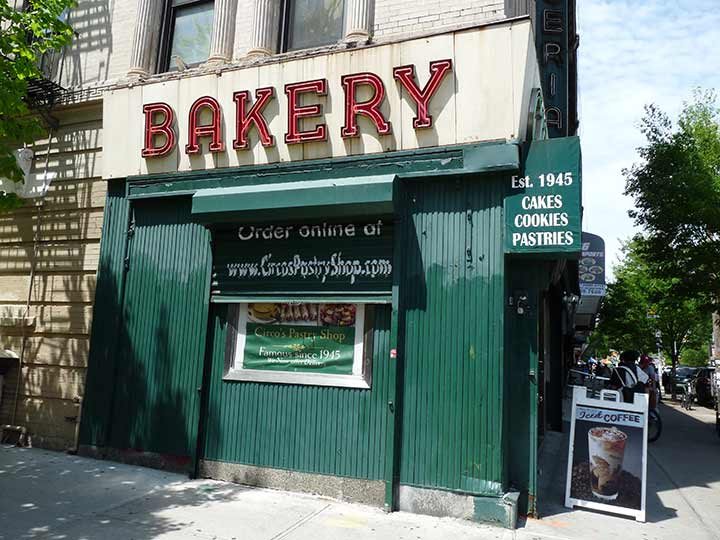

If you’re talking signs, the king on this block is Circo’s Pasticceria (Bakery) on the corner of Knickerbocker and DeKalb. Circo’s Bakery, at 312 Knickerbocker Avenue at Hart Street, has been a Bushwick fixture since 1945, according to the store’s website. Original founder Circo sold the shop to two longtime bakers in 1973, and one of them, Nino Pierdipino, still runs the shop with his two sons Salvatore and Anthony.
The sign may or may not be 1945 vintage, but it’s at least a few decades old. A two-sided vertical neon sign appears over the main sign. Since dolce is “sweet” in Italian, we may translate this as “place where sweet items are produced.”
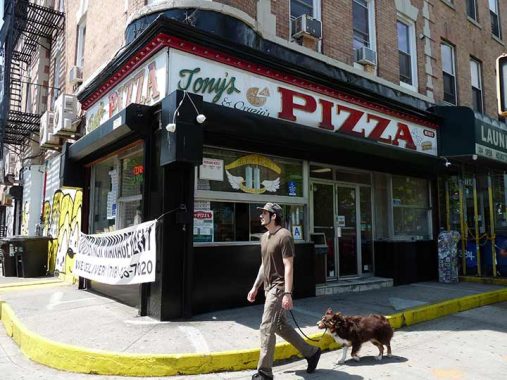
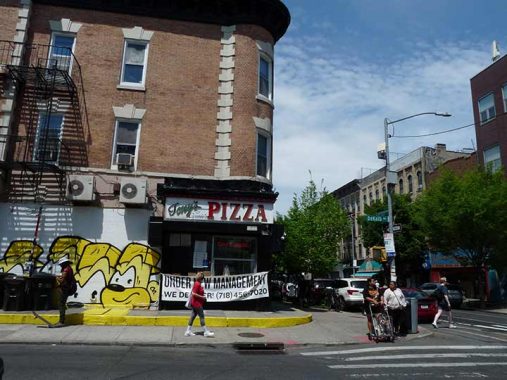
And the signs just keep on’ comin’! Like at Tony’s (& Orazio’s) Pizza, corner Knickerbocker and DeKalb Avenues. I like extended-letter fonts, and “pizza” is a short word, so it’s extended here. May Italian eateries have signs in red, white and green, Italian flag colors. According to its website it has been in business since 1969.

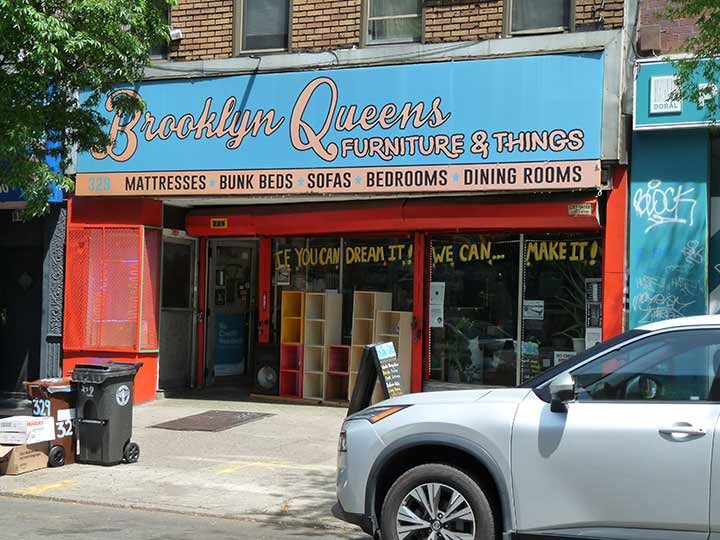

Art and signage sampler, Knickerbocker Avenue between Hart Street and Stockholm Street
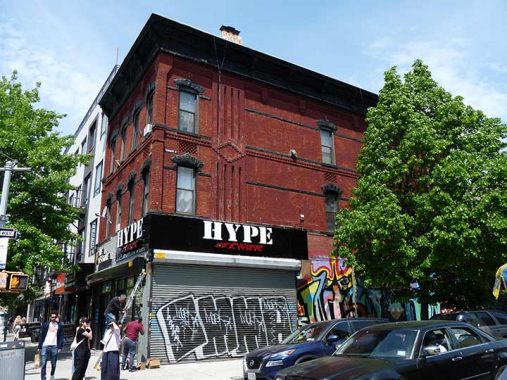
I noticed a very faint painted ad on this building at Knickerbocker and Stanhope street. It was faded even in 1940, but I was able to make out one word: Sarnoff. It likely had nothing to do with David Sarnoff, the founder of RCA.

Since Myrtle Avenue cuts across the Bushwick-Ridgewood street grid, a number of triangle-shaped plazas were created. In recent years the Department of Transportation has turned these into vest pocket parks with benches, lampposts and plantings. From here, I turned left on Greene Avenue and immediately saw…
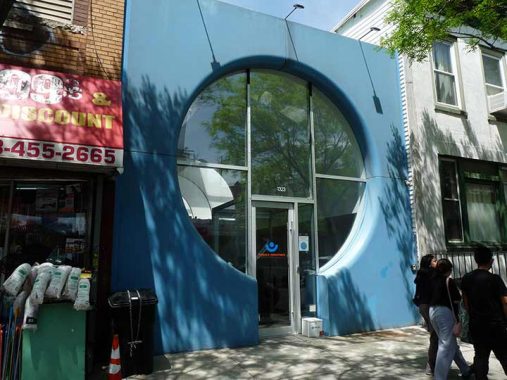
This amazing building front with a circular window was built for a branch of Tribeca Pediatrics and constructed from an existing building from 2019-2020. The interior is bright and features primary colors to brighten the mood of the children treated here. Sadly, I do not have architectural or construction details.
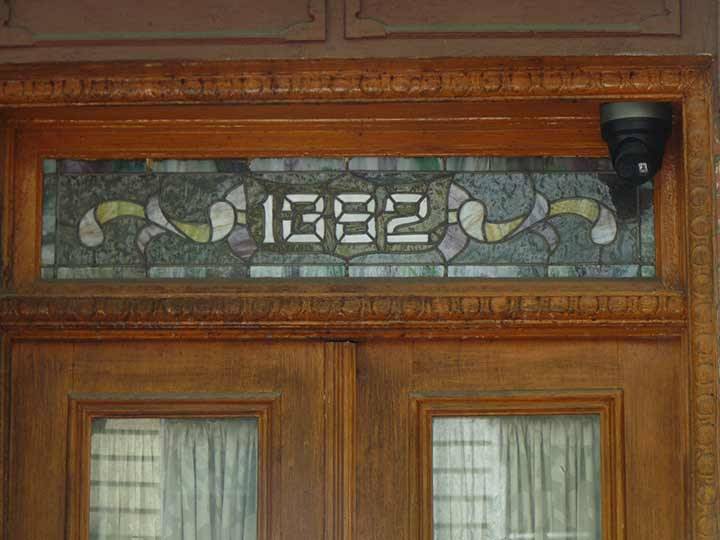
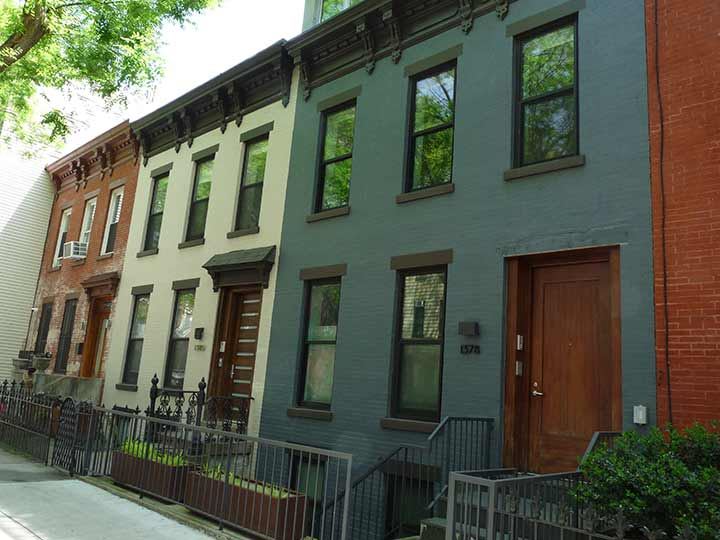
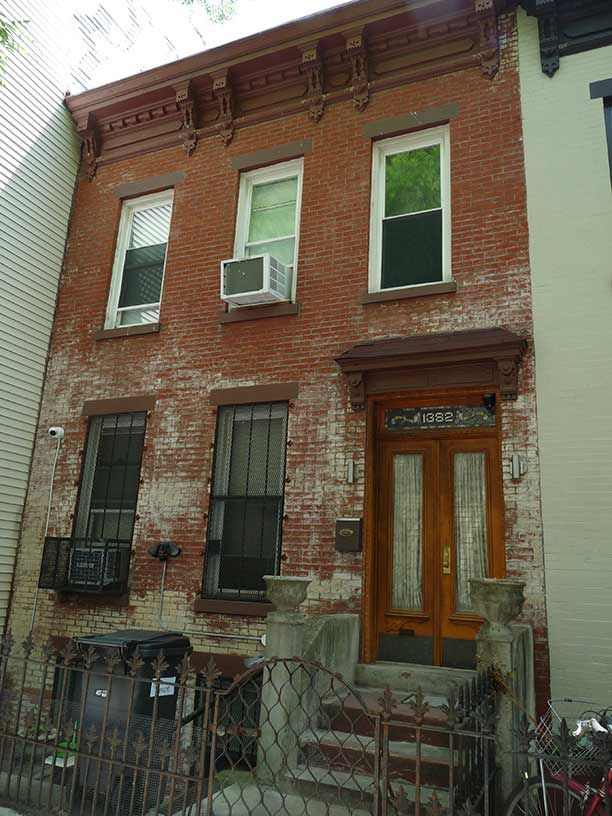
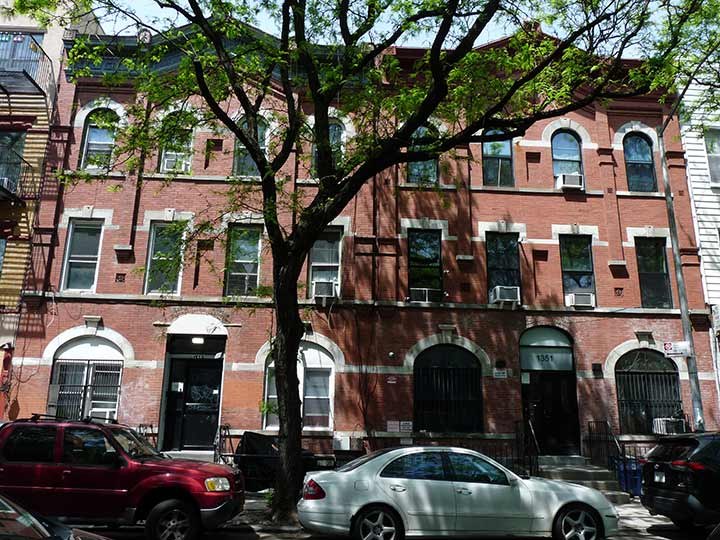
A sampler of the bread-and -butter residential architecture on Greene Avenue between Knickerbocker and Irving. #1382 could use a bit of repair, but has some exquisite etched glass work showing the address number in the transom.

Imaginative woodcut signage for Bushwick Finest barber on Irving Avenue between Greene and Bleecker.
Bleecker Street, of course, shares a name with Bleecker Street in Greenwich Village and is often misspelled “Bleeker.” The name means “bleacher” in Dutch, from bleaching clothing. In Bushwick, the name probably refers to the Dutch colonial family whose first North American resident was Jan Jansen Bleecker (1641-1732) from whom Anthony, who owned property in what became the Village, was descended.

Attached 3 story walkup apartment buildings on Bleecker between Irving and Wyckoff. I liked the arched doorways and 3rd story windows.
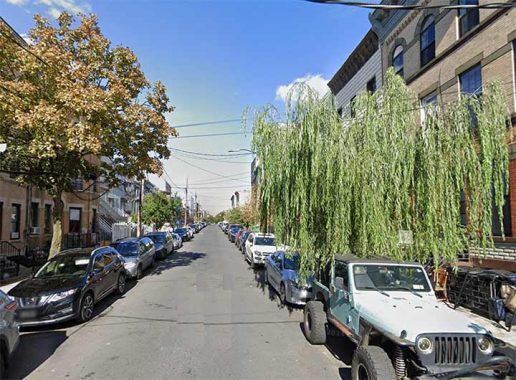
In NYC weeping willows are not often used as curb trees, as they tend to spread out wide, and are instead found in large yards or parks; but Bleecker Street has one.
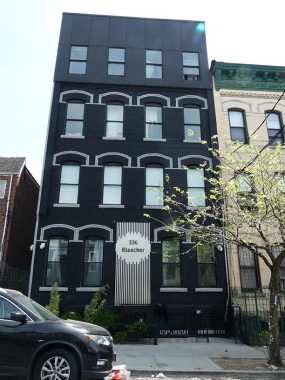
336 Bleecker has had an ambitious dark gray and white makeover. In 2020, it looked like its next door neighbor. Rents for 2 or 3 bedroom apartments in this region, especially in recently renovated buildings, is $4500-$5000.

Since 2019, #347 Bleecker has had the blues; that year it was drenched in that color. The duplex to the left is #345A-347A, followed by #347. Thus unusual sequence came about because they are relatively new buildings constructed in the cut of the old LIRR Evergreen Branch, which was a freight line used until the 1960s; the cut lasted for about 20 years after that.
Lots of detail has been stripped off #347 over the years. In the 1940s photo, you can see the next-door railroad cut.
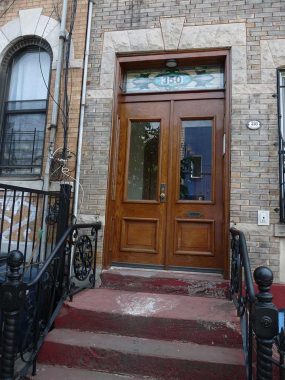
I knew I didn’t miss another bit of premier etched glass on the transom at #350 Bleecker. Also see those large lintels and keystones, and original stoop railings.

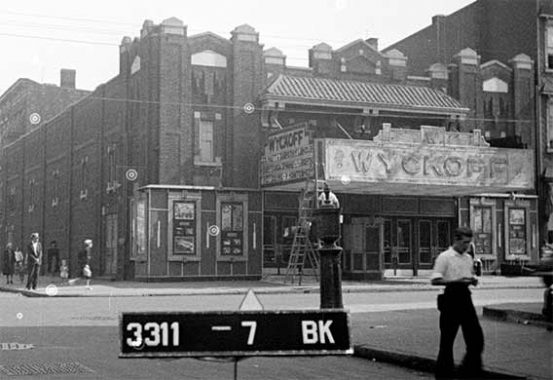
Kingdom Hall Jehovah’s Witnesses, Bleecker Street at Wyckoff Avenue, formerly Wyckoff Theatre.
The Wyckoff Theatre stands at the eastern corner of Wyckoff Avenue and Bleecker Street, in the Wyckoff Heights section of Bushwick, Brooklyn. It was opened on May 8, 1915 with “God is Love”, and was designed by architect Walter B. Wills. In September 1918 alterations were carried out to the plans of architect Eric O. Holmgren. The Wyckoff Theatre was closed in 1951. It was before my time, so my earliest memory of it is as a Jehovah’s Witnesses Hall, about 1960 or 1961, a use which continues in 2019.
My oldest aunt went there with her mother to see “Seven Brides For Seven Brothers” in 1954 or 1955 for an adult admission of ten cents. It was not air conditioned at first, but my oldest aunt recalls going there as a kid in the late-1920’s and 1930’s for a nickel, and having a “grand old time” there, seeing double features with cartoons, newsreels and short subjects. [Cinematreasures]
Running from Flushing Avenue to Cooper Street, Wyckoff Avenue, named for a Dutch Colonial family, there’s a Wyckoff Street in Gowanus) is completely in Brooklyn up to Gates Avenue, and then the Broooklyn-Queens line runs down the middle to George Street (Queens) and then completely in Queens till it ends. Here, I should remind you that there is a George Street in Bushwick (Brooklyn) and a George Street in Ridgewood (Queens) that can’t be mistaken since they’re about a mile and a half apart, and that there is both a Jefferson Street and a Jefferson Avenue in Bushwick. The two are 22 blocks apart, and neither can be mistaken for the other, but both encounter Wyckoff Avenue and its brother Bushwick and Ridgewood avenues.
Any old-time readers from the area remember when NYC was using color coded signs, and on the borough border on Wyckoff, where there black/white Brooklyn signs on one side and white/blue Queens signs on the other? If you have photos of this, let me know. Today, this undefended border is absolutely seamless, and Ridgewood to some degree even retains Bushwick’s house numbering until numbered streets take over further east as you get close to Glendale.
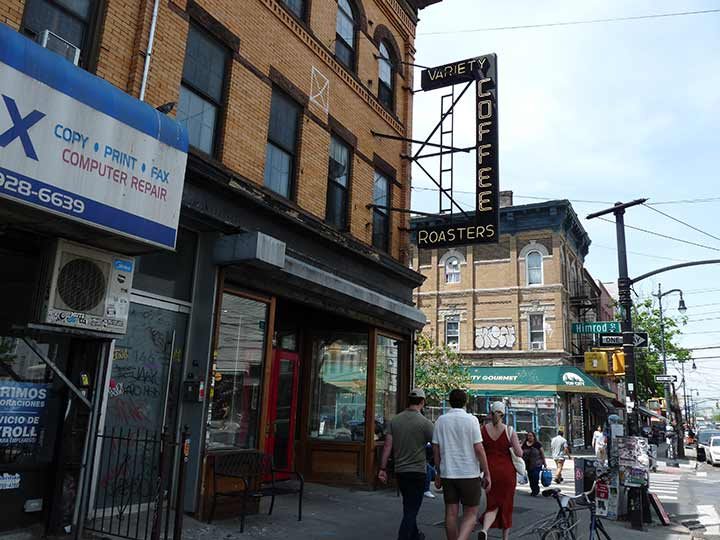
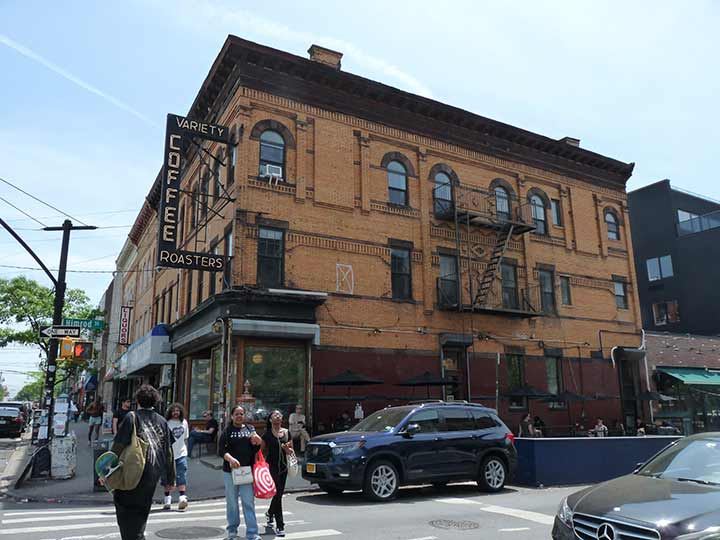
In 2014, Variety Coffee Roasters took over the space formerly owned by Wyckoff Paint Fair at Himrod and Wyckoff, which as you can see on FNY’s 2008 Wyckoff Avenue page, had some amazing wood cut letters on its sidewalk sign, as well as a C-shaped neon sign on the corner. Miracle of miracles, Variety Coffee has kept the neon sign structure and changed it to a sign of its own.
The 1200-square-foot space sits on a sunny corner of Wyckoff just south of the L train, on a strip largely populated by Latin American groceries and old-school businesses–nothing too fancy. The renovation of the airy space includes a new storefront, hand-built bar, and a custom chandelier (Variety is and has always been all about the chandeliers) from Conant Metal & Light in Compton’s home state of Vermont. (Those handsome industrial sconces above the roasting area in back are, on the other hand, utility lights from Home Depot.) Only the refinished brick interior remains of the original space. [Sprudge]
Since I have retained the tastes and preferences I had as a 12-year-old, as I’ve mentioned earlier, I have never become a coffee drinker, which means I am missing out on “sample roasting” and “Piero cap upgrades” mentioned elsewhere in the article. I’ll stick to Snapple.
With my lower back acting up, it was time to sit down…on the train.
Check out the ForgottenBook, take a look at the gift shop. As always, “comment…as you see fit.” I earn a small payment when you click on any ad on the site.
9/28/25
5 comments
Weeping Beech trees are beautiful, but create significant problems as street trees. They like lots of water and their root system agressively seeks it out. They will penetrate sewer lines and cause serious clogs and breaks. They are usually planted in parks and on on golf courses in wet or marshy areas.
Nice shot of St. Aloysius towers. I was married at that church.
I don’t know if George Street intersects anywhere with Jefferson but if it does, they should rename that intersection “Sherman Hemsley.”
Last time I walked by Welling Ct had taken a dive as a graffiti destination due to gentrification. The previous graf prime destination, Drake Ave in Hunts Point, has also faded in popularity. It seems Bushwick around Troutman and Jefferson has sucked up all the graffiti energy these days.
Boone Ave also with plenty street art