
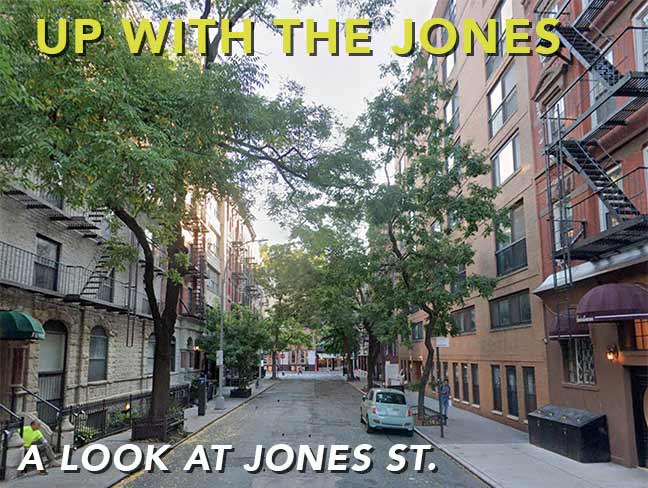

In the complicated Greenwich Village street layout, Jones Street, along with Cornelia, is a one-block street between West 4th and Bleecker west of 6th Avenue. It was named for Dr. Gardiner Jones, on whose land the city constructed the street in the early 1800s. Great Jones Street, running between Broadway and the4 Bowery in the place of East 3rd Street, and the intersecting privatized Jones Alley were named for his brother-in-law, a renowned lawyer, Samuel Jones. (The “Great” in Great Jones Street refers to its relative substantial width in comparison to the usual in the 1800s, not lawyer Jones’ fame.)
The Greenwich Village Jones Street’s most well-known appearance was on the cover of “The Freewheelin’ Bob Dylan” in which the songsmith is seen walking with his girlfriend, the late Suze Rutolo, on a snowy day in 1962. While a “Mr. Jones” appears in a later Dylan song, “Ballad of a Thin Man,” Dylan stated he was writing about a specific person not named Jones; since he wanted a generic name, he may have decided to use the relatively anonymous-sounding Jones Street in the Village.
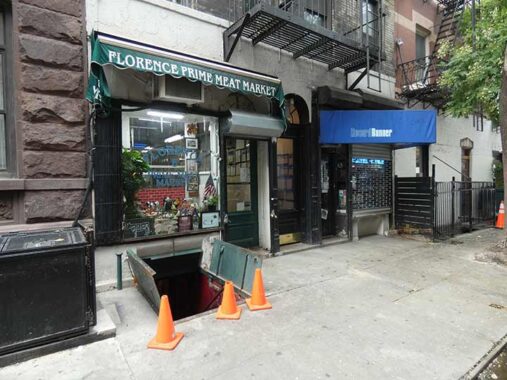
Florence Prime Meat Market at #5 Jones Street has been in business since 1936 and survived a threatened closure in 2022. Its awning sign is set in the Benguiat font.
The meat hooks, counters, and enameled cast iron panels on the wall date to when this neighborhood was a hub of New York’s Italian-American communities. The sawdust on the floor isn’t a stylistic nod to a traditional butcher, it’s what they’ve always done at Florence. [Eater]
Record Runner is also a longstanding Greenwich Village institution though not quite as long; this location opened in 1984, and an earlier location a block away on Cornelia opened in 1979. Record Runner sells vinyl almost exclusively. Citing better sound qualiy, many have moved back to vinyl in recent years; the Rolling Stones plan to release a vinyl-only single in 2026.
Sorry to say, when I began collecting vinyl in the 1980s, Record Runner wasn’t my go-to: I patronized Venus and Sounds on 8th Street-St. Mark’s Place, and also an occasional Sunday pilgrimage to Tower, from where I would tote home stacks of wax in their familiar yellow plastic bags. Everyone knew where I had been.
The Renaissance Revival #5 Jones was built in 1898, replacing earlier Federal style row houses, some of which still survive on the block.
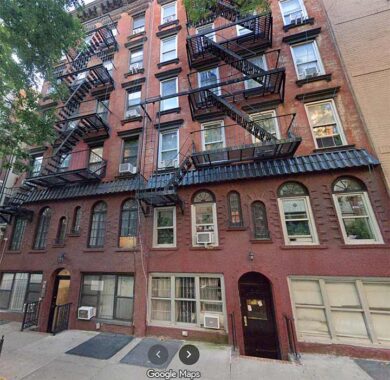
I was struck by the twin #6 and #8 Jones because of the arched entrances and offset narrow arched windows above them. The dwellings were completed in 1872, but given their current exterior appearance between 1915 and 1930 and received “received features evocative of bohemian‖ character, such as studio windows” according to the Landmarks Preservation Commission Greenwich Village Historic District Extension II Report.
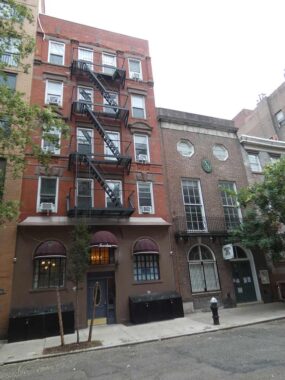


#14 Jones, left, “This altered Queen Anne style multiple dwelling … “was designed as French flats for twenty families by architect Charles Rentz in 1887.” Its ground floor was updated in 1929.
#16 Jones, bearing the date of construction on a cornerstone, was the second building designed for the Greenwich House Settlement by Chester Aldrich, of the prominent architectural firm of Delano & Aldrich. The building was originally a trade school for boys, with training in woodworking and stone carving. Since 1948 it has housed Greenwich House Pottery, which
“offers a ceramics program for every level of practice and discipline, including wheel throwing, handbuilding, mold making, slipcasting, and special topics.” [Greenwich House Pottery]
The pottery was founded in 1909 on Barrow Street. The upper-floor identifying cartouche was designed by faculty member Peter Gourfain in commemoration of the 100th anniversary of the founding of Greenwich House in 2002. Its Latin inscription argilla potest servare vitam tuam means “Clay can save your life.”
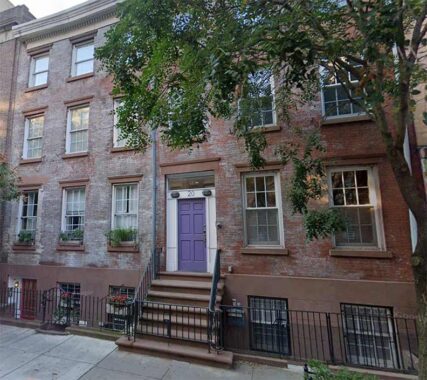
#18-20 Jones street look old and they are, as they go back to 1844. They were built for early developer George Schott with renovations in 1947 and 1993. The ever dependable Tom Miller, Daytonian in Manhattan, here details the residents of #20 over the decades. For several years, the buildings were an extension of Greenwich Settlement House, which sought to improve the lives of local impoverished residents.
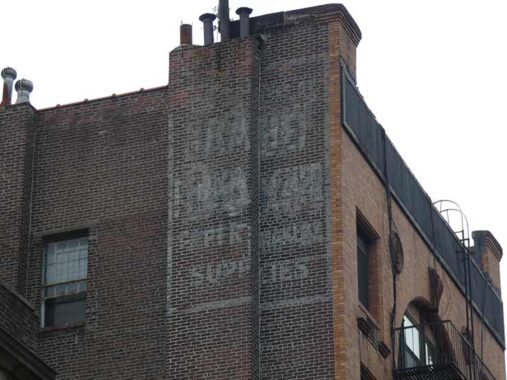
#22 Jones displays a painted ad, a palimpsest that I can’t make out. Also of interest, and also nearly unphotographable, are the terra cotta medallions with the digraph “SS” for 1895 developers George Schenk and A. W. Schlichte.
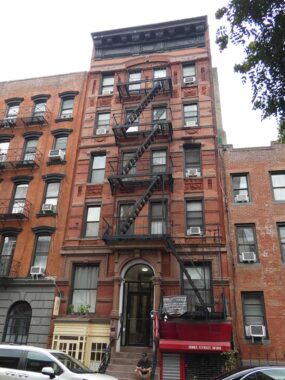
#23 Jones, built in 1891, is a prototype of the larger multiunit apartment buildings that would proliferate in subsequent decades, a master class in brick and terra cotta construction.
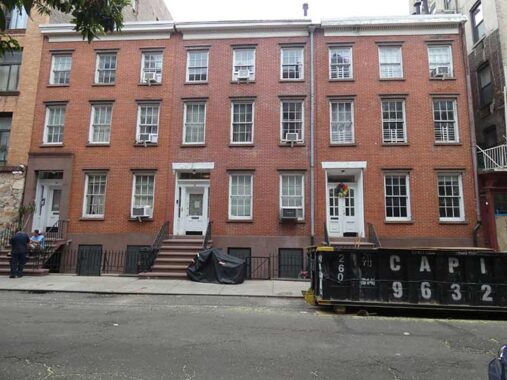
Sorry about the dumpster in the photo but I can’t do anything there. #26-30 Jones, the handsomest trio on the block, are iied for the oldest, reaching completion in 1844. Both #26 and 28 have retained original Doric pilasters and all have 6-over-6 window panes.
from the LPC Report:
“In November 1902, no. 26 became the first home of Greenwich House, a settlement house founded by Mary Kingsbury Simkhovitch. Mrs. Simkhovitch, a social worker, moved into no. 26 with her family and five female residents who, with their colleagues, would establish classes and social services for the working families of the neighborhood and conduct social surveys. By 1905, nos. 26 and 28 Jones Street were purchased by the Cooperative Social Settlement Society of New York
220 City as part of the Greenwich House holdings. Sixteen years later they were converted into the Greenwich House Co-operative Apartments.”
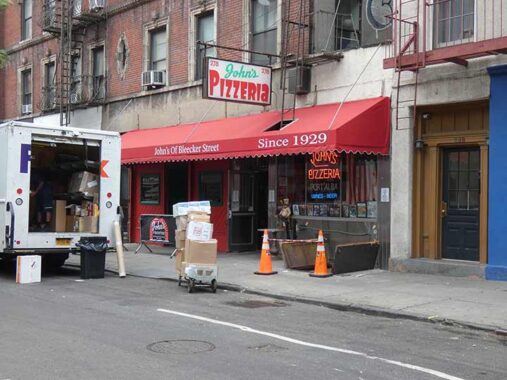
Part of Bleecker Street’s charm is the presence of longstanding businesses who have been supported by residents for decades, instead of impersonal chain stores. John’s Pizza has been here at Bleecker and Jones since 1929, enough time to craft a recipe that is recognized by many as NYC’s best pizza, though that honor is largely subjective. Original owner John Sasso learned the craft from NYC’s first “pizzaiolo,” Gennaro Lombardi, whose legacy pizza place can still be found on Spring Street.
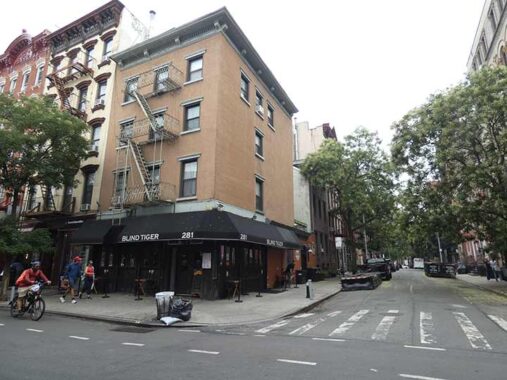
“A ‘blind tiger’ is slang for an illicit saloon or speakeasy that sold alcohol illegally, particularly during the U.S. Prohibition era (1920–1933). These establishments often disguised themselves as other businesses, such as ‘museums’ featuring exotic animal attractions (like a ‘blind tiger’ or ‘blind pig’) to sell complimentary drinks and circumvent strict liquor laws…The phrase was a way to describe an establishment that was “anything but blind” to the law, but rather hid in plain sight.”
Blind Tiger, on Jones and Bleecker, has been in business since 2006 and was a pioneer in the craft beer trend.
Check out the ForgottenBook, take a look at the gift shop. As always, “comment…as you see fit.” I earn a small payment when you click on any ad on the site.
4/14/26