

In mid-August I was looking for a walk that wasn’t too taxing yet would get my steps in. I have been undergoing PT since early August and will be wrapping up the in-gym work this coming week, whereupon I will begin training at home. Today I marched 5 miles along the Hudson waterfront with a minimum of discomfort, so maybe it’s working. On the August walk, I took the Queens Boulevard line to 71st/Continental and walked north to the #7 111th Street station, with most of my route along 110th and 108th Streets.
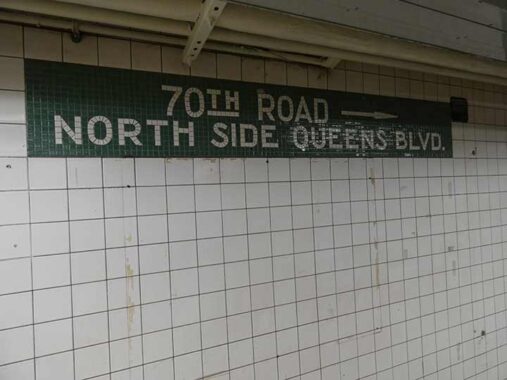
Many IND stations were built with extremely large mezzanines, actually overbuilt in my opinion, like the new Second Avenue Q train extension stations that opened in 2017 and the new Grand Central LIRR connection opened in 2022. Less can be more.
The mezzanine did give IND sign designers (Squire Vickers had a hand in it) a chance to design smaller tiled directional signage. I have taken a keen interest in these of late and show them off whenever I find them.
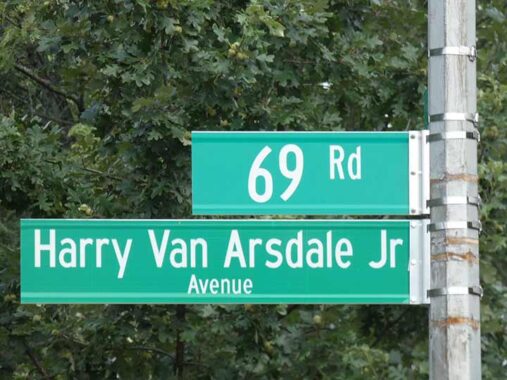
164th Street in Flushing is the east end of Electchester, a massive mid-Queens housing project originally built for electrical union workers in the 1940s.
The middle-income project was spearheaded by Harry Van Arsdale, Jr. president of Local 3 of the International Brotherhood of Electrical Workers. Another part was managed by the City Housing Authority who built the Pomonok Houses, among other developments. Electchester was the latest in a series of housing projects built for specific categories of unionized workers, joining the Amalgamated Houses, Bronx, and Seward Park Houses, Manhattan (garment workers); Concourse Village, Bronx (meat cutters); Big Six towers, Woodside (printers and lithographers).
East of Flushing Meadows, HVA Jr. Avenue switches allegiances to Jewel Avenue. Older signs put the two names on the same sign, making each illegible!
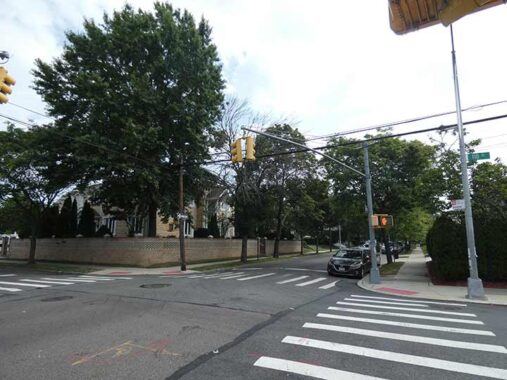
Why did I photograph this corner, 110th Street and 69th Road? I was disappointed to see that the remnants of one of the last “Olive” stoplights in NYC, which persisted here long after the actual stoplight was removed, have been discarded.


I was last in this stretch of Forest Hills in 2020, and Forest Hills High was shrouded by construction scaffolds. I came back in 2025 and yet another set of construction netting is there. It’s like they know I’m coming. Thus, I borrowed a shot from homes.com. The school was built from 1937-1941 at 110th Street and 67th Avenue when the surrounding area was newly developed and it was meant to alleviate overcrowding at Grover Cleveland (Ridgewood), Newtown (Elmhurst) and Jamaica High Schools.
The school design was innovative in and of itself, with the gymnasiums and auditorium separated from the main unit (building). This created separate gymnasiums for boys and girls, with the extended wings forming a plaza. In order to meet the conditions of the locality, it was designed to be three stories high, with a total of 10 acres allotted to it. Partly due to its lot size, an athletic field was built into the back part of the lot, with a grandstand designed for 3,000 people and a “spacious” field for football and track. Designed by the architect Eric Kebbon, ground was to be broken in six months, and the school was expected to open its doors in September 1940 (but opened in February 1941). wikipedia
All four original Ramones members—John “Johnny” Cummings, Jeffrey “Joey” Hyman, Douglas “Dee Dee” Colvin, and Thomas “Tommy” Erdelyi—attended Forest Hills High School. Joey Ramone has a sign of his own at Bowery and East 2nd Street, near the site of the club CBGB where the Ramones made their musical name. Not bad for a band whose music was tremendously influential, but never hit the national top 40! Other grads include sporstcasters Dick Stockton and Ian Eagle, Paul Simon and Art Garfunkel, Captain Kangaroo (Bob Keeshan), and Mountain’s Leslie West.
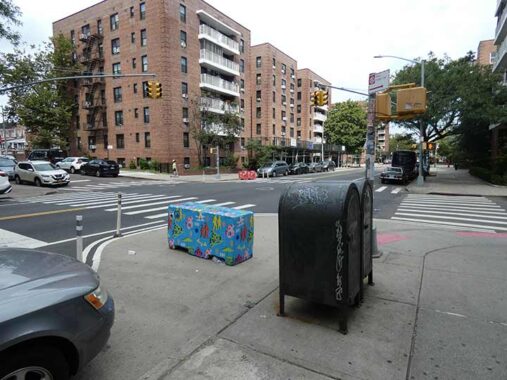
I headed west to 108th Street and headed north. Before the 1920s, the street was in two separate pieces. In Corona, Central Avenue extended as far south as Corona Avenue, and stopped there. Meanwhile in Forest Hills it was laid out as Continental Avenue. NYC connected the two pieces, creating a key connection between the two neighborhoods, while Continental avenue was renamed 108th Street north of Queens Boulevard and 71st Avenue west of it.
I hate to agree with Streetsblog and Transportation Alternatives, but I do favor “daylighting” street corners, or prohibiting parking right up to the corner, in many cases. At many corners when I’m trying to cross non-signaled corners, I have to peer around monster trucks parked right next to the crosswalk. What I don’t like are the ugly concrete blocks, some painted garishly as here.


Engine 324 was built in 1939 at 108th Street and the Horace Harding Expressway and dedicated by Mayor Fiorello LaGuardia in 1939, when the Horace Harding was built as Nassau Boulevard and was temporarily called World’s Fair Boulevard. It became a full fledged expressway in the 1950s, when parts of it were elevated. Technically it’s not called the Long Island expressway till it gets into Nassau County.


As I have said 108th Street was extended south of Corona Avenue in the early 20th Century and cut across a pre-existing grid at angles, creating many triangle-shaped plots, some used as parks. Some of these tiny streets like Westside Avenue and Van Doren Street show their suburban or even rural past by lacking sidewalks, and the street is too narrow to build them.


In the very triangle formed by Westside, Van Doren and 108th Street is Ten Heroes Plaza, one of NYC’s few Vietnam War memorials, honoring ten area residents who gave their lives in the southeast Asia conflict, 1959-1975. The ten heroes are listed on this NYC Parks page for the plaza, which was dedicated in 2002.
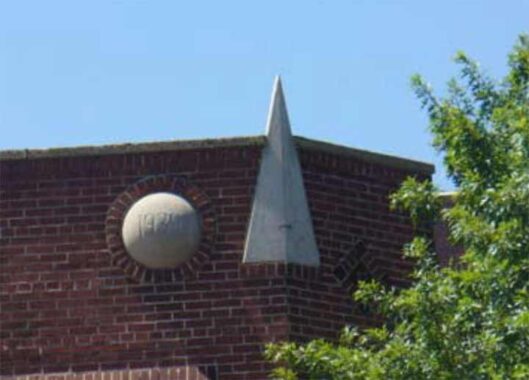
For years I had labored under the impression that the last great representation of the Trylon and Perisphere, the central attractions of the 1939-1940 NYC World’s Fair, were the mosaics in the ticket booth and lobby at the now-altered torn down Trylon Theatre on Queens Boulevard and 99th Street.
That was before FNY correspondent and Newtown Historical Society prez Christina Wilkinson spotted the Trylon and Perisphere, as well as the number 1939, on this building at 108th and Van Doren Streets in Corona, to the west of the fairgrounds. I’ll use a shot from a few years ago, as in August 2025, they were partially obscured by foliage.
Over the years, I found more Trylons and Perispheres (they’re always paired except they weren’t at the Trylon Theatre) at the entrance to the old Flushing Meadows Fairgrounds on the ramp leading to the #7 train, as well as at the White Mana Diner in Jersey City, which is where the diner was built before being moved to the Garden State.
And I found even more, in 2024!
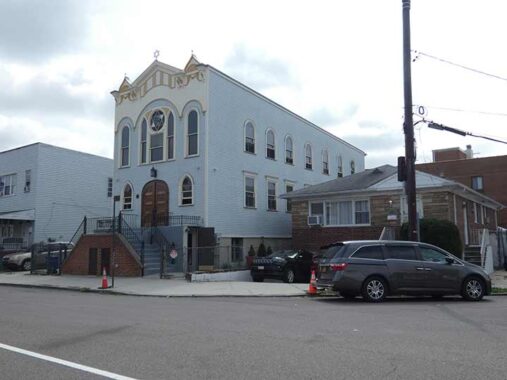
The congregation constructed the Tifereth Israel synagogue building, 55th and Otis Avenues, in 1911, a wooden Gothic and Moorish revival structure designed by Crescent L. Varrone, and modeled after the narrow tenement synagogues built on Manhattan’s Lower East Side. The walls were later stuccoed. Neighborhood demographics changed, and most Jews moved away starting in the 1970s. By the 1990s, the remaining congregation was aged, and had difficulty paying for synagogue repairs and finding enough men for a prayer quorum.
Bukharan Jews began moving to Corona in the 1990s, and in the mid-1990s began worshiping in Tifereth Israel’s basement. Disputes between the old congregation and the Bukharan Jews and their new rabbi came to a head in 1997. Lawsuits in rabbinical and state courts led to the Bukharan congregation taking over the synagogue. The building deteriorated, and by 2008 was in need of $1.4 million in exterior repairs alone.
As of 2010, the New York Landmarks Conservancy had begun $1.5 million in restoration work. Tifereth Israel’s building was the oldest structure built as a synagogue in Queens, and the oldest synagogue building in Queens continuously used for worship. wikipedia
Before she was known as Estée Lauder, Josephine Esther Mentzer attended this synagogue while growing up above her father’s hardware store on nearby Hillside Avenue (Van Doren Street, today). In a stable behind the house, her uncle, a chemist, mixed experimental face creams which Estée sold in Manhattan beauty salons. Over time, Estée managed to develop her one-woman cosmetics enterprise into a multi-billion dollar empire.
The story goes that when her career was just starting out Madonna used the synagogue as a rehearsal space from 1979-1980.
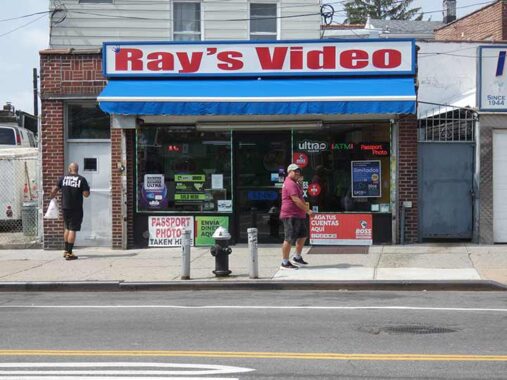
Ray’s Video, 108th Street at 52nd Avenue, likely began as a video rental in the early 2010s, but has adapted and now offers phone accessories, phone services, and photo ID cards, as well as passport photos.
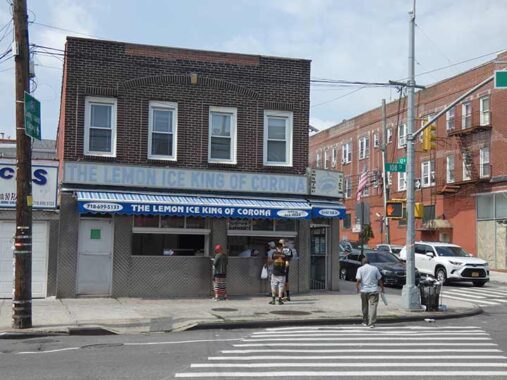
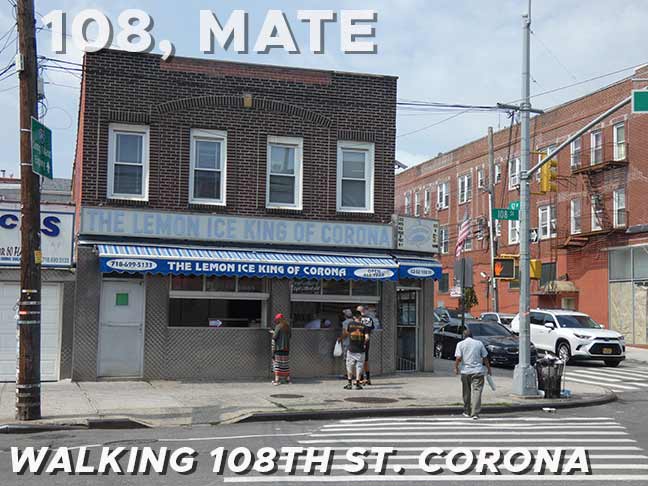
It’s not “forgotten” but I can’t not talk about the Lemon Ice King of Corona, 108th and 54th. A 108th Street mainstay, Peter Benfaremo’s institution started dispensing lemon-flavored Italian ice in 1944. Today, the establishment serves either 25 or 29 varieties (depending on which of their signs you believe). Famous for their ices containing chunks of real fruit, their selection today also includes um, exotic flavors such as chocolate chip and peanut butter. Cash only and don’t ask for napkins or spoons.
I always get the…lemon ice. Nobody ever called me adventurous.
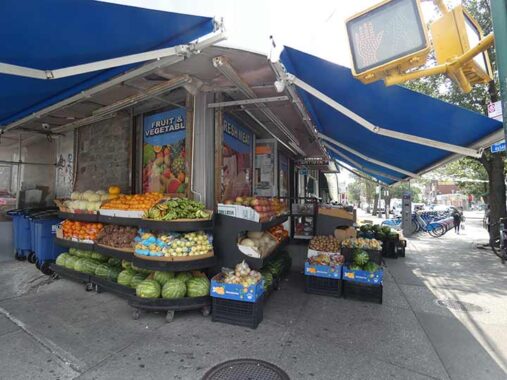
Indulge me in a bit of expostulation. Nothing makes me prouder in being an American than passing a grocery or fruit and vegetable stand bulging and bursting with produce. You can get whatever fruit or vegetable you want in thousands upon thousands of stores like this in every urban center in the country.
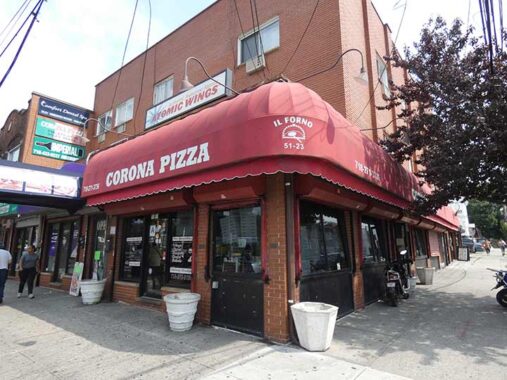
Similarly you cannot go for more than a few blocks in the restaurant or shopping strips of any NYC neighborhood and not be able to get an excellent, or at least good, slice of pizza (though Little Neck has only one traditional pizzeria, Toskana, though Bocconcini is a sitdown restaurant that serves pizza.)
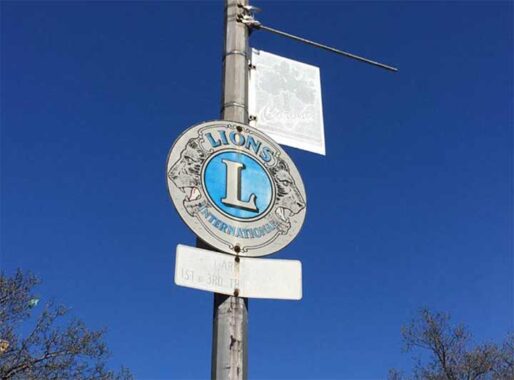
If Lions Club meetings are held nearby you may see signs mounted on local lampposts, like this one on 108th Street at Moore Park.
The Lions Club is a similar service organization founded by Melvin Jones in Chicago in 1917. The Lions presently have over one million members worldwide. Its charter states its goals:
- Organize, charter and supervise service clubs to be known as Lions clubs.
- Coordinate the activities and standardize the administration of Lions clubs.
- Create and foster a spirit of understanding among the peoples of the world.
- Promote the principles of good government and good citizenship.
- Take an active interest in the civic, cultural, social and moral welfare of the community.
- Unite the clubs in the bonds of friendship, good fellowship and mutual understanding.
- Provide a forum for the open discussion of all matters of public interest; provided, however, that partisan politics andsectarian religion shall not be debated by club members.
- Encourage service-minded people to serve their community without personal financial reward, and to encourage efficiency and promote high ethical standards in commerce, industry, professions, public works and private endeavors.


This Veterans of Foreign Wars hall on 108th Street opposite Moore Park pays tribute to “Flanders Field.” Flanders is a region in Belgium where the WWI Second Battle of Ypres (pronounced roughly “eep”) took place in 1915; it was the place where German armies first used chemical attacks of chlorine gas on French and Canadian forces.
The experiences of Canadian doctor Lieutenant-Colonel John McCrae prompted him to write one of the more evocative poetic works that arose from the war, “In Flanders Fields”:
In Flanders fields the poppies blow
Between the crosses, row on row,
That mark our place; and in the sky
The larks, still bravely singing, fly
Scarce heard amid the guns below.
We are the Dead. Short days ago
We lived, felt dawn, saw sunset glow,
Loved and were loved, and now we lie
In Flanders fields.
Take up our quarrel with the foe:
To you from failing hands we throw
The torch; be yours to hold it high.
If ye break faith with us who die
We shall not sleep, though poppies grow
In Flanders fields.
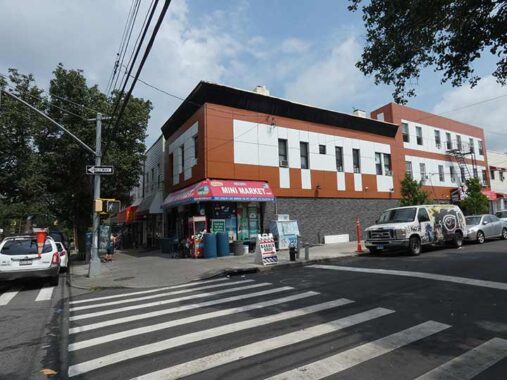
For some reason this corner building at 108th and 51st Avenue has had numerous makeovers over the years; check out Street View as well as 1940s.nyc.


108th Street Lumber (at 50th Avenue); 48-15 108th is now Corona Megawash Laundromat (great band name) but the metal letters “Precision” hint at an earlier tenant. Any area residents can let me know? Comments are open.

Since the Department of Transportation’s street sign replacement program began in 2011, initially using upper and lower case Clearview but then returning to Highway Gothic, it’s pathetic at this point to still see so many signs sunbleached into illegibility, especially on major routes. In recent years the DOT has shifted its focus into promoting bicycling and “open streets” so I really shouldn’t be too surprised.
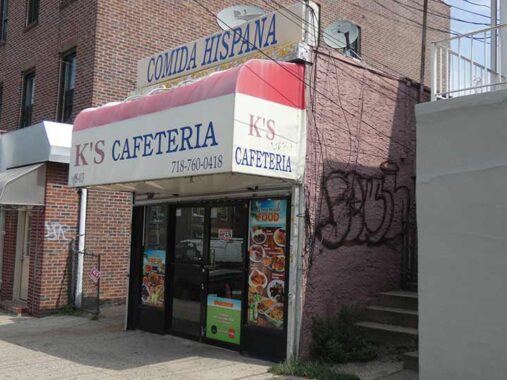
K’s Cafeteria, 48-03 108th, has an awning sign in the Cushing font, which has been used as both a display and text font. I have a Douay (Catholic) Bible with the text completely in Cushing, with Jesus’ words in the New Testament printed in red ink. Today the most popular version is the 1980s re-draw by ITC, an offshoot of my employer between 1982-1988, Photo-Lettering.
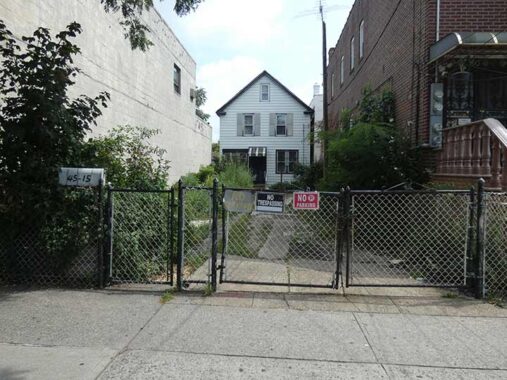
I have always been fascinated with houses that are set way, way back from the street with huge front yards, like 45-15 108th Street.I wonder why they were built that way.


The LIRR Port Washington Branch cuts Corona in half on an embankment from west to east, and only major roads such as 108th Street get past it. It’s accompanied by the narrow 44th (seen here) and 45th Avenues, which have a wall on one side of each. I don’t often see these streets from the surface, but I do see them from above as I ride the RR. Before the Great Renumbering both sides were called Railroad Avenue.
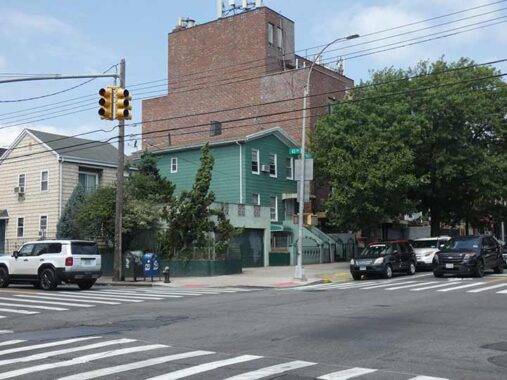
42-18 108th, the little green house with the peaked roof, has been there a long time, since before the surrounding two buildings, as seen in in 1940s.nyc.


Han-Gil Presbyterian Church, which shares the space with Iglesia Jesus Mi Salvador, at 43rd and 108th, looked a lot different in 1940 when it was a pool hall with apartments on the upper floors.


Another church, Christian Congregation of the United States (108-16 43rd Avenue), is “part of an “is an international non-denominational fellowship of assemblies with roots in the Italian Pentecostal revival in Chicago, which began in 1907. It can be found, for example, in Brazil, Argentina, Paraguay, the United States, Mozambique, Italy, Portugal and Ireland. There are approximately 3 million members, 2.5 million being in Brazil.” [wikipedia] The Portugal-Brazil connections explain why services are held in Portuguese in this heavily Spanish and Chinese-speaking neighborhood.
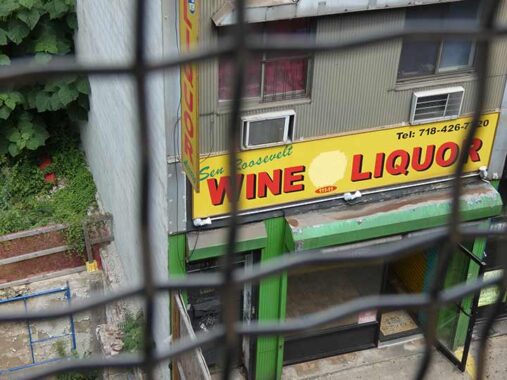
From the 111th Street station platform, Flushing Line #7. Yes, Roosevelt Avenue is named for President Theodore Roosevelt, but he was never a US senator. He was NYC Police Commissioner, a state assemblyman, Governor of New York, Assistant Secretary of the Navy, Vice President under William McKinley, and finally President.
Check out the ForgottenBook, take a look at the gift shop. As always, “comment…as you see fit.” I earn a small payment when you click on any ad on the site.
10/19/25
8 comments
Soldiers in World War I called Ypres “Wipers.” Other French and Belgian towns in the combat zone also got nicknames: Ploegsteert = Plug Street, Auchonvilliers = Ocean Villas, Moquet = Moo Cow, and Etaples = Eat Apples. Not far behind the lines, Pigalle, then as now the main red light district of Paris, became Pig Alley.
Regarding the firehouse plaque: Elmer Mustard is an awesome name.
Sounds like a condiment that might taste a bit gluey.
Second that!
LIRR Port Washington Branch embankment through Corona dates from a 1930 grade crossing elimination project that removed the tracks from the surface level. The former Corona station was located about a ½ mile west of 108th Street, where National Street goes under the tracks. The LIRR Corona Station closed in April 1964, long after its ridership shifted to the nearby #7 subway route. By then there was only one train in each direction on weekdays (6:59 AM westbound and 4:30 PM leaving Penn Station eastbound). \
Sources: Wikipedia (https://en.wikipedia.org/wiki/Corona_station_(LIRR)) and my own 1961 LIRR timetable.
How disappointing: not one picture of you and Julio down by the schoolyard! (Although Paul Simon IS mentioned 😉
The Trylon Theatre hasn’t been altered-is was demolished.
Re that trylon/perishere: Grew up in an area of Queens put up in the late 1930s. One of the houses got stones representing the trylon and peri sphere over the front door. Can’t remember exactly; haven’t been by there for decades. Developer was Gross-Morton: https://www.qchron.com/qboro/i_have_often_walked/gross-morton-homes-186th-street-fresh-meadows/article_a925b462-512d-52a5-b59c-10cb8a4a5592.html