

REMINDERS of the colonial-era Bowne family can be seen all over NYC, from Flushing, Queens to City Island, Bronx. I lived in Flushing 14 years, 1993-2007, and have been on Bowne Street a great deal to see its collection of historic artifacts, but this time I thought I would walk it in its entirety from Northern Boulevard to Kissena Park. I began walking streets in their entirety years ago, selecting Bedford Avenue, Brooklyn’s longest avenue, as the first case. It’s so lengthy I did it in three different walks. Some time later, I instituted a new category, FNY Crosstown, in which I cover east-west streets in Manhattan and very occasionally, other boroughs. In walking streets and avenues’ full lengths, I select for variability and interest; it’s fascinating to see a street change character as I proceed. As we’ll see, Bowne Street fills that category nicely. I’ll get into the Bowne (pronounced BROWN without the R) a bit later.
GOOGLE MAP: BOWNE STREET-KISSENA PARK-AUBURNDALE
Flushing High School


Bowne Street begins opposite one of NYC’s most impressive-looking high schools, located on Northern Boulevard. Flushing High is landmarked Collegiate Gothic building dating to 1915, rather resembling Shepard Hall at City College of NYC in Morningside Heights. This may be the handsomest high school campus open to the public, and the gates were open on the Sunday I was passing by. The high school itself was chartered in 1875 as the NYC area’s first public high school in Queens County. Over 2000 students go to school at FHS. Alumni include actor George Maharis, restaurateur to the stars Vincent Sardi, Jr., comedian Godfrey Cambridge and Fleshtones singer Peter Zaremba. whose Time Out NY‘s articles on NYC inspired my own Forgotten NY research.
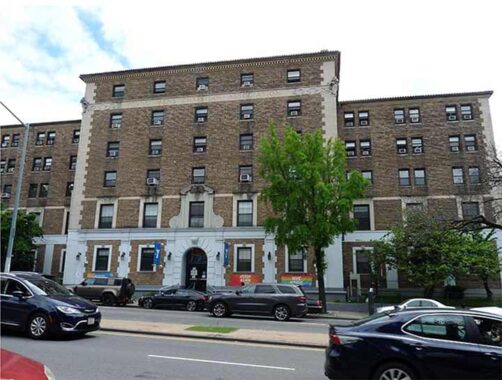
Directly across the street on the SW corner of Bowne Street is Flushing’s YMCA, built in 1925. According to the YMCA website, the organization was founded in 1844 and in 1891, James Naismith invented basketball under the YMCA’s employ. You know what, I keep meaning to sign up for swim lessons at the Y. I consider it a black mark that I never learned (and most animals know how at birth). I was enrolled at the Park Slope Y at age 8, but quit when fear got the best of me. At 69… is it too late. I would need to buy expensive prescription swim goggles.


36-19 Bowne Street, south of Northern Blvd. is interesting to me for its brick detailing, especially at the upper windows, but also a bit of history. Its original address, #10 Bowne Avenue, is inscribed in copper lettering on the west-facing northern end. Thus, Bowne Street used to be an avenue. When was the change made? This 1909 Queens map plate (I cannot screen shot it because of copyright protections) reveals that most of Flushing’s streets carried different names, originally. Most notably, Amity Street is the east end of Roosevelt Avenue, and Bowne was retained but Street became Avenue.
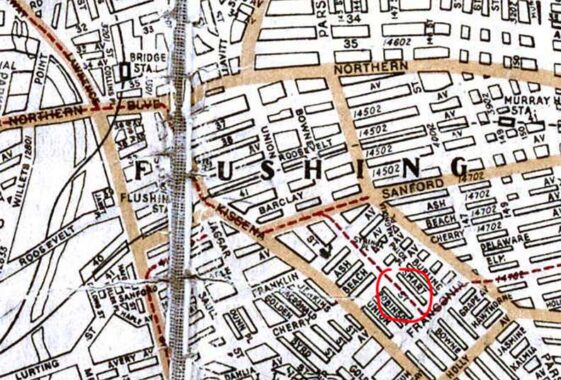
Hagstrom mapped Flushing in 1922 and by then, Flushing’s new street names had been instituted, as well as its house numbering, as #10 Bowne Avenue became #36-19 Bowne Street. Even after these changes, much of Flushing’s original names were retained!
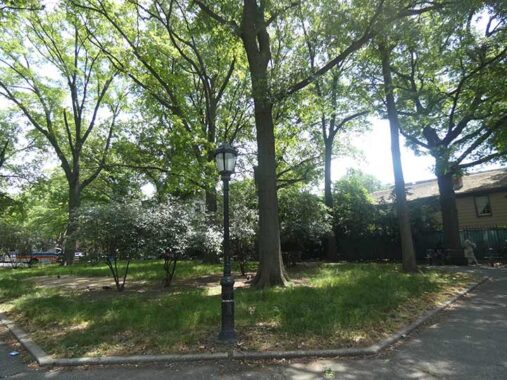
At one time I believe 37th Avenue, or its old name, Washington Street, proceeded directly through to Bowne Street, but for many years it has been a pedestrian mall, Carman Green, between Kingsland Homestead, a playground and the Bowne House, named for Margaret Isabel Carman (1890-1976), a preeminent scholar on the history of Flushing and longtime teacher at Flushing High School.
Unfortunately, by mid-June 2026, when I obtained these photos, Carman Park had become something of a homeless camp.


Years ago, Flushing’s so-called “Freedom Trail” was marked only by red stripes on the sidewalk and very small lamppost-mounted red signs (some of which may remain in place). Flushing is considered a bulwark in the cause of religious freedom in the USA (see Bowne House, below). Many years ago the Flushing Freedom Trail was established to link its historic sites and was marked by small red signs and a red stripe on the sidewalk that has since faded away. More recently these helpful signs have been installed showing the trail superimposed on a Flushing street map, with descriptions on the other side.
Kingsland Homestead
Amazingly, though Flushing can claim two buildings from the 17th century, the Bowne House (see below) and the Quaker Meetinghouse (Manhattan has none), 18th Century buildings are few and far between!
The Kingsland Homestead has been located in three sites since its construction in about 1790. In the 1920s it was moved to make way for the Flushing subway; before 1968 it was located at the southeast corner of Roosevelt Avenue and 155th Street, where it was beginning to become rundown. The Queens Historical Society had it moved to its present location on 37th Avenue, and the Society is housed in the homestead now.
Quaker Joseph Doughty constructed this building at about 1785-1790. It is named for his son-in-law, sea captain Joseph King, who bought it in 1802. It was later occupied by the Murray family, who gave their name to Murray Hill and Murray Street in east Flushing, well into the 20th century. The interior of the homestead has been preserved pretty much as it was in the 19th century, and a public exhibit by the Queens Historical Society occupies much of the first floor that includes a representation of the Flushing Remonstrance. Kingsland is open from 2:30pm – 4:30pm Wednesdays, Saturdays and Sundays, but you are advised to call ahead for an appointment at (718) 939-0647, ext 17. Prolific Queens author Jason Antos serves as its executive director. Some years ago I was beating Jason in Jeopardy! at Neir’s Tavern but he hit a pair of late Daily Doubles and I was sunk. I have given a few Forgotten NY-associated presentations here, the most recent in October 2024. Don’t miss the Northern Boulevard mile marker displayed at the front gate.
According to Ghosts of New York City chronicler Therese Lanigan-Schmidt, the presence of restless spirits has been noted in the old house over the past couple of centuries, but that’s old hat for Flushing: spooks apparently have troubled the Friends Meetinghouse and the John Bowne house as well! (I agree with Popeye, though: “Ghosks Is the Bunk”)
Bowne House


After years of inaccessibility, this over 360-year old building is open for inspection more often these days, but never when I’m around. Bowne House was built in 1661 by English settler John Bowne and, unlike many other colonial houses from the 17th and 18th centuries, it still looks a great deal like it did when it was built (though a coat of paint wouldn’t hurt).
Peter Stuyvesant, continuing his reign of terror against religious dissenters, had Bowne, a Quaker, arrested in 1662. Before the construction of the Friends Meetinghouse on Northern Boulevard in 1699, Bowne’s house was the primary site for Quaker services. Sentenced to pay a hefty fine, Bowne refused and was jailed; he was subsequently exiled to Holland.
While he was there, Stuyvesant’s bosses at the Dutch West India Company reversed Stuyvesant’s non-tolerant policy, claiming that the colony needed many immigrants to ensure economic expansion, no matter what faith they were. Bowne returned home to Flushing in 1664; the British sailed into New Netherland five months later, and Stuyvesant surrendered without a shot being fired.
Bowne’s illustrious descendants included Robert Bowne, who founded the still-extant Bowne & Co. financial printers; Walter Bowne, NYC mayor from 1829-1833; shipping magnate Robert Bowne Minturn; and abolitionist Mary Bowne Parsons, wife of horticulturalist Samuel Parsons, who may have used the Bowne House as an underground railroad way station. I’m unsure if they’re related to the Flushing Bownes, but there was also a Bowne family who settled in City Island, quite a ways from here.


Flushing’s history in the colonial era was closely intertwined with plants. William Prince established a commercial plant farm, or nursery, in western Flushing in 1737 along Flushing Bay. He first limited his business to apple, plum, pear and other fruit and flowering trees, and later expanded to shade and ornamental trees. After Prince’s business slumped during the Revolutionary War, he gained ground again and by 1789, President Washington had heard of him, and accompanied by Vice President Adams, paid a visit. According to accounts, though he seemed unimpressed with the gardens, he purchased a fruit tree.
The Quakers, which established a tenuous foothold in Flushing with Englishman John Bowne in the mid-1650s, were subject to official harassment by New Netherland’s director general Peter Stuyvesant; Bowne was hauled back to Holland for a time to answer for his ‘crimes.’ Stuyvesant’s attitude later eased, and was rendered null in 1664 when the British claimed New Netherland and the Dutch, with no stomach for war, acceded.
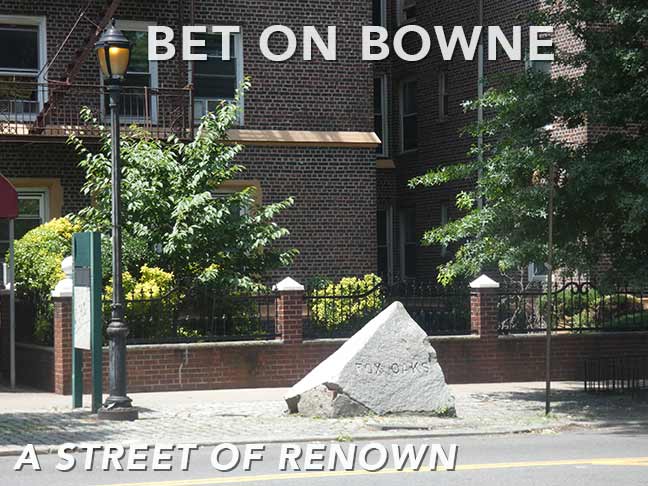
A stone marker across Bowne Street from the Bowne House, carved into a rough pyramid, reads: “Here stood the Fox Oaks, beneath whose branches George Fox, founder of the Society of Friends, preached June 7, 1672.” Bowne Street is still crowned by oaks.
I like its accompaniment by a Type A lamp most often found in Parks, but also on this stretch of Bowne Street.
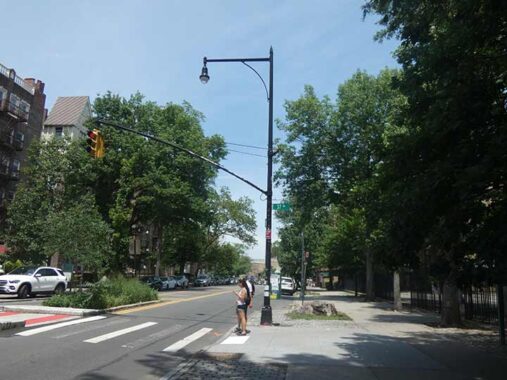
Speaking of lamps, the north end of Bowne Street features these straight-mast, bracketed poles that were first used on 8th Avenue in Manhattan and Flatbush Avenue in Brooklyn in the late 1980s and have become a staple of business sections around town.


The Congressman Rosenthal on the 37th Avenue sign was Benjamin Stanley Rosenthal (June 8, 1923 – January 4, 1983):
“a Representative from New York, […] born in New York City. He attended public schools (including Stuyvesant High School), Long Island University, and City College. He served in the United States Army, 1943–1946, and received his LL.B. from Brooklyn Law School as well as an LL.M. from New York University, 1952. He was admitted to the New York bar in 1949 and commenced practice in New York City. He was elected as a Democrat to the Eighty-seventh United States Congress, by special election, to fill the vacancy caused by the resignation of United States Representative Lester Holtzman, and reelected to the eleven succeeding Congresses (February 20, 1962 – January 4, 1983). He died in Washington, D.C. “wikipedia
He was succeeded by US Rep. Gary Ackerman, who served fifteen terms in the House from 1983-2013 and was succeeded by US Rep. Gregory Meeks.


The west side of Bowne Street from 37th Avenue to Roosevelt is marked by handsome apartment houses built in the early 20th century, one of which has an incongruous addition of a few extra stories.
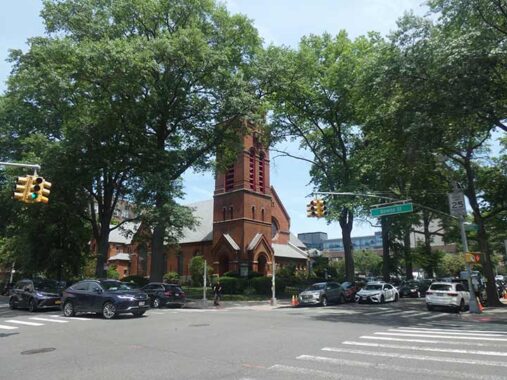
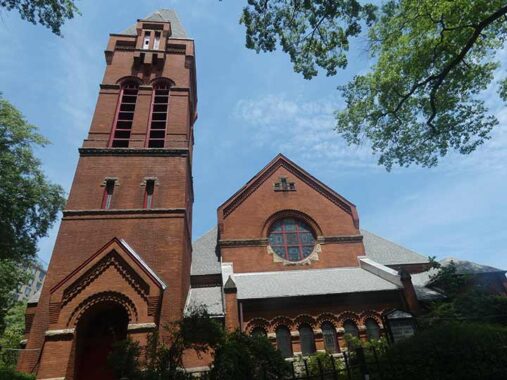


This bell-towered brick church at Bowne Street and Roosevelt Avenue (formerly Amity Street) is late to the Landmarks Preservation Commission party and was designaed in 2009. As a result until recently I didn’t know much about it. Quoting from its LPC Report:
Originally built for the Protestant Reformed Dutch Church, this building is significant as an excellent example of the Romanesque Revival style, especially notable for its prominent corner tower, decorative brickwork, and opalescent stained-glass windows. Several of the windows were designed by artist and congregant Agnes Fairchild Northrop of Tiffany Studios. It is one of downtown Flushing’s most significant religious structures.
George E. Potter, an architect with a practice in Springfield, Massachusetts, and later in Hartford, Connecticut, most likely designed the church [completed in 1892].
The church was in danger of demolition before its designation. The report is worth a read, plenty of Flushing information as well. Make a sandwich.


The apartment building on the SE corner of Bowne Street and Sanford Avenue was labeled the Bernard Mansion when constructed. Year by year, more and more of Sanford Avenue‘s charming 19th and early 20th Century structures fall victim to overdevelopers’ relentless thirst for multi-family dwellings that, since they’re built on the cheap, are ugly as garbage.
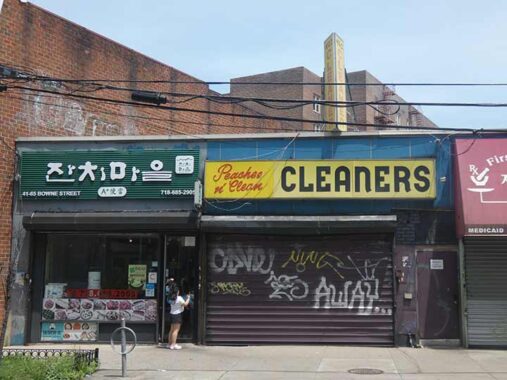
An old school sign in an area where signage is increasingly in the Korean and Chinese languages. While Bowne street continued to be residential, it narrows south of Sanford Avenue and there is a mix of businesses as well. There are still some apartment buildings, some large, but private residences also increase in number.
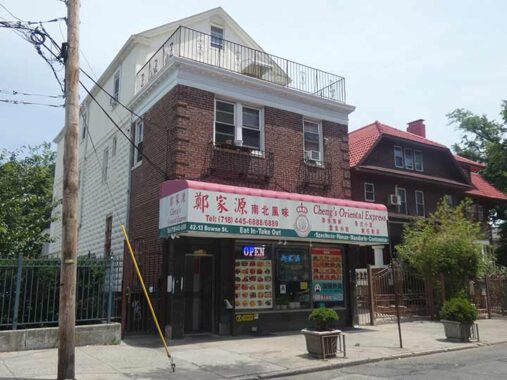
This awning sign on Bowne street south of Franklin Avenue interested me because while most of the lettering is in Chinese, the words “Cheng’s Oriental Express” are rendered in oldstyle Cheltenham Italic (not the newer version of Cheltenham with a higher x-height cut by ITC in the 1980s). It was designed in 1896 by Bertram Goodhue, an architect by trade, and Ingalls Kimball, who named it after his own Cheltenham Press. The font is used extensively in the New York Times in its heds.


A pair of concrete and brick gateposts were added to the west side of Cherry Avenue at Bowne Street to announce the Waldheim area. As Flushing historian Paul Graziano explains:
“The significant history of the Waldheim tract began in 1822, when Nathan Sanford (seee Sanford Avenue, above), then Chancellor of the State of New York, bought up several farms, with west frontage on Jamaica Avenue (Kissena Boulevard), north frontage along the midblock boundary of Franklin and Ash avenues, east frontage on Parsons Boulevard, and south frontage on what is today Delaware Avenue. In 1836, Sanford built what came to be known as Sanford Hall (left, on Sanford Avenue east of Kissena Blvd.) , an imposing mansion that had most of its interiors surfaced with imported marble. Sanford died in 1839, when the property was acquired by Drs. John and James MacDonald, who established an insane asylum for the very wealthy. James MacDonald was the father of Eliza MacDonald, who was a critical player of the fight for women’s rights in the Suffrage movement, from before the turn of the century until her death in February of 1937 at the age of 90. At one time, the MacDonald family owned an enormous area of Flushing, stretching from the Flushing River on the west to Parsons Boulevard on the east, and from Sanford Avenue on the north to what is today Kissena Corridor Park on the south.”
In 2005, after a period of deterioration, the gateposts were restored to their original appearance with the aid of the Queens Historical Society and then City Councilman John Liu; however, area vandals have resumed their grim work.
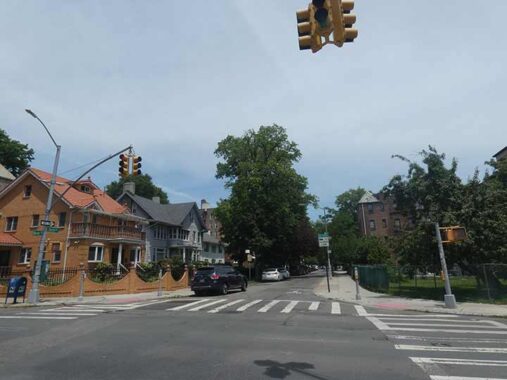
Looking west on Cherry Avenue into Waldheim. I should really survey the disappearing neighborhood of Waldheim again since more of it disappears every year; FNY last covered it in depth in 2006.


I would occasionally get the Q65 bus when I lived in Flushing and its route is on this stretch of Bowne Street. I was sort of intewrested in The Leonia, a massive apartment complex with an inner courtyard between Cherry and 45th Avenues.


On the same block two of the world’s major religions face off across Bowne Street (just kidding, I’m sure they keep things ecumenical): the BAPS Shri Swaminarayan Mandir, a Hindu denomination founded by Bhagwan Swaminarayan (1781-1830) rooted in Vedic Hindu scriptures and philosophy: he is regarded by his followers as the Supreme Incarnation of God; and the Kissena Jewish Center, a synagogue founded in 1950.
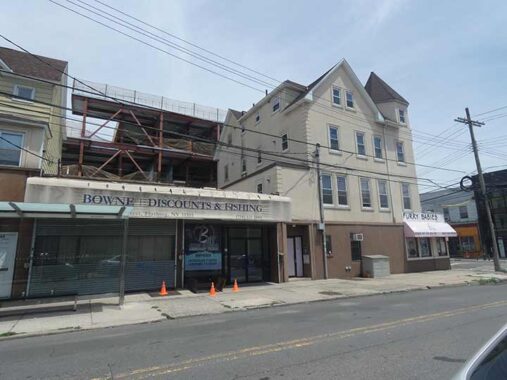
I wouldn’t have considered this stretch of Bowne Street, in the heart of Queens’ Little India, to be a stronghold for fishing, of all pastimes, but here it was, Bowne Discounts and Fishing, just north of 45th Avenue in the Flushing Hospital environs. Sadly it has since closed.


I have had a fascination for this gabled and turreted house on the NE corner of Bowne Street and 45th Avenue for a long time. Its 1940 tax photo shows it hasn’t changed all that much.
45th Avenue used to be called Franconia Avenue, the “F” in Flushing’s collection of “plant streets” beginning with Ash and ending in Rose. However, this was one of three avenues in the sequence named for locations, not plants; Franconia is a region in southern Germany (In German, Franken) including northern Bavaria. The largest city in Franconia is Nuremberg, and picturesque Rothenberg preserves many beautiful buildings from the medieval era and is a worldwide tourist attraction. Franconia Avenue was renamed 45th Avenue in the mid-20th century for reasons that escape my research. A trolley line from Jamaica once ran along 45th Avenue (and 164th Street, a clue for the reason for that street’s great width). 45th Avenue is the only numbered avenue in western Flushing between Ash and Rose Avenues. The only modern-day clue about its former name is Franconia Pharmacy at 45th Avenue and 162nd Street on the Auburndale border.


The Ganesh Temple of the Hindu Temple Society of North America on Bowne Street just north of Holly was opened on July 4, 1977. As the first Hindu Temple in North America composed of largely imported materials, and constructed by artisans from India, Sri Maha Vallabha Ganapati Devasthãnam (or the Ganesh Temple) is one of the most impressive and historically important Hindu temples in the West. Flushing, Queens was chosen as the location for the Ganesh Temple based on three criteria: it was the gateway of the U.S.- all Indian immigrants came here and there was a large concentration of Hindus in the tri-state area of New York, New Jersey, and Connecticut; it was within walking distance for many, or one bus or subway fare; and the possibility existed to purchase a suitable site. Its strength and influence outside of New York is proven by the fact that the temple has served as a model for many other Hindu communities.
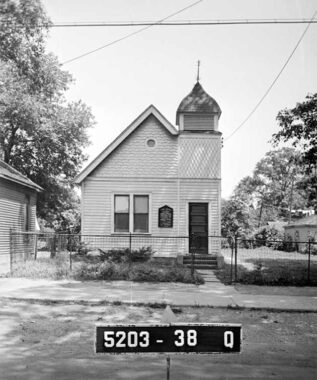
From the Ganesh Temple website:
“The Hindu Temple Society of North America (“Society”), a non-profit religious institution was incorporated on January 26, 1970, under the laws of the State of New York. Soon thereafter, the Society acquired from a non-functioning Russian Orthodox Church [shown here in 1940], a site on which the present Temple is situated. It was in a small frame house that daily rituals were performed and weekend services conducted by volunteer priests, until the present structure, designed in accordance with the Agama Sastras (ancient scriptures relating to temple building), was completed early in 1977[…]”


Hindu Temple Society of North America has only added to its holdings in recent years with the administrative center and staff residences shown here. The Temple Canteen, initiated in 1993 on Holly Avenue, is patronized from all over New York City.


The NE corner building at 45th Avenue and Bowne Street is largely intact from 1940, and while that year it hosted one of the then-popular Roulston’s groceries, today it’s the Shree Siddhivinayaka Grocery, named for a famed Ganeshi temple in Mumbai.


South of Holly Avenue Bowne Street becomes completely residential and is accompanied by shade trees. Here is a sampler of homes built in the early to mid-20th century found on this stretch.


Bowne Street reaches its southern end at Rose Avenue, which borders Kissena Park.
Kissena Park, a large 234-acre tract bounded by Kissena Boulevard, Oak Avenue, 164th Street and Booth Memorial Avenue, is one-half “regular” city park with walkways and playgrounds, and half “natural” with bridle paths and heavily wooded areas where you shouldn’t be too surprised to see pheasants and rabbits darting about. It was developed gradually in the early years of the 20th Century, with NYC slowly acquiring territory from private owners and police department property. Kissena Lake was once fed by streams, some of which emanated from the flushing River, but it was cut off by the Works Progress Administration in 1942 and placed in a concrete retainer. It is periodically cleaned of algae buildup and is stocked with fish that support herons, egrets, cormorants and even snapping turtles. “Kissena” is thought to be a Chippewa Indian term meaning “it is cold”; though the Chippewa lived in Michigan, 19th-century horticulturalist Samuel Parsons, whose tree grove is in the park at Rose Avenue and Parsons Blvd. probably named it.
I pressed further into Auburndale, as the linked map above indicates, but I’ll save that for another time.
Check out the ForgottenBook (HarperCollins, 2006), as well as Forgotten Queens (Arcadia, 2013). I also have a chapter in the anthology “New York Calling: From Blackout to Bloomberg” (Reaktion, 2007). As always, “comment…as you see fit.” I earn a small payment when you click on any ad on the site.
10/4/26
6 comments
Nancy Reagan lived the first couple of years of her life at 149-40 Roosevelt Avenue. The house is still standing.
For the Bowne Street section of this congressional district, Gary Ackerman was succeeded by Grace Meng in 2013. She is still representing downtown Flushing in 2026. Ackerman is also known as the founder of the late Queens Tribune.
There is a Bowne Street in Brooklyn which appears to have been named (circa 1830s) for Samuel and Rodman Bowne, major Brooklyn landowners and operators of a ferry to the city. From what I’ve been able to find, these Bownes were part of the City Island/Pelham group.
There was another, apparently unrelated Bowne family, originally from Salem, Massachusetts, who located in Gravesend; I believe they were part of the Lady Moody group. Many of them relocated to central New Jersey before 1700 and became heavily involved in the political and commercial life there. Andrew Bowne, who had moved from Gravesend to Manhattan, was a NYC Alderman in the 1680s; after a move to NJ, he ultimately became acting governor there in 1699. Descendants of this Bowne family include former NJ Governor Tom Kean, Sr. (Of 1980s “New Jersey and you” fame) and his son US Rep. Tom Kean, Jr., as well as President Abraham Lincoln.
I also failed to learn swimming at the YMCA, at age seven in my case, and it was due to the name of my grandmother’s doctor. His name was Friedman, and because my grandmother had basically no topic of conversation other than her health whenever we went over all I’d hear was Friedman this and Friedman that.
During the swimming lessons, the instructor kept mentioning rotary breathing. In my mind I heard it as “rotary Friedman,” which obviously made no sense, and I failed to grasp the concept and made no progress in learning to swim (I learned a few years later).
My father grew up at 151-07 33rd road in Flushing, a block or two north of Travis Triangle. He used to say that growing up in the late 1930’s and 40’s that neighbor hood kids would sing “all the monkeys in the zoo go to PS 22” for the PS 22 school in Flushing. Good times in Flushing.
Walking it end to end is the honest way. One facade photo can make any block look like something it isn’t; the full run from Northern Blvd to Kissena is what actually tells you. The copper lettering at 36-19 (old #10 Bowne Avenue) is a good catch, and the map history on the rename is the part I’d have missed.