
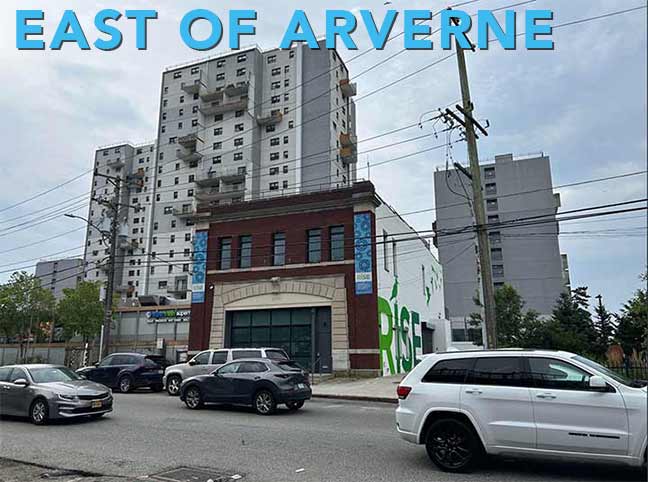


OVER the years, this site has documented many former firehouses repurposed as offices and residences. Usually the reason for their closing was in favor of a new firehouse nearby that can accommodate more equipment, vehicles, and personnel. Across the street from the Beach 60th Street-Straiton station on the A train is the former FDNY Engine 265, now home of the environmental nonprofit RISE.
This firehouse was built in 1922, following a devastating fire that ravaged many of the summer bungalows on the surrounding blocks. In the decades since, the bungalows were rebuilt and then demolished again as the blocks between the elevated train tracks and the ocean were declared an urban renewal area. In contrast to Arverne-by-the-Sea at Beach 67th Street which received a beautiful new set of streets and homes, the blocks around Beach 60th Street remain much the same as at the end of the previous century.
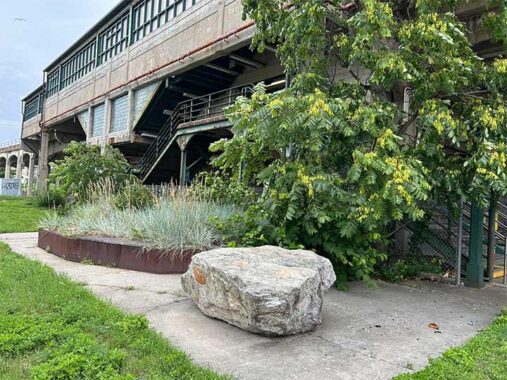
As a train station provides a first impression to its neighborhood, a plaza next to it with a civic monument is ideal here. In 2024, RISE sponsored the installation of Rockaway Petroglyph by Keith Sudeith which depicts local geography on a boulder with images of horseshoe crabs and airplanes. Stations are often situated near civic centers. This one is in proximity to an HRA benefits office, the Arverne post office, and the former firehouse.
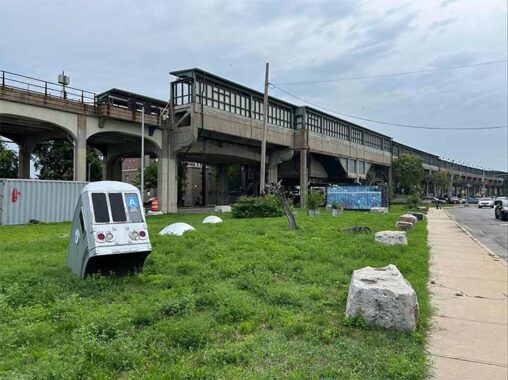
An earlier example of this is the sculpture of the A train emerging out of the ground in the manner of a serpent by Zaq Landsberg and Peter Castillo. Installed in 2023, it is beginning to show signs of wear and tear as the elements batter this imaginative sculpture. Landsberg also has a piece at the Teleport on Staten Island, depicting the Statue of Liberty reclining.
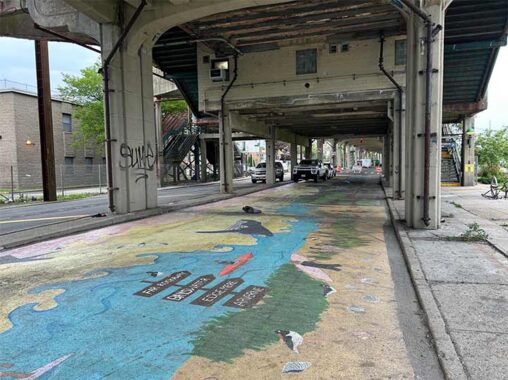
Finally, there is a painting on the surface of Rockaway Freeway underneath this station titled Seaside Strong, created in 2025 by Ayushi Shirarmwar and Camila Morales in partnership with RISE and the city DOT. Once a speedy drive beneath the tracks, portions of the Rockaway Freeway have recently been pedestrianized as the city continues to wage an ongoing war on cars. This artwork is a response to the question, “what makes the Rockaways unique and resilient?” As a rule, the plural name for this peninsula refers to all of its neighborhoods collectively.
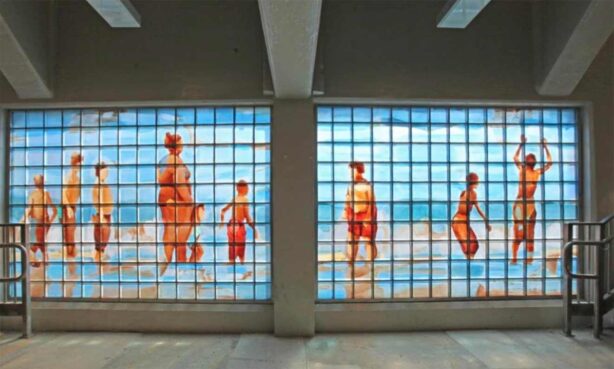
On the station’s mezzanine, the MTA commissioned Simon Levenson’s 2011 work titled The Beaches of New York City. The installation followed a renovation project here that installed windscreens and new lighting to this otherwise nondescript concrete structure. Like many stations, Beach 60th Street has civic buildings nearby: an HRA benefits center and a post office. The Q52 bus stop here offers a direct ride to Elmhurst.
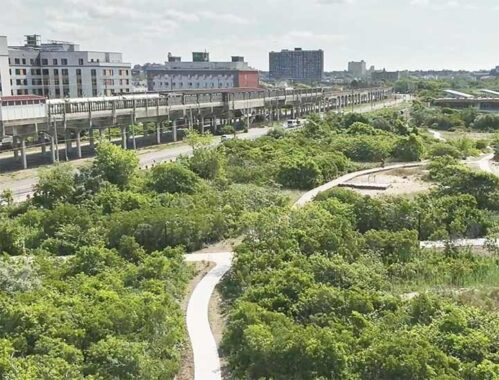
To the east of the former firehouse, Arverne East Nature Preserve occupies the empty blocks between Beach 56th and Beach 44th Streets. Where dead-end streets with hydrants on a wasteland marked an unrealized urban renewal area, the Parks Department planted native species, laid out trails, and built a nature center. The appearance here is designed to evoke the Rockaways as they were in their natural state.
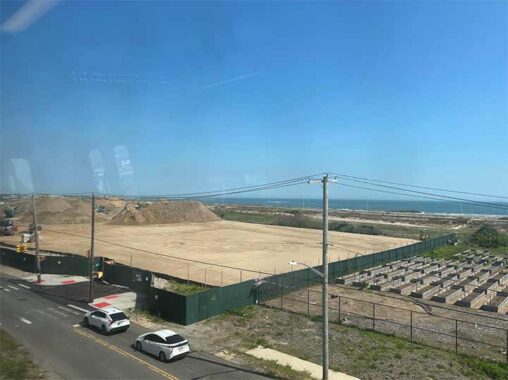
To the east of Beach 44th Street, a new neighborhood is being built on the oceanfront. Billed as Arverne East, it is properly closer to Edgemere. Along with new apartments, plans include a public swimming pool by the boardwalk. It is history coming full circle as an area once known as a summer resort is again hosting recreational amenities. Be sure to visit the splash playground on Beach 30th Street.
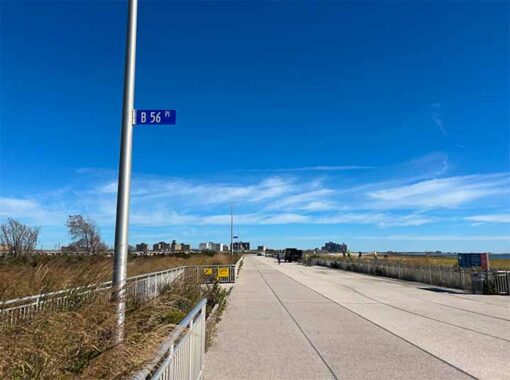
On the Boardwalk, which was rebuilt in concrete following Hurricane Sandy of 2012, street signs continue to mark the demapped streets here, perhaps to measure distance for the bikers and joggers on the oceanfront walkway. Formally, this boardwalk is addressed as Ocean Promenade, a continuous stretch from Beach 9th to Beach 126th Streets with blue street signs found only on this walkway.
On the map of this neighborhood, Rockaway Beach Boulevard does an unusual act. Going east, at Beach 56th Place this boulevard becomes Edgemere Avenue. Then on the north side of the tracks at Beach 54th Street, Arverne Boulevard becomes Rockaway Beach Boulevard.
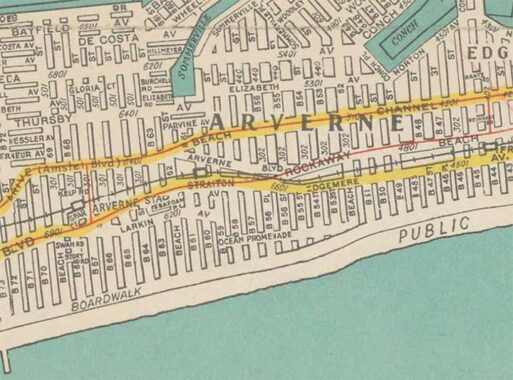
The Hagstrom map from the 1940s reveals the mystery of these two segments. Prior to the grade elimination of the Rockaway line, this boulevard crossed the tracks in a diagonal direction. The two segments were separated when the tracks were elevated with Rockaway Freeway running underneath them.
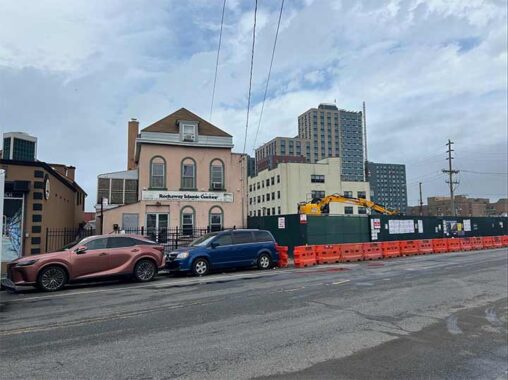
In the last century Arverne had the oldest synagogue on the peninsula, Derech Emunah, that held on to the turn of the millennium. At Beach 54th Street and Rockaway Beach Boulevard is the oldest mosque on the peninsula: Rockaway Islamic Center which is in a repurposed house. Around the corner from the mosque, the Arverne library has a property whose borders predate the grid. It is presently undergoing an expansion.
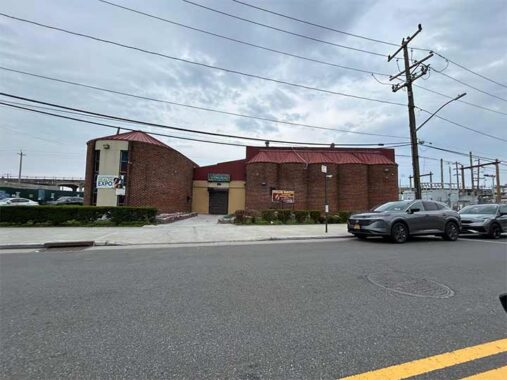
Solid Rock Seventh-Day Adventist Church has the silo look on its exterior. Prior to 1977, Young Israel of the Rockaways had this site. Its decline resulted from white flight, when the city built low-income projects here. Fearing crime that followed the construction of NYCHA projects in other neighborhoods, the Jewish community here relocated to Far Rockaway. The electric substation next to this church belongs to PSEG. While the rest of the city is powered by Con Ed, the Rockaways are connected to Long Island’s electric grid. Prior to the annexation of the peninsula by the city in 1898, it was within the Town of Hempstead.
New apartments across the street from this church stand on the site of Peninsula Hospital, which closed in 2012, having sunk deep into debt. Its demise leaves only one functioning hospital in the Rockaways, St. John’s Episcopal.
Sergey Kadinsky is the author of Hidden Waters of New York City: A History and Guide to 101 Forgotten Lakes, Ponds, Creeks, and Streams in the Five Boroughs (2016, Countryman Press), adjunct history professor at Touro University and the webmaster of Hidden Waters Blog.
7/25/26