
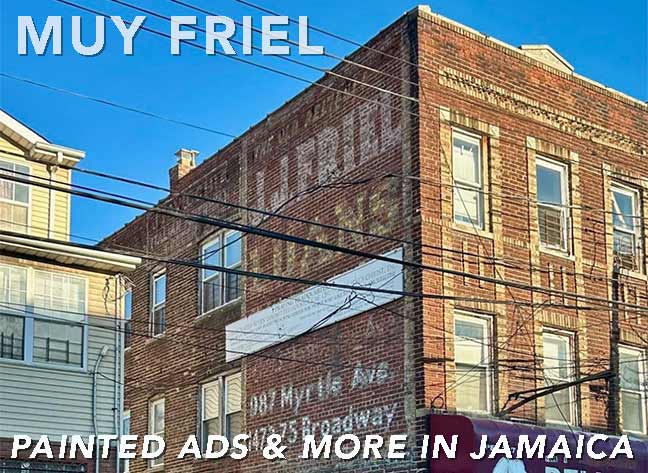


OVER the years, fading ad historian Kevin Jump and Forgotten-NY founder Kevin Walsh have documented numerous examples of painted ads across the city for loan broker J.J. Friel. They’ve seen Friel’s murals in downtown Jamaica, by the elevated tracks in Bushwick, and the late great Gary Fonville found one in Park Slope.
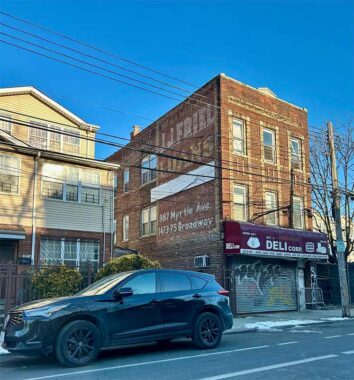
In South Jamaica at 106-25 160th Street, across from the NYCHA South Jamaica Houses is another Friel ad sharing the wall with a billboard for the “Consecrated Seven Committee Apostolical Church of Jesus Christ, Inc.” Quite a mouthful for a denomination!
Joseph Friel’s business was founded in 1870. According to Jump, he was an immigrant who began his career as a ditch digger, then as a pawn shop worker before opening his own shops with three in Brooklyn and one in Jamaica. His 1914 obituary appeared in the Brooklyn Daily Eagle, revealing his birthplace, age of immigration, and place of burial.
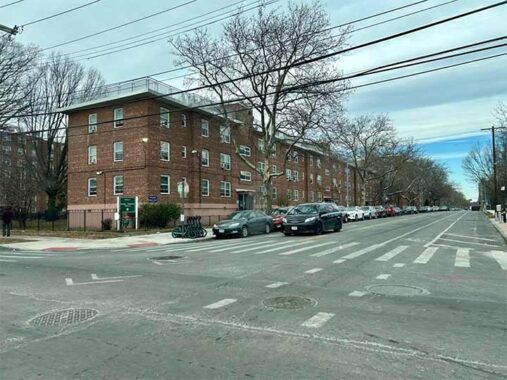
South Jamaica Houses are not a typical NYCHA project, which are often very tall on a superblock. Built between 1940 and 1954, these 27 buildings are three to four stories each.
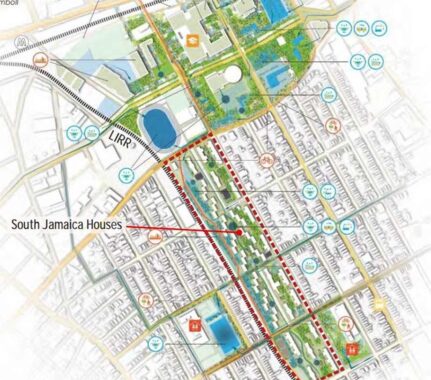
The amount of open space on the grounds of this complex allows for the creation of stormwater retention basins in the event of a cloudburst, or rainfall that would otherwise overburden the sewers. In 2018, NYCHA adopted a plan to channel excess water towards spaces between the apartments and railroad tracks, echoing the creek that flowed near this site prior to the early 20th century.
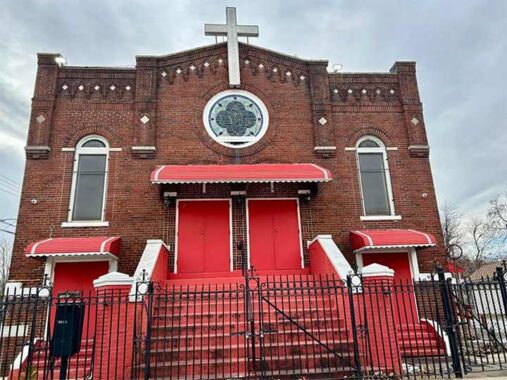
Around the corner from the Friel ad is the Mount Zion Baptist Church on Union Hall Street, a Black congregation whose building used to be Bnai Israel of Jamaica. Like many synagogues-turned-churches, its past is revealed in its architecture, with a Star of David on its south side. The rose window also had one, as seen in this 1941 tax photo. A cornerstone on this church offers no information on its Jewish past, only that the church was founded in 1929 by the Rev. J. H. Jackson. Etched into the cement next to the cornerstone are the dates “1927-1951,” perhaps the years when this address was a synagogue.
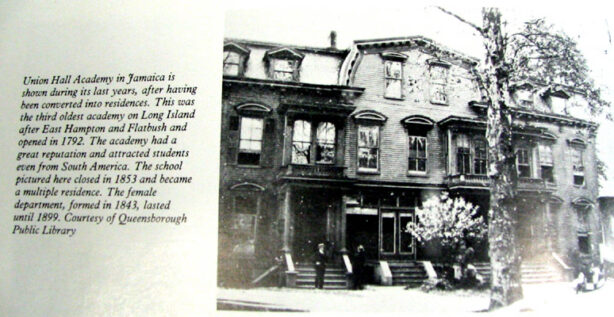
This photo, from the Queensborough Public Library, shows former buildings of the Academy, which had by then moved to Union Hall Street south of Jamaica Avenue and north of what would be Archer Avenue.
In 1791, the prestigious Union Hall Academy was built in Jamaica Township by residents of the three towns of Queens. An amount of $2,000 was pledged for the construction of the academy and it was an immediate educational success. Within four years after the original construction of the academy, it required expansion. At that time, in addition to a regular staff, there were five assistants to the principal as well as a library and research facilities. Some of the educators were well known such as Henry Onderdonk, the famous Long Island historian who taught at Union Hall between 1832 and 1865.
In 1841, a fire nearly destroyed the academy while Walt Whitman was on the staff. As early as 1816, it became so popular that a female school was added to the standard academy. However, the rise of the public school system provided too much competition for the fashionable educational establishment. Although other schools were being built such as the Maple Hall Institute, a private boarding school for boys, the Union Hall Academy was closed in 1873. — Kathleen Lonetto, Long Island Heritage. More on FNY’s Jamaica Avenue page
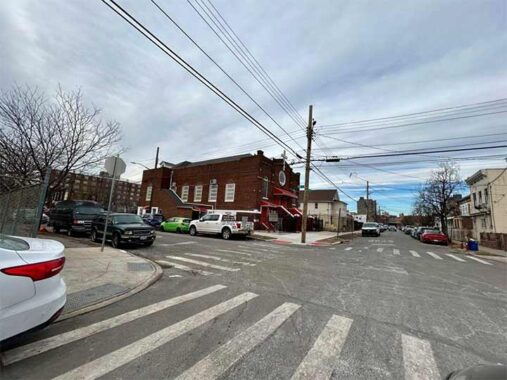
The name Union Hall honors an academy of that name that was the school of choice in Jamaica between 1792 and 1872. It stood at the corner of Union Hall Street and Jamaica Avenue. In the 1970s, a portion of Union Hall Street was demapped for the campus of CUNY York College. My assumption that this street was named after organized labor is as wrong as it would be for Manhattan’s Union Square Park.
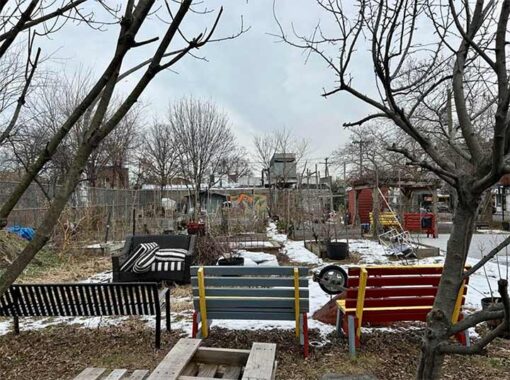
Urban decline in that decade resulted in abandoned parcels that were taken over by the city and developed as community gardens. McKinley’s Children’s Garden is one of 500 city-owned Greenthumb gardens where city dwellers can engage in agriculture. It was acquired by the city in 1975 and designated as a garden in 2005. Across the street, Discovery Community Garden serves the same purpose. At the time of my visit, this garden was hosting a bird theme mural cosponsored by the National Audubon Society.
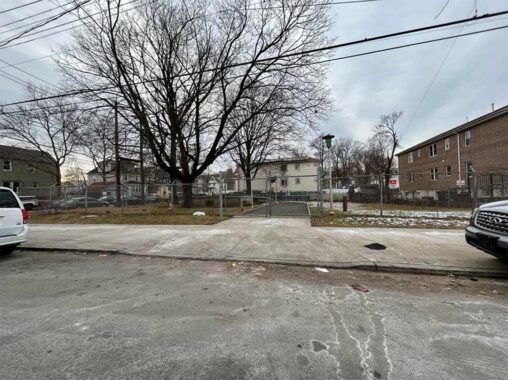
A green spot on Union Hall Street that is not open to the public is this DEP pumping station, one of many across southeast Queens, which is the last corner of the city that relied on pumps and water towers before being connected to the city’s Catskills-Delaware-Croton water supply. Prior to its acquisition by the city’s Department of Environmental Protection, this station was operated by the old Jamaica Water Supply Company. The light fixtures at these sites are unique, not found anywhere in the city. What nickname would Kevin assign to them?
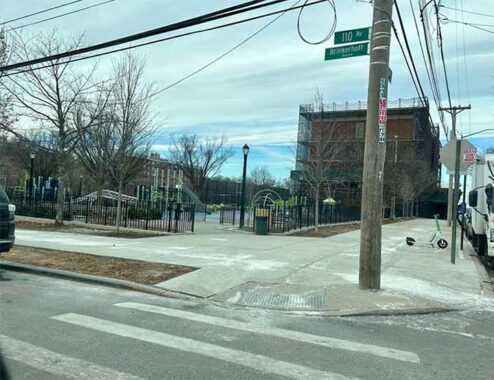
The tallest building on Union Hall Street is P.S. 40 Samuel Huntington School at 110th Avenue, one of hundreds of city public schools designed by CBJ Snyder. The school’s namesake was a signer of the Declaration of Independence. The school shares its block with Jamaica Playground, which serves as its schoolyard. Unfortunately, on my visit to this block, this school was covered by unsightly construction scaffolding.
Note the name on the street sign, Brinkerhoff Avenue. FNY discusses it here.
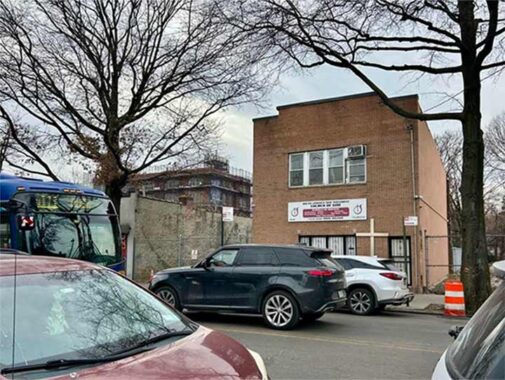
Guy R. Brewer Boulevard is a rare full name street, running from downtown Jamaica to Springfield Gardens. It is the address to many Black churches that give southeast Queens the feeling of a Bible Belt. Its namesake was an influential state assemblyman who served for five terms in office.
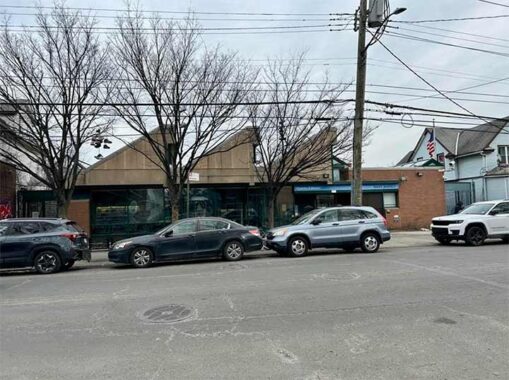
In any neighborhood, the public library is an ideal resource for local history. Completed in 1999, the South Jamaica Library is a pioneer in sustainable architecture, reducing waste and relying on natural light in its design. On my visit, I noted its sizable collection of graphic novels relating to Black history.
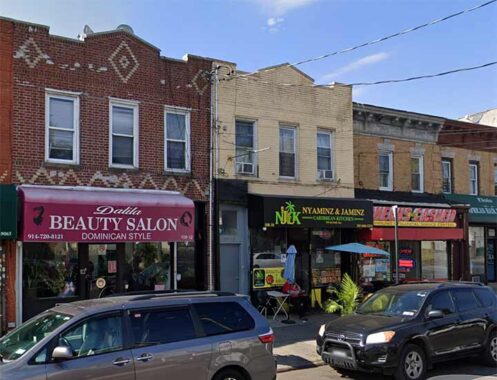
Nyaminz and Jaminz is the name of a Jamaican restaurant on Guy R. Brewer. In this island nation, the patois dialect of English includes West African terms that survived centuries of slavery. Nyam means to eat. Having developed in similar circumstances, Haitian Creole is regarded as a language, but linguists have not assigned this status to Jamaican Patois. In Caribbean neighborhoods, such eateries are also known as jerk shops. It’s not an insult as this word is related to jerky.
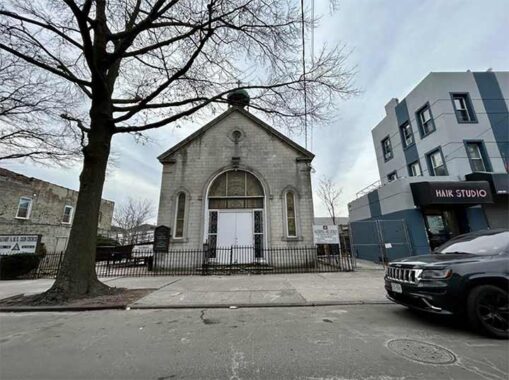
Calvary AME Zion Church, Guy Brewer Blvd. south of Tuskegee Airmen Way, wasn’t initially built for the country’s oldest Black Christian denomination. A brick above its entrance bears the name St. Mark’s Evangelical Lutheran Church, which built this structure. Concerning religious conversions, Hollis probably has more houses of worship that were transferred from one religion to another.
Sergey Kadinsky is the author of Hidden Waters of New York City: A History and Guide to 101 Forgotten Lakes, Ponds, Creeks, and Streams in the Five Boroughs (2016, Countryman Press), adjunct history professor at Touro University and the webmaster of Hidden Waters Blog.
Check out the ForgottenBook, take a look at the gift shop. As always, “comment…as you see fit.” I earn a small payment when you click on any ad on the site.
1/24/26
1 comment
And Union Hall also gave its name to the LIRR station that closed in the 1970’s.