
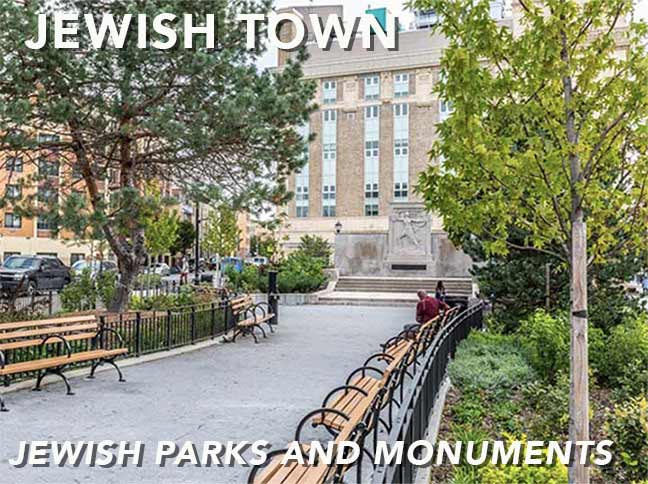


Time for another entry in Sergey Kadinsky’s ongoing series featuring ethnic parks and monuments, following Irish Town, Latino Town and Italian Town. Once again, listings are not presented in strict alphabetical order, and for the sake of brevity, not all listings will have a photo. Images courtesy NYC Parks, Google Street View, Sergey and Kevin; and where noted
AFTER having the list of city parks named after Irish-Americans deleted on Wikipedia for stupid reasons, I brought it back to life on this website. Now, it’s the turn for Jewish American New Yorkers. These parks are arranged alphabetically by borough. This essay is as much about Jewish New Yorkers as it is about Kevin’s travels around the city over the years.
Manhattan
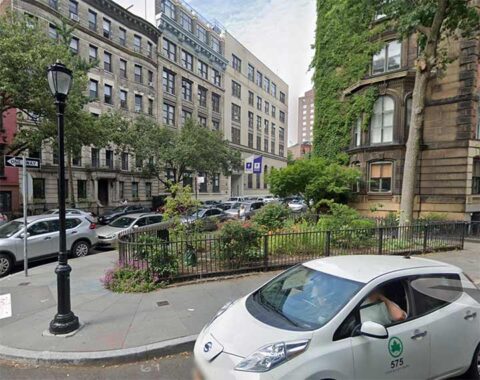
Abe Lebewohl Park in the East Village honors the beloved proprietor of Second Avenue Deli who was killed on the job in 1996. This park dates to 1799, historically known as St. Mark’s Park for the church next to it. This murder remains unsolved. Kevin visited this park during his survey of E. 10th Street in 2020, and Stuyvesant Place in 2012.
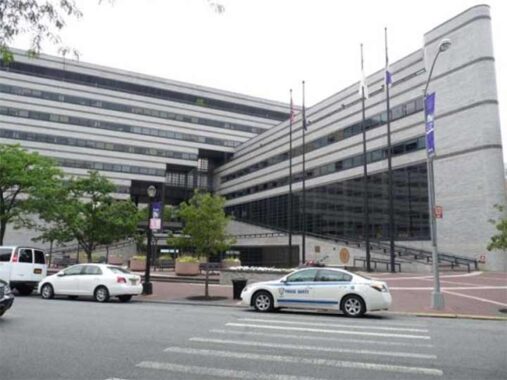
Adolph Lewisohn Plaza is at the corner of the pedestrianized W. 138th Street and Convent Avenue in the CCNY campus. It honors the investment banker and mining executive whose philanthropy included a concert amphitheater that stood here from 1915 to 1973. After the demolition of Lewisohn Stadium in favor of the massive North Academic Center, the plaza in front of the new building was named for Lewisohn in 1985. Walking the length of Convent Avenue, Kevin visited this plaza in 2013. I gave a Forgotten Tour of this plaza in 2004 when I was a student here.
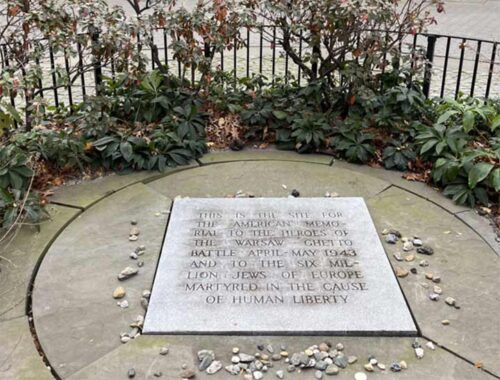
American Memorial to Six Million Jews of Europe in Riverside Park is a granite plaque installed in 1947, in memory of Jews murdered in the holocaust, particularly the Warsaw Ghetto uprising. It was among the earliest such monuments in this country, a cornerstone for a larger project that was not completed. Speaking before 15,000 onlookers, Mayor William O’Dwyer spoke of a monument designed by sculptor Jo Davidson. “It will be 50 feet high and 50 feet in diameter,” The New York Times reported.
Afterwards, new designs were submitted by Percival Goodman in 1949, Erich Mendelsohn and Ivan Meštrović in 1951, in 1964 by Nathan Rapoport, and in 1968 by Louis Kahn. All were rejected for either being too big, ugly, traumatic, or distracting to drivers on the Henry Hudson Parkway, and whether to prioritize martyrdom or resistance. So in the end, a simple block honors the memory of the six million victims.
Manhattan’s larger memorial to the holocaust is the Museum of Jewish Heritage in Battery Park City, which opened in 1997.
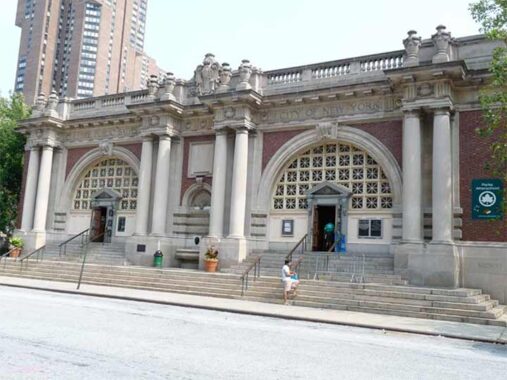
Asser Levy Recreation Center in Kips Bay honors one of the first jews to arrive in New Amsterdam. His surname signifies a descendant of the biblical tribe of Levi. I visited this park in 2012, when Asser Levy Place was pedestrianized and Kevin was here in 2011.
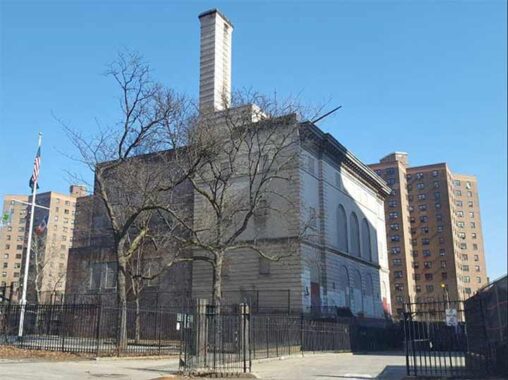
Baruch Playground on the Lower East Side honors a father and son who improved the city’s quality of life and participated in the civic scene. Dr. Simon Baruch would have been forgotten here as a former surgeon in the Confederate Army, but after moving to New York in 1881, he became known as the physician to the poor on the Lower East Side. Seeing their living conditions, he advocated building public bathhouses to reduce illnesses in the crowded tenements. His son Bernard acquired this property and donated it to the city, which built a playground and bathhouse here. The father attended its grand opening in 1901. This bathhouse was later abandoned. A financier, Bernard Baruch is also honored as the namesake of CUNY’s Baruch College and NYCHA Baruch Houses. I visited this park in 2018.
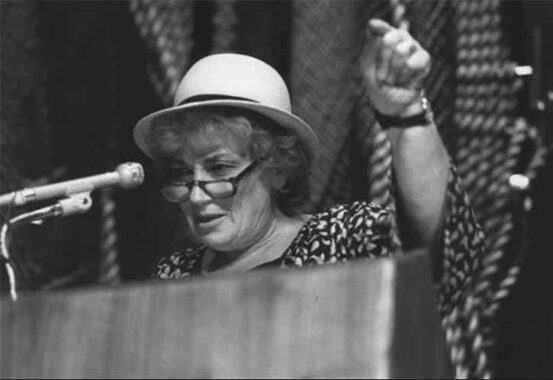
Bella Abzug Park in Hudson Yards honors the big-hatted Congresswoman who represented Manhattan’s west side. Initially designated as Hudson Yards Park, it was renamed for Abzug in 2019, who spoke up for feminist, anti-war, and LGBT causes. In 1976, she ran for Senate, losing in the primary to Daniel Patrick Moynihan, and in the following year she ran for mayor, losing in the primary to Ed Koch. A block of Bank Street in Greenwich Village is co-named for Abzug. I visited this park in 2019.
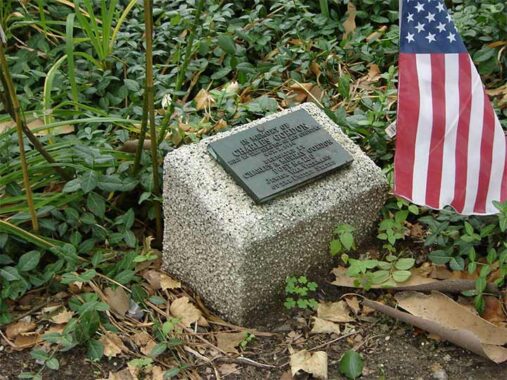
The Charles and Murray Gordon memorial at Fort Washington Park at Riverside Drive and W. 156th Street honors two local Jewish servicemen killed in action in World War I. The plaque was installed in 1925 by the local Jewish War Veterans chapter.
David B. Friedland Square in Washington Heights honors the councilman who represented upper Manhattan from 1965 until his death in 1976. A triangle bounded by Broadway, St. Nicholas Avenue and W. 175th Street, this park is also known as Duarte Triangle to the neighborhood’s sizable Dominican community.
Darlene & Julien Yoseloff Playground in Central Park is named for the son and daughter-in-law of Thomas Yoseloff, who founded a book publishing firm. Located on the northern edge of the park, it was historically known as the 110th Street Playground.
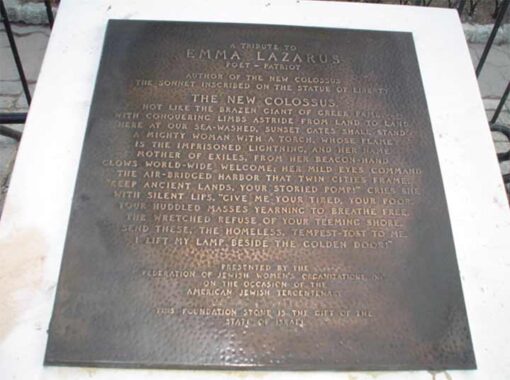
The Emma Lazarus Memorial Plaque in Battery Park honors a local Jewish writer. Another city honor for Lazarus is PS 268 in East Flatbush, which is co-named for her. She is best known for her 1883 poem “The New Colossus” about the Statue of Liberty.
The Fred Lebow Monument in Central Park honors the founder of the New York City Marathon. Designed by Daniel Mitrovich, it was dedicated in 1994, shortly after his death. Born in Romania, this Holocaust survivor organized the first run in Central Park in 1970, with 126 participants. In 1976, the run assumed its five borough route, becoming an event with participants from around the world.
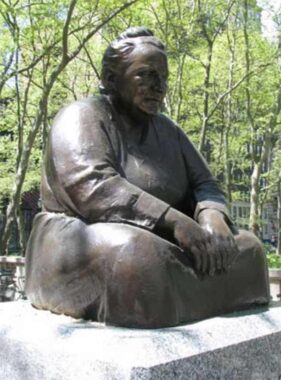
The Gertrude Stein monument in Bryant Park was dedicated by sculptor Jo Davidson in 1992, donated to the city by Dr. Maury P. Leibovitz, an art dealer. A patron of culture, Stein was a friend to Picasso, Braque, and Matisse, among other modernist artists of early 1900s Paris. She later ran a literary salon that influenced writers such as Ernest Hemingway, Sherwood Anderson, and F. Scott Fitzgerald. Stein also wrote her own novels and was open about her lesbian relationship with Alice B. Toklas. Davidson personally knew Stein, depicting her as a symbol of wisdom. Kevin visited this monument in 2012.
|
|
|
|
|
|
|
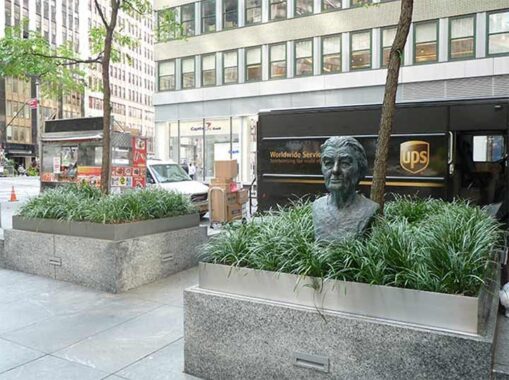
Golda Meir Square in the Garment District honors Israel’s first elected woman leader. A privately owned public space, this plaza was conceived by Malcolm Hoenlein, who proposed it to Jack Weiler, who owned the building on W. 39th Street and Broadway that faces this plaza. The monument was sculpted by Beatrice Goldfine and dedicated in 1979. “The first lesson of what democracy really means, I learned here,” Meir said during one of her New York visits. Kevin visited this park in 2023.
On the opposite side of this building facing Seventh Avenue is The Garment Worker by sculptor Judth Weller. Installed in 1984, it honors Jewish garment workers.
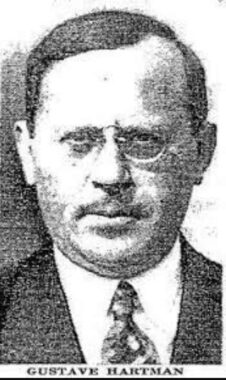
Gustave Hartman Triangle in the East Village honors a municipal court judge and philanthropist. Among his causes was Hebrew Orphan Asylum, which he founded in 1913, a forerunner of today’s Jewish Child Care Association. He lived nearby for nearly his entire life, when this neighborhood was the first home to many Jewish immigrants. The nonprofit Village Preservation has a detailed essay on this park and its namesake. Walking the length of Houston Street, Kevin visited this park in 2005.
|
|
|
|
|
|
|
|
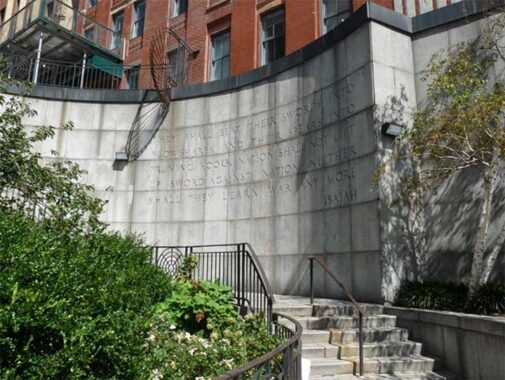
Isaiah Wall at Ralph Bunche Park in Turtle Bay faces the United Nations, an ideal monument with quotations about world peace across the street from an organization dedicated to reducing conflicts. Known in Hebrew as Yeshayahu, this prophet lived in the southern kingdom of Judah. His calls for peace and universal themes made him popular as a source for religious inspiration. In 1981, Mayor Ed Koch named the steps along this wall in honor of Natan Sharansky, a dissident languishing in Soviet prison. After his release in 1986, Sharansky became involved in Israeli politics. Kevin visited these steps in 2020.
The Jacob H. Schiff Playground in Hamilton Heights is across the street from my alma mater CCNY. The park honors the great financier for his support of the Hebrew Orphan Asylum that stood here in the early 20th century. In 1951, the building was converted into an army barracks and then college classrooms. After its demolition in 1952, the site became a park sharing this superblock with P.S. 192 Jacob H. Schiff School.
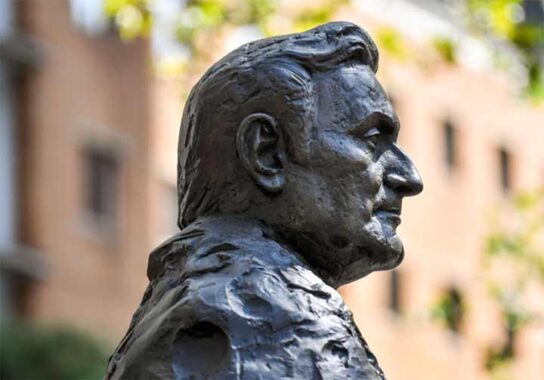
The Jacob Joseph Playground on the Lower East Side is named for for two Jacob Josephs; the school for Rabbi Jacob Joseph (1840-1902) who served as the first and last chief rabbi of New York, whose yeshiva was on this block before relocating to Staten Island; and his great-grandson Captain Jacob Joseph (1920-1942), who was killed in action in World War II at Guadalcanal. Kevin visited this park in 2025.
Jacob K. Javits Playground in Washington Heights honors the local resident who served as state attorney general and as a senator. He is also honored with the federal building in Tribeca and the convention center in Hell’s Kitchen which I visited earlier this year.
James Michael Levin Playground in Central Park was named in 1987 by Philip and Janice Levin in honor of their son, who was killed by a hit and run driver 37 years earlier at age 3. Along with charitable causes, the Levins loved to collect art and supported art museums, including cultural institutions in Israel. Inside this playground is the Loeb Memorial Fountain (see below).
Jerusalem Grove in Battery Park has 15 cedars planted in 1976 by mayor Abe Beame, a gift from his Jerusalem counterpart Teddy Kollek in honor of the “sister city” relationship between the Holy City and the Big Apple. Another example of this is United Jerusalem Way, a street sign installed in 1997 at E. 70th Street at Second Avenue.
The Jewish-American Tercentenary Flagstaff at Peter Minuit Plaza in front of the South Ferry terminal was dedicated in 1954 marking three centuries since the first Jews arrived in New Amsterdam. It contains a plaque commissioned by the state with a relief by Abram Belskie installed a year later.
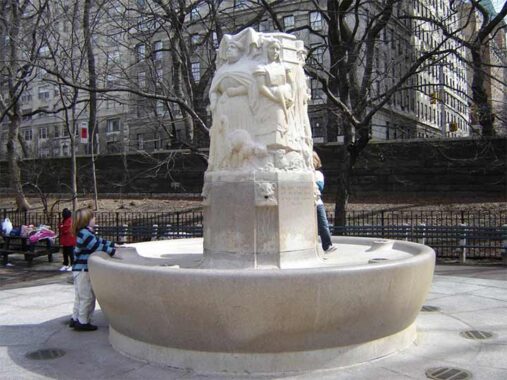
Loeb Memorial Fountain in Central Park’s Levin Playground honors Sophie Irene Loeb with a sculpture installed in 1936, designed by Frederick George Richard Roth. Loeb was a reporter for the New York World who called for social reforms, particularly helping destitute mothers raise their children. In 1915, she founded the Child Welfare Board of New York, which was expanded in 1921 to the Child Welfare Committee of America. Daytonian in Manhattan tells the detailed story of this fountain and its namesake. The family also appears on the map of Central Park with the Loeb Boathouse.
Margaret L. Kempner Playground is named for a daughter of the Loeb family. Historically it was known as the E. 96th Street Playground.
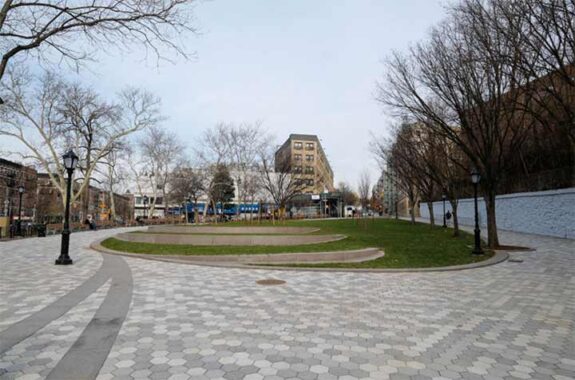
Montefiore Square in Hamilton Heights is where the grid-defiant Hamilton Place merges with Broadway at 138th Street. The park was created in 1906 and named after Sir Moses Haim Montefiore (1784-1885), a wealthy Italian-Jewish businessman who donated large sums to Jewish industry, economic development, education and health care. In 2022, this park was expanded by demapping a block of Hamilton Place next to it. The Bronx’s Montefiore Hospital and Queens’ Montefiore Cemetery are also named for him. Kevin visited this park in 2018.
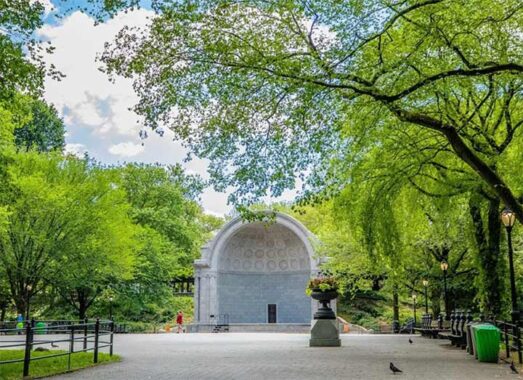
The Naumburg Bandshell in Central Park is named for Elkan Naumburg, a merchant who supported music in the city by sponsoring free concerts in Central Park. Completed in 1923, this bandshell faces The Mall, which serves as a boulevard of monuments deep inside the park.
Nathan Straus Playground on the Lower East Side honors the financier who made his wealth as the co-owner of Macy’s with his brother Isidor. In his role as boss of the world’s largest department store, he created an employee dining hall with full meals for just five cents; and personal gifts of money, clothing, and medical treatment for workers in need. Outside of Macy’s his philanthropy supported city parks and state forests, milk pasteurization, and Jewish settlement in Turkish Palestine. He served as president of the city’s Board of Health in 1898 and as president of the American Jewish Congress from 1918 to 1920. This park opened in 1959 in tandem with P.S.140 with which it shares the block.
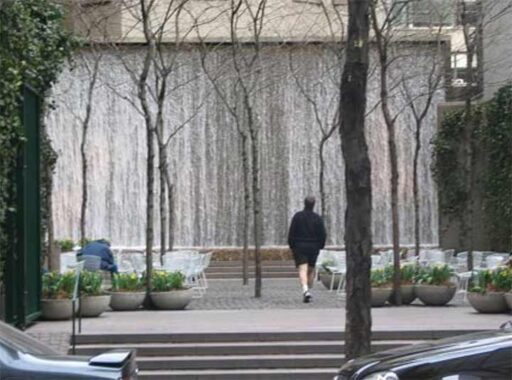
Paley Park in Midtown is a privately operated public space (POPS) financed by CBS founder William S. Paley in honor of his father Samuel. It opened in 1967 as an example of “pocket parks.” The park has tables designed by Eero Saarinen, chairs by Henry Bertoia, an artificial waterfall, walls covered with English ivy, and a fragment of the Berlin Wall. Kevin visited this park in 2005 during his walk on 53rd Street.
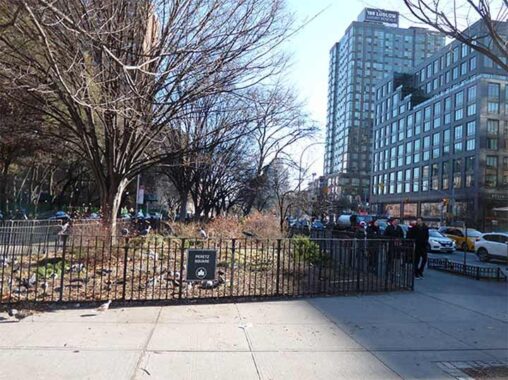
Peretz Square on the Lower East Side was named in 1952 in honor of Isaac Leib Peretz (1851-1915), an attorney, author, essayist and poet born in Poland under Russian rule. He wrote primarily in Yiddish and was known as the “Great Educator” of the Jewish masses. When this park was named, thousands of his admirers attended the ceremony. Kevin visited this park in 2013, then on his survey of E. 1st Street in 2021, and Avenue A in 2025.
Pulitzer Fountain at Grand Army Plaza in Manhattan honors journalist Joseph Pulitzer, who founded the country’s first journalism school. His name also lives on in the highest prize awarded to journalists for their work.
Rapkin-Gayle Plaza in SoHo honors urban planner Chester Rapkin, who is credited with coining the term Soho in a 1962 report that he wrote. It contributed towards saving this neighborhood from urban renewal. In 2022, the city designated the space above a DEP water tunnel shaft as Rapkin-Gayle Plaza, with SoHo preservationist Margot Gayle as the co-honoree.
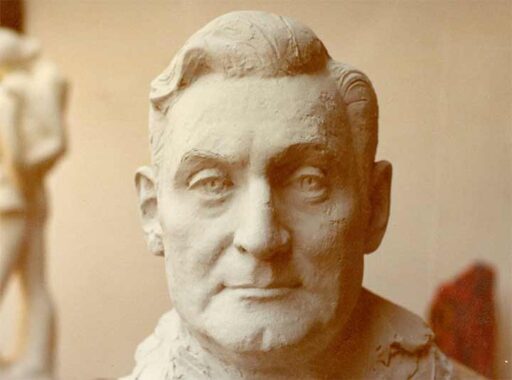
Richard Tucker Park on the Upper West Side is a triangular park bounded by Broadway, Amsterdam Avenue, and W. 66th Street. As it is across the street from Lincoln Center and the Juilliard School, the namesake is a cantor and tenor who had a career of 30 years with the Metropolitan Opera, totalling 715 performances. He sang at Robert F. Kennedy’s funeral, for the troops serving in South Vietnam, and on High Holidays in synagogues. Tucker was buried in Queens. His music lives on with Richard Tucker Music Foundation which supports young talent in opera and in 1979, commissioned a bust of Tucker in this park by Milton Hebald. A copy of this bust was installed at the Tel Aviv Museum of Art.
Rudin Family Playground in Central Park was named for one of the city’s great real estate families whose patriarch Louis Rudinsky bought his first building here in 1902. Among the buildings owned by Rudin is 3 Times Square, which is leased to Touro University, where I teach history.
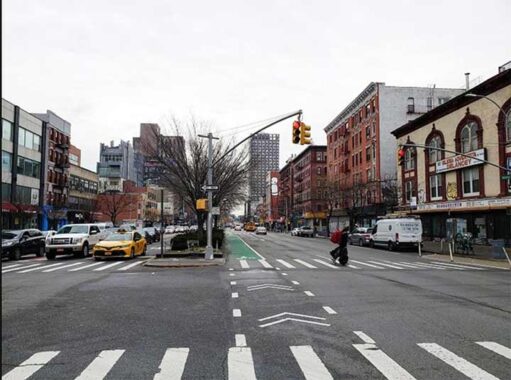
Schiff Malls on the Lower East Side is the designation for the traffic medians of Delancey Street. Jacob H. Schiff belonged to an earlier immigrant wave of German Jews who found success in America and settled on the Upper East Side. As a philanthropist, he did more than simply write a check, he secretly walked the streets of the Lower East Side, quietly observing the causes that he funded and people that benefited from his support. After his death in 1921, the median was named Schiff Parkway. I visited this park in 2020 for my essay on Sara D. Roosevelt Park.
Sidney Hillman Playground on the Lower East Side honors the labor organizer who led the Amalgamated Clothing Workers of America, which founded Amalgamated Bank and the Amalgamated Housing co-op in the Bronx and Cooperative Village across the street. One of the three co-ops in this “village” is named for Hillman, and in turn each building in it also honors a Jewish figure associated with organized labor: Edward Filene, Meyer London, and Louis Brandeis. As clothing manufacturing declined in this country, Hillman’s union merged into larger unions over the decades, with Workers United regarded as its present-day descendant.
Sol Bloom Playground on the Upper West Side honors the local congressman who represented this neighborhood from 1923 to 1949. At the time, most Americans were staunchly anti-immigrant and even as the holocaust was raging in Europe, Bloom urged American Jews not to protest President Roosevelt’s refusal to ease quotas. Prior to politics, Bloom was an entertainment impresario who organized the midway at the 1893 Chicago world’s fair, and developed Manhattan theaters such as the Apollo, Harris, and Music Box.
Sol Lain Playground on the Lower East Side honors a neighborhood activist who lived in the nearby Vladeck Houses. It was named for Lain following his death in 1971. Another honor carrying his name is the Sol Lain Association, which sponsors youth sports events at the playground and back-to-school block parties. The association also helps maintain the playground.
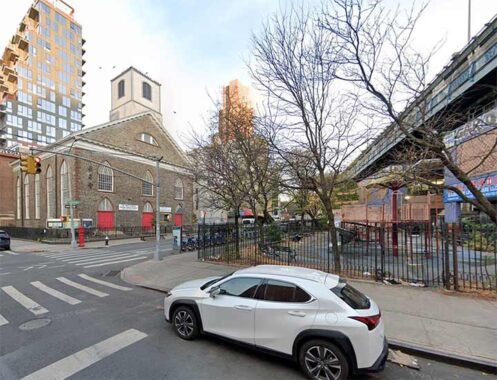
Sophie Irene Loeb Playground, Market Street in Chinatown, honors the social reformer who sought to improve the lives of New York’s poor immigrants. Fittingly, this playground is in that historic immigrant neighborhood in the shadow of Manhattan Bridge bordered by Market Street. She is also honored with a fountain in Central Park. Kevin visited this street in 2022.
Stanley Isaacs Playground on the Upper East Side honors a former Manhattan Borough President and later Councilman who worked with Robert Moses to build the FDR Drive. Like Mayor LaGuardia, Gov. Thomas E. Dewey, and Senator Jacob Javits, he was a liberal Republican elected by voters as an alternative to the corrupt Tammany-run Democratic Party. But when he hired Communist Simon Gerson as his assistant in 1941, the party refused to renominate him. He successfully ran that year for City Council as a Fusionist. His name also appears on the NYCHA project that shares the block with this park.
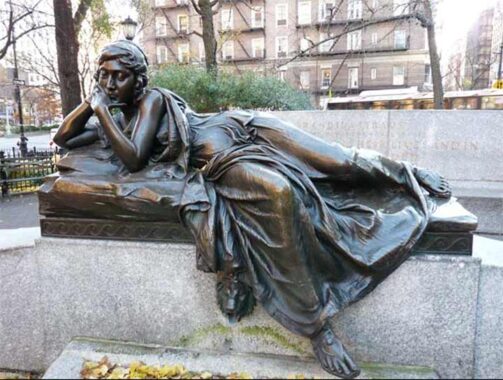
Straus Park on the Upper West Side contains the memorial for local couple Isidor and Ida Straus, who drowned on the Titanic. Famously, Mrs. Straus did not take a seat on Lifeboat No. 8. “We have lived together for many years. Where you go, I go.” She offered her coat and lease on life to her maid Ellen Bird. The couple became known for their heroism. In 1915, the Straus Memorial was dedicated, funded by public donations, designed by sculptor Augustus Lukeman and architect Evarts Tracy.
Previously, this park was known as Schuyler Square and Bloomingdale Square, formed by the merger of Bloomingdale Road and 11th Avenue,which respectively became Broadway and West End Avenue. Kevin visited this park in 2014.
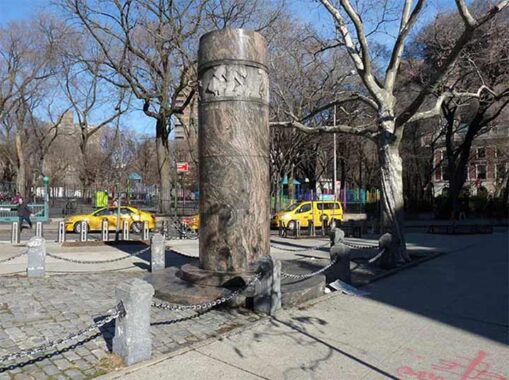
Straus Square on the Lower East Side was named in 1931 shortly after the death of Macy’s owner Nathan Straus whose philanthropy covered many civic and Jewish causes. Previously, it was known as Rutgers Square. This triangular park is formed by East Broadway, Canal Street and Essex Street. With the pedestrianization of the segment of Canal Street here, Straus Square is effectively connected to Seward Park. Kevin visited this park in 2023 and in 2019. I was here in 2025.
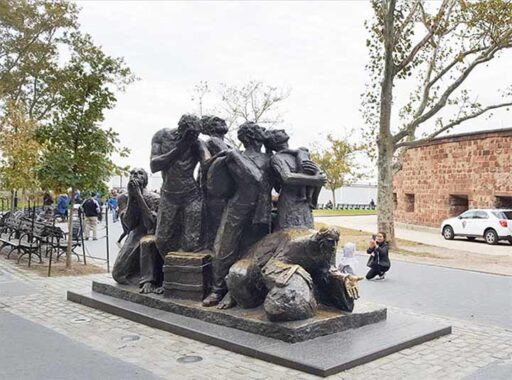
The Immigrants Sculpture in Battery Park honors the site’s historic role as a port of arrival for newcomers. Designed by Luis Sanguino, it stands in front of Castle Clinton. It was sponsored by developer Samuel Rudin, whose parents came from Belarus in 1883 and initially settled on the Lower East Side. I visited this monument in 2023 for my survey of Battery Park.
Vladeck Park on the Lower East Side honors labor activist Baruch Charney Vladeck, who faced persecution from imperial Russian authorities for his leftist views. He arrived in New York in 1908. He worked at the Forward newspaper and ran for office as a Socialist. He later organized labor groups, served on the board of NYCHA, and in the last year of his life, was elected to the City Council. A half million mourners followed his casket through the Lower East Side. Vladeck’s descendants followed him into politics, such as great-grandson Stephen Vladeck, a professor at Georgetown Law. Vladeck’s name also appears on the NYCHA project with which it shares the block.
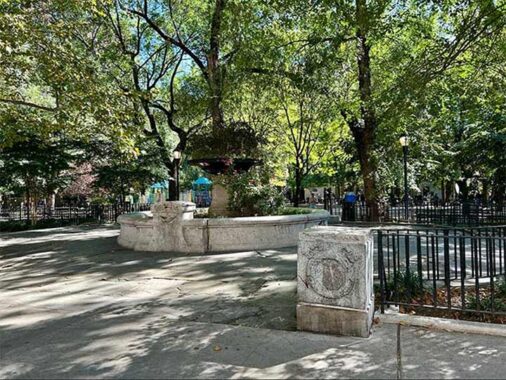
Schiff Fountain in Seward Park on the Lower East Side was initially placed in nearby Straus Square in 1894, a gift from Jacob H. Schiff. It was designed by Arnold W. Brunner, a Beaux Arts architect who also designed the Asser Levy Bathhouse. This fountain was moved in 1931 to its present location after the subway tunnel was constructed under Essex Street. I visited this fountain in 2025 for my survey of Seward Park.
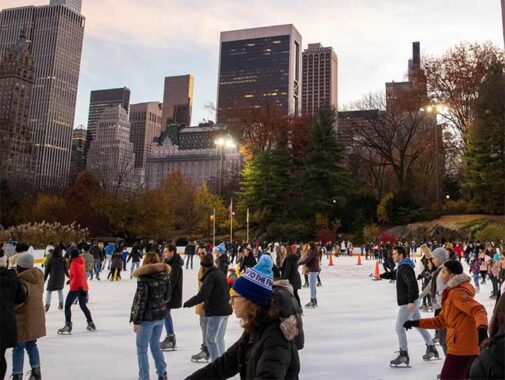
Wollman Rink in Central Park honors philanthropist Kate Wollman who donated funds in 1949 to build this ice skating rink. Her parents were German Jews who supported abolishing slavery. Her father participated in the Civil War, her great uncles Henry and Richard Bloch founded H&R Block. Generational wealth inherited by Wollman benefited many charitable causes in New York, including this skating rink. Wollman’s name also appeared on the original ice skating rink in Prospect Park, which was later rebuilt and renamed for the LeFrak family.
Bronx
The Ben Abrams Playground on Bronx Park East north of Lydig Avenue honors a cafe owner whose business stood on nearby Holland Avenue. He was an active member of the local Democratic club, the Pelham Parkway Jewish Council, B’nai B’rith, and as a volunteer at Our Lady of Mercy Hospital.
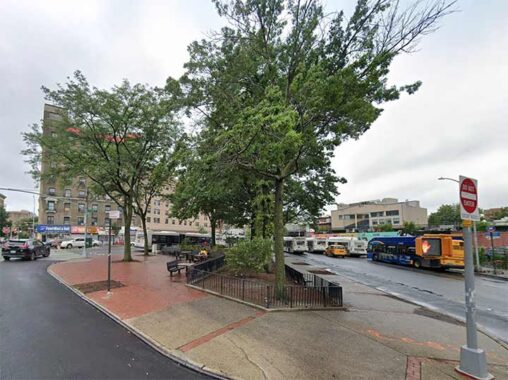
Benjamin Gladstone Square honors an attorney who was involved in the Hebrew Kindergarten and Infants Home and the Bronx County Bar Association. A champion of organized labor, school reform, and unemployment benefits, he served in the State Assembly in the last year of his life. After his death, Fox Triangle was named for him. I visited this park in 2023.
Charles M. Lee Triangle near Pelham Parkway honors a Bronx Republican activist who served as an Assistant U.S. Attorney, B’nai B’rith member, and Bronx County Bar Association member. Two years after his death in 2001, this space was named for him. This triangle is bounded by Paulding Avenue and a split in Bogart Avenue. A block to the south is the very short Woodmansten Place, which Kevin visited in 2012.
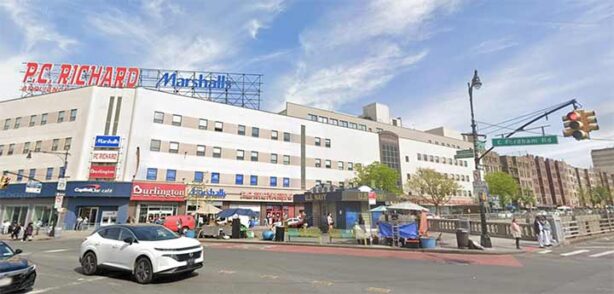
George Farkas Square marks the Fordham Road overpass above Grand Concourse, facing the massive Two Fordham Square building that had the flagship Alexander’s department store, which Farkas named for his father. By 1992, the company was bankrupt, shutting all of its 11 stores and laying off 5,000 workers. Its properties lived on as a real estate investment trust managed by Vornado. This plaza was named for Farkas in 1980 following his death. Puerto Ricans moved in and this plaza was since co-named to also honor rapper Big Pun, and Marine Cpl. Ramona Valdez. Kevin visited this location in 1999 and in 2000 when it was Caldor’s, and again in 2011 when it was a P.C. Richards.
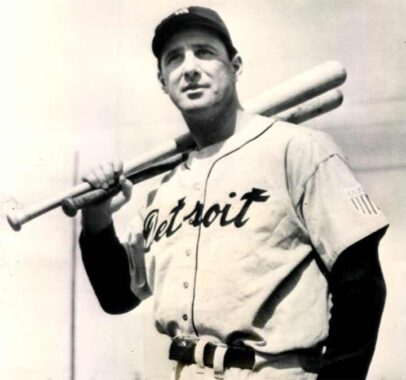
Hank Greenberg Ballfield in Crotona Park honors a son of the Bronx who made Jewish boys proud, on the field as one of the earliest Jews in in Major League Baseball, a visible counterpoint to antisemitism, and serving longer during World War Two than any other professional ballplayer. He returned to the field in 1945, with the Detroit Tigers winning the World Series. Just before retiring, he was among the few players who warmly welcomed Jackie Robinson to the major leagues. A true mensch.
Harold Rapkin Plaza is the Esplanade median at Paulding Avenue facing the Morris Park subway station. The namesake was a leader of the local Jewish War Veterans chapter. Rapkin also involved in promoting the naming of a nearby plaza in honor of Yonatan Netanyahu, the crosswalk at Pelham Parkway South and Muliner Avenue for Raoul Wallenberg and the corner of Pelham Parkway South and Cruger Avenue as ‘Jewish War Veterans of the USA and Ladies Auxiliary Lane’. Rapkin died in 1997, with this plaza named for him four years later.


The Heinrich Heine Fountain in Joyce Kilmer Park honors the romanticist German poet whose work “Lorelei” is the alternative name for this monument. Kevin describes it in detail on his 2009 visit to this park. Designed by Ernst Herter, this monument was installed in the Bronx in 1899 after being rejected by Heine’s native city of Dusseldorf. Perhaps to make amends, when the long-vandalized fountain was restored in 1999 on its centennial, the keynote speech was delivered by Wolfgang Scheffler, Deputy Mayor of Dusseldorf. That city has a university belatedly named for Heine.
Keltch Park in Highbridge honors Ensign Rubin Ketch who was killed when his patrol gunboat USS Plymouth was hit by a German u-boat torpedo off the coast of New Jersey on Aug. 5, 1943. Keltch rescued at least a dozen men, going back into the sinking ship that was on fire, going down with it. The purple heart posthumously awarded to him unexplainably ended up at an estate sale in Vermont in 2018. Buyer Jeff Kauffman tracked down Keltch’s relatives and a ceremony in this park handed them the medal. Kevin visited this park in 2015.
The Netanyahu Memorial at Pelham Parkway and Holland Avenue honors the heroic commander of the 1976 Entebbe Raid in which Yonatan Netanyahu was killed by Ugandan guards while his men rescued all but four of the 106 hostages held by Palestinian terrorists. He was the only Israeli killed in that operation. His bravery inspired Jews around the world. In 1977, the local chapter of the Zionist Organization of America in partnership with the Queens-based Sprung monuments, installed a stone plaque here honoring him. Yonatan’s younger brother Benjamin also secured his place in history books as Israel’s longest ruling Prime Minister. Kevin visited this location in 2010.
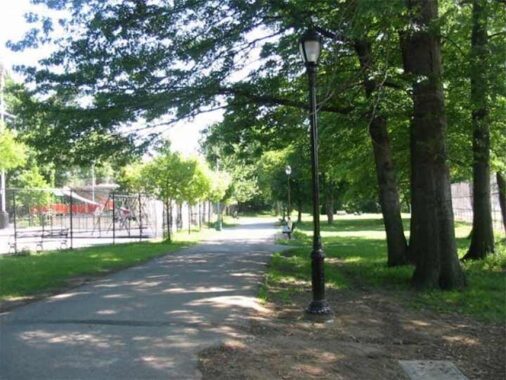
Oscar Comras Mall is the lawn near the intersection of Bronx Park East and Boston Road. It honors the neighborhood activist who brought the New York Philharmonic Orchestra to the nearby New York Botanical Garden. He further fulfilled his dream by arranging for performances of orchestral and band concerts throughout the summer months in Bronx Park. This space was named for Comras in 1967. His widow Blanche Rifkin Comras was also active in many local causes. In 2018, the corner of Pelham Parkway South and Bogart Avenue was co-named Blanche Comras Rifkin Way in her memory.
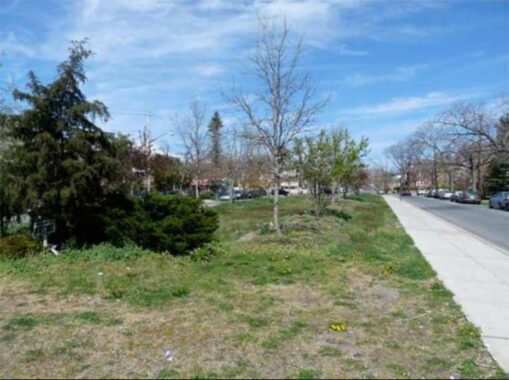
Private Sidney Weissman Memorial Plaza is on the Esplanade at Astor Avenue covering the Dyre Avenue Line in Pelham Parkway. Weissman, 30, was killed on November 27, 1943, After serving in Oran, Algeria, he was sent aboard the HMT Rohna en route to India. A German bomber sank the ship, killing 1,138 of the crew, most of them Americans. This park was named for Weissman in 1962. Kevin visited this park in 2012 on his tour of the Dyre Avenue Line.
Sid Jacobs Ballfield at Bronx Park East honors the coach of the Pelham Parkway Little League, who organized its games until his death in 1972. since 1960 and was its vice president in 1967.
Senator Abraham Bernstein Square at Pelham Parkway and White Plains Road honors the local lawmaker who represented this section of the Bronx from 1961 until his death in 1990. Among his unsuccessful causes in office was an attempt to ban pro wrestling. His name also appears on nearby P.S.105 Sen. Abraham Bernstein School.
Brooklyn
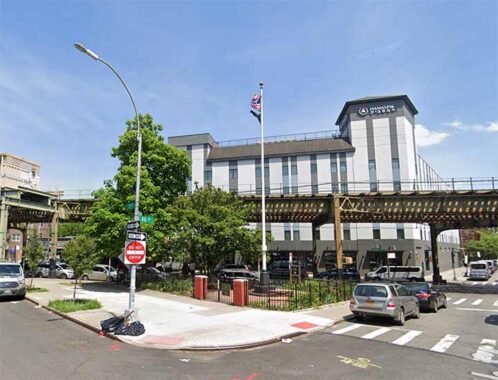
Alben Triangle, 11th and New Utrecht Avenues in Borough Park, honors local World War One soldier Binyamin “Bud” H. Alben, who was mortally wounded in Sept. 1918 in the battle for Bois-le-Pretre, France. Mistakenly given a Christian burial, his remains were disinterred and reburied under Jewish customs in 1921. Two years later, the Bud H. Alben VFW Post #1436 petitioned the city to name this triangle for the local war hero. Kevin visited this park in 2007, then in 2016, and again in 2022.
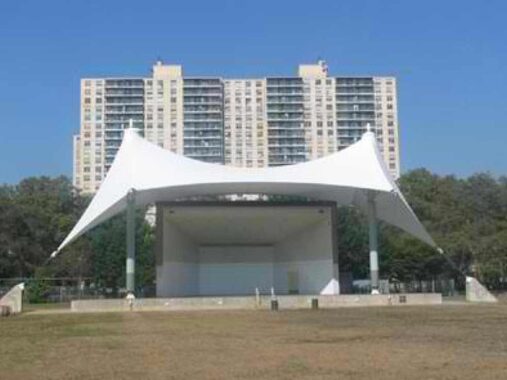
Asser Levy Park in Brighton Beach honors one of New Amsterdam’s early Jewish settlers. Previously, it was known as Seaside Park, designated as a public space by the city of Brooklyn in 1876. It was renamed a century later in recognition of the neighborhood’s sizable Jewish community. Inside this park is the Sidney Jonas Bandshell, named for the labor organizer who also brought musical talent to this park. The bandshell was named for him in 1998. The park marks the southern end of Ocean Parkway, where it curves into Surf Avenue. Kevin visited this park in 2005.
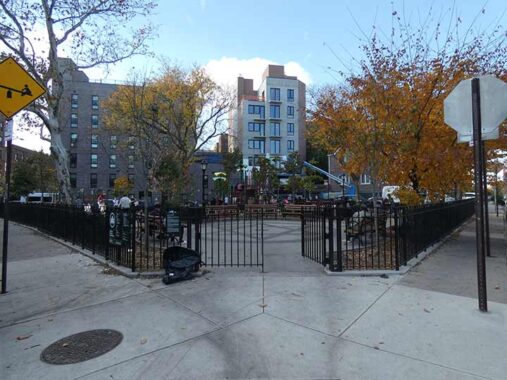
Babi Yar Triangle, Corbin Place in Brighton Beach, was named in 1981 on the 40th anniversary of the massacre at the Babi Yar ravine outside Kyiv in which the Nazis and their Ukrainian collaborators executed 33,711 Jews. Since the 1970s, Brighton Beach has been the first American home for many Jewish refugees from the Soviet Union, where communist authorities suppressed holocaust commemorations that focused on the primary victims. This park serves as a reminder that this massacre is not forgotten. Following Ukrainian independence, memorials were built at the ravine to commemorate Jewish victims. Kevin visited this park in 2006.
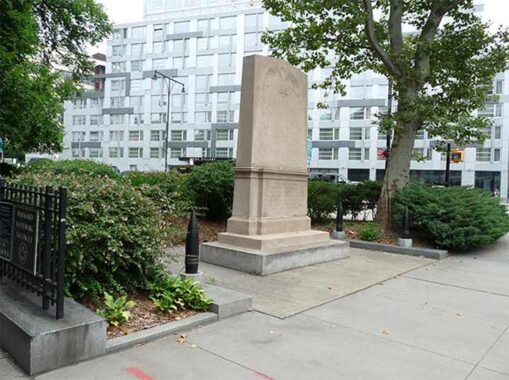
Bernard Weinberg Triangle in downtown Brooklyn is formed by Flatbush Avenue, Tillary Street and a demapped portion of Bridge Street, which now connects this little triangle to McLaughlin park. The park has a memorial for local World War I casualties, but they are not connected to Weinberg. The NYC Parks site is silent on the namesake, which is why we have Forgotten-NY. Weinberg was a local resident killed in action during the liberation of France in 1944. He was 19. This park was named for Weinberg in 1952. Kevin visited this park in 2014 and in 2025.
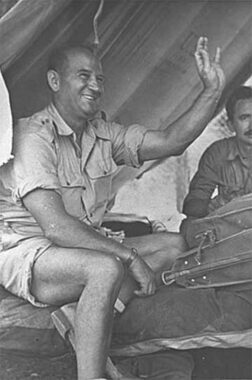
Colonel David Marcus Playground in Midwood was named on Oct. 11, 1948 with words of praise from President Truman and Mayor O’Dwyer. Son of Romanian Jewish immigrants, he excelled in law, prosecuting Lucky Luciano and serving as the corrections commissioner. On the eve of World War Two, he became a legal officer in the military and at age 44, parachuted into Normandy.
Witnessing the death camps and Nuremberg trials, he became a zionist and volunteered to serve in the newly formed Israeli army as its first general, tasked with opening the road to Jerusalem. He was killed by friendly fire and buried with honors at West Point. In 1966, his experiences were retold in Cast a Giant Shadow, an action film starring Kirk Douglas as Marcus. His name also appears on P.S. 217.
In Israel, Marcus’s name appears on the Mishmar David kibbutz, and streets in Jerusalem, Tel Aviv, Haifa, and Afula, among other places.
|
|
|
|
|
|
|
|
Dome Playground in Borough Park honors Jessie and Charles Dome. Charles Dome was a member of Community Board 12 and the Board of Trustees of Temple Emanuel of Boro Park. He was a founding member of the Roosevelt Democratic Club. Jessie Dome was a school teacher in the public school system for thirty-five years. She was a member of the Sisterhood of Temple Emanuel of Boro Park and a volunteer at Maimonides Hospital. She passed away on October 31, 1987. This park was named for the couple in 1988.
As for their beloved temple, once a diverse Jewish neighborhood, Borough Park gradually became almost entirely Orthodox. Temple Emanuel was sold to a Hasidic school and later demolished.
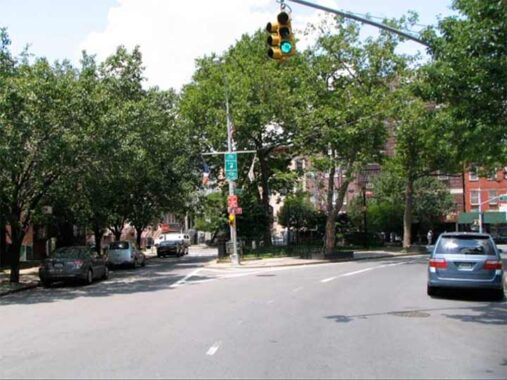
Harold W. Cohn Memorial Square in Williamsburg honors a local politician who was not too old to fight the Nazis. At age 31, he signed up and participated in the Battle of the Bulge. Cohn represented the neighborhood in the State Assembly from 1959 to 1968. The park was renamed for Cohn in 1985, eleven years after his death. Previously it was known as Joseph A. Wynn Circle, honoring a local casualty of World War One. In 1991, Friends of Cohn Park commissioned a monument to Cohn sculpted by Stanislaw Lutistanski. Cohn’s surname is related to Cohen, representing the priestly descendants of Aaron. Kevin visited this park in 2014.
Harry Maze Playground in East Flatbush honors the councilman who represented this neighborhood from 1966 to 1969. While his tenure in elected office was short, he was active in many civic causes,as president of the Winthrop Community Club, vice-president of the Humanity Club, and member of the Board of Trustees of the Congregation of Shaari Israel. This park was named for Maze in 1973, two years after his death. The surname Maze is a Hebrew acronym denoting a kohen, the priestly descendant of Aaron. As for his synagogue, it disbanded in 1991, with a Pentecostal church purchasing the building.
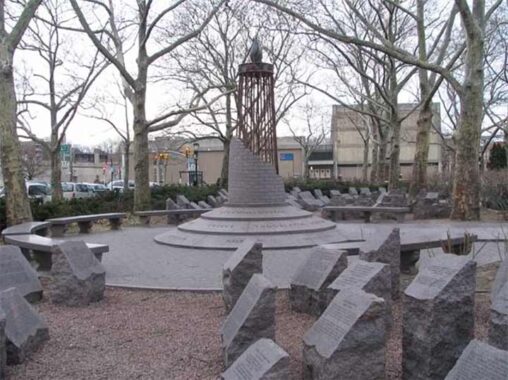
Holocaust Memorial Park in Sheepshead Bay is at the head of the bay, containing monuments relating to the massacres, ghettoes, and death camps where a third of the world’s Jews were subjected to genocide. Memorial gatherings take place in this park on days relating to Holocaust commemoration. The park was designated in 1986, with the monument completed in 1997. Kevin visited this park in 2006.
Irving Schloss Triangle in Brighton Beach honors the D-Day veteran and founder of the Brighton Neighborhood Improvement Program. Under his leadership, BNIP gained national acclaim as an effective crimefighting group. This park is bounded by Neptune Avenue, East 12th Street and Guider Avenue. I researched its history in 2019.
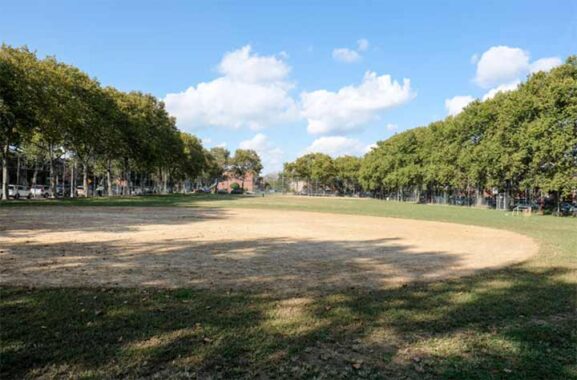
Jacob Joffe Field in Flatlands honors the local resident who founded Futurama Civic Association. Joffe was born in British Palestine, fighting against the Nazis in the Jewish Brigade of the British Army. After the victory, he returned to his home and served in the newly-formed Israeli army during its war of independence. In 1950, Jacob and his wife Natalie immigrated to New York, settling in Brooklyn. He died in 1962, the year when the city developed this park. Futurama was the name of the attached housing development surrounding this park, a name later popularized by Matt Groening’s sci-fi animated sitcom.
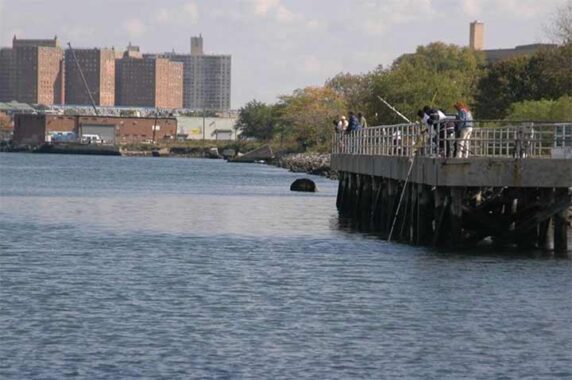
Kaiser Park in Coney Island honors Dr. Leon S. Kaiser, a local educator who served as principal of Mark Twain Junior High School, which borders on this park. A resident of Coney Island, Kaiser was active in professional, civic, and Jewish causes, serving as chairman of the Building Fund Committee for the Coney Island Jewish Center. Marie Lorenz, Duke Riley and “Movie Mike” Olshan rowed past this park in 2006 on their visit to Coney Island Creek.
Kolbert Playground in Midwood honors pvt. Paul W. Kolbert, a local resident who fought on the western front in World War Two. During a battle to retake the town of Binsfield, Luxembourg in 1945, Kolbert was killed while providing needed cover fire for the evacuation of his fellow soldiers. He was buried with honors at Union Fields Cemetery.
Inside this park, there are two more Jewish individuals with place name honors. Rachel Haber Cohen Playground honors the City Hall staffer who assisted Mayor Giuliani with millennium celebrations, dying shortly afterward in March 2000. Rivka Greenberg Trencher Swing Area honors the activist mother who protested the park’s redesign in 1982, advocating to restore the swings. In 1984, Trencher learned that she had a serious illness. Given only a year to live by doctors, she surpassed all expectations and fought the disease for seven years.
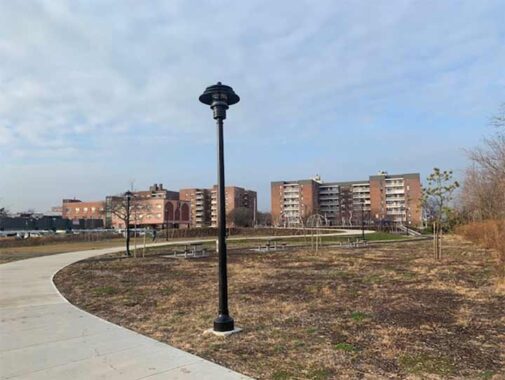
Lew Fidler Park in Sheepshead Bay honors a popular councilman who represented this neighborhood from 2002 to 2013. I remember volunteering on his unsuccessful State Senate run in 2012, when his posters had a logo featuring a violin and bow. In Yiddish his surname translates as “fiddler” indicating a musician among his ancestors. This new park was named for Fidler in 2022, a year after his death. I visited this park shortly after its opening.
Rapaport Playground in Borough Park is named for local civic activist Betty Kornblum Rapaport, a lifelong resident of this neighborhood. Her family was among the founders of Congregation Beth El. She was a supporter of the Infants Home of Borough Park. Betty Rappaport was also involved with the YMHA of Borough Park. Most people carrying this last name are descended from 15th century rabbi Avraham Menahem ben Yaakov ha-Kohen Rapa, who lived in Porto, Italy. As a kohen, he and his male descendants represent the priestly caste that originated with the biblical prophet Aaron.
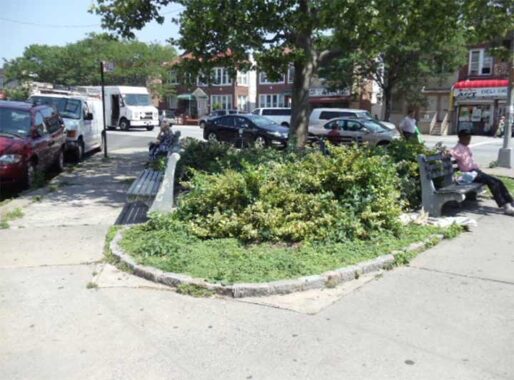
Samuel Goldberg Triangle in Bensonhurst honors a local civic activist. With his eyesight too poor for military service in World War Two, this patriot enlisted in the city’s civil defense, which coordinated childcare, carpooling, nutrition education, and rationing, among other needs. In peacetime, he led the Marlboro Civic League, which advocated for this triangle to become a park. The park was named for Goldberg after his death in 1985. This park is formed by the collision of three street grids: Avenue O, 65th Street, and West 3rd Street.
Sobel Playground in Williamsburg honors Private Louis Sobel, who was killed in action at the Second Battle of the Marne on July 18, 1918. At the time of this park’s dedication on May 15, 1938, it was the first public space in New York City to be named for a Jewish war hero. The last name is derived from “sable,” indicating a possible ancestor in the fur trade.
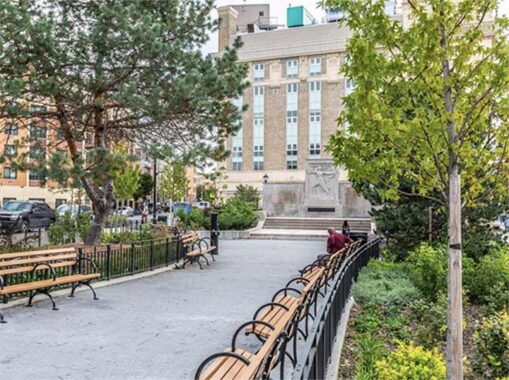
Zion Triangle, Pitkin and East New York Avenues in Brownsville, has had three names in its history. Initially it was Vanderveer Park in honor of the landowner who donated land for it. In the 1920s, Brownsville was one of the most Jewish neighborhoods in America and residents had it renamed Zion Park following the dedication of the park’s war memorial. In 1930, it was renamed Loew Square in honor of Loew’s Pitkin Theatre that stood next to the park; its founder was Jewish. He was also a founder of MGM Studios. But local residents continued to call it Zion Park and the name was officially restored in 1987. Kevin visited this park in 2014 and with more details in 2005.
Queens
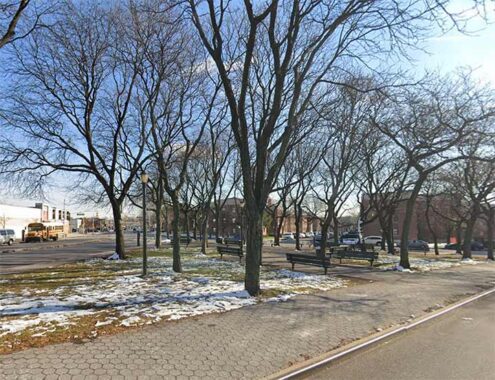
Abe Wolfson Triangle in Kew Gardens Hills is marked by a split in Kissena Boulevard at 72nd Road. The namesake was one of the founders of the Queens Historical Society at the young age of nineteen, serving as its first president. As an environmental activist, he also founded the Flushing Meadows Park Action Committee and fought for the cleanups of the Flushing River and Meadow Lake. Wolfson died in 1971 at age 21 while learning to fly in a single-engine Cessna. Kevin visited this park in 2015.
Arthur J. Katzman Playground at Yellowstone Park in Forest Hills honors the city councilman who made this park possible in 1968. He served in office from 1962 through 1991, before term limits came into effect. I visited this park in 2021. Katzman was born in Belarus during the Russian Empire, representing an earlier wave of Jewish immigrants.
By the time of his retirement, a second wave of Jewish immigrants from that region was arriving in New York as the Soviet Union was collapsing. This included my extended family, which initially settled in Rego Park and Forest Hills.
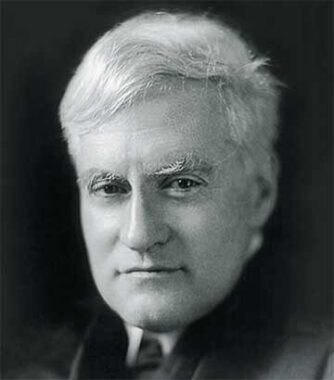
Cardozo Playground, Arverne Blvd. and Beach 57th in Arverne, honors Supreme Court justice Benjamin Nathan Cardozo. His family lived for many generations in New York’s historic Sephardic community, with his surname originating in medieval Portugal. His name also appears on a public high school in Bayside, and Yeshiva University’s law school in Manhattan. The park shares its block with PS/MS 333, which is co-named for Cardozo.
|
|
|
|
|
|
Ehrenreich-Austin Playground in Forest Hills is located on Austin Street and honors Leo Ehrenreich, a real estate agent who was nicknamed the “one man civic association” for his many accomplishments on the neighborhood level, such as securing federal funding to widen widen Austin Street, installing traffic signals and parking meters, and convincing Parks Commissioner Robert Moses to build a park here. He died in 1962 and his name was later added to this park.
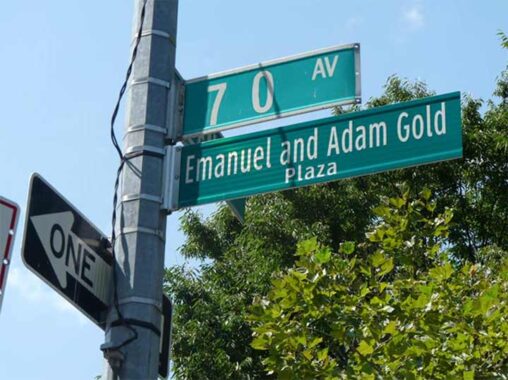
Emanuel and Adam Gold Plaza at MacDonald Park on Queens Boulevard in Forest Hills honors a local State Senator who served from 1971 to 1998. I’ve been active in politics from a young age, writing to politicians and newspapers. When I was a student at PS139, he was the first politician who wrote a letter back to me.
Gold authored more than 80 laws including the “Son of Sam” law that blocked notorious criminals from making money by publishing their stories. When the law was overturned by the U.S. Supreme Court in 1991 on First Amendment grounds, Gold worked to craft a new version eliminating the deficiencies found by the high court. Adam was one of his five children. Born with a disability, he worked as a staffer for lawmakers, a visible reminder on the working potential of individuals often overlooked. The plaza was dedicated in 2013 shortly after Emanuel’s death. Kevin visited this park in 2020.
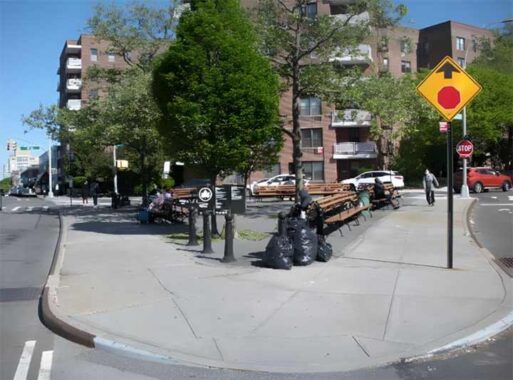
Federoff Triangle, Queens Blvd. at 102nd St. in Forest Hills honors Barnett (Barnie) and Gussie Federoff who once lived near this triangle. Gussie was a member of the Washington Heights branch of the Hadassah and raised money for the United Jewish Appeal. She died on December 16, 1967. Barnett is remembered for being the first president of the Senior Citizens Society of Lost Battalion Hall Recreation Center. He died on February 10, 1970. Local historian Michael Perlman concedes that there’s little information available on the namesakes and wrote a story about this park in 2017 in Queens Ledger, which led to Federoff descendants responding with more details on their lives. Gussie used to be a common name among Ashkenazi women in the early 20th century, but these days you’re more likely to see it on a tombstone.
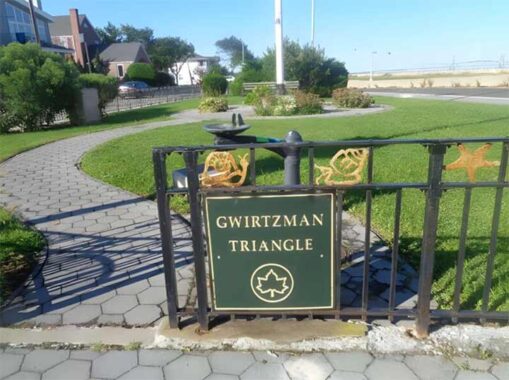
Gwirtzman Triangle, Beach Channel Drive and Cronston Avenue in Neponsit, honors civic activist Leroy H. Gwirtzman. The park is bounded by Beach Channel Drive, Beach 144th Street, and Cronston Avenue. The namesake served as president of the Neponsit Property Owners Association, was a member of Queens Community Board 14, the 100th Precinct Mobile Observation Patrol, and Jewish War Veterans. He died in 1992 and this park was named for him eight years later.
Haym Salomon Square, Main Street and Vleigh Place in Kew Gardens Hills, honors the financier and spy of the American Revolution. This triangle is bound by Main Street, Vleigh Place, and 72nd Road, facing the neighborhood’s public library. It was given this name in 1976 on the occasion of this country’s bicentennial.
Ilse Metzger Sitting Area, 78th Avenue and 113th Street, is at the southern edge of Flushing Meadows-Corona Park in Forest Hills. Born in Austria, she escaped the Nazis in 1938, spending the war in Britain. After immigrating to New York in 1946, she became active in the local Democratic Party, serving as a district leader for Forest Hills and Kew Gardens, along with Councilman Morton Povman. Metzger also worked with the Boy Scouts, Hadassah, and the local civilian crime patrol. Metzger died in 1981 and this sitting area was named for her two years later.
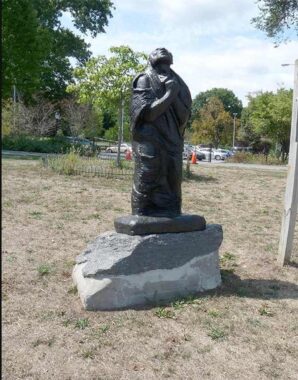
The Job Sculpture, Park Lane at the northern edge of Forest Park, was created in 1968 by Natan J. Rapoport to mark the twentieth anniversary of the founding of modern Israel. The sculpture expresses the universal suffering and ultimate test of faith that was endured by the biblical figure and victims of the Holocaust. Kevin visited this artwork in 2022.
The Judge Moses Weinstein Playground in Kew Gardens Hills honors the World War II veteran, six-term state assemblyman, Chair of the Queens County Democratic Organization, and judge. Formerly known as Vleigh Place Playground, it was renamed for Weinstein in 2008, a year after his death. It lies on a triangular plot bounded by Vleigh Place, Union Turnpike, and 141st Street, near his house.
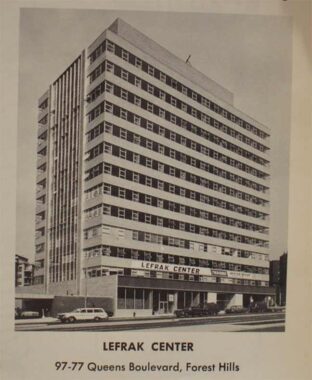
LeFrak Memorial Square in Rego Park is where 65th Avenue and 98th Street merge to intersect with Queens Boulevard. Overlooking this crossroads is LeFrak Center, an office tower named for this family of real estate developers. A mile to the north is LeFrak City. Patriarch Harry LeFrak was an immigrant from France raised on the Lower East Side. His firm built more than 400 apartment buildings citywide. His son Samuel’s philanthropy involved hospitals here and in Israel, a music record label, and the grassland around Willow Lake. The matriarch Sarah brought the family to Forest Hills in 1953. In addition to the LeFrak Foundation, her charitable efforts included the Women’s Zionist Organization of American and State of Israel Bonds.
[originally spelled Lefrak; the family restyled it “LeFrak” to look more French]
Rabbi Kirshblum Triangle in Kew Gardens Hills honors the longtime rabbi of the Kew Gardens Hills Jewish Center. It is bound by Main Street, Vleigh Place, and 75th Avenue. From 1946 until his death in 1983, he had the pulpit at Kew Gardens Hills Jewish Center, the neighborhood’s only Conservative synagogue. Rabbi Irving Usher Kirshblum was also active in the Zionist Organization of America, Queens Legion of the National Conference of Christians and Jews, and president of the Queens Interfaith Clergy Council, and the board of Queens Library.
Sobelsohn Playground in Forest Park honors Kew Gardens resident William Sobelsohn. He led the Sobelsohn School in Manhattan that trained people for business careers, served as treasurer of the New Frontier Regular Democratic Club, was active in the Kew Gardens Civic Association and nearby Congregation Anshe Sholom. His distinct synagogue appears in the AIA Guide, a modernist structure amid century-old mansions. I visited that synagogue in 2011.
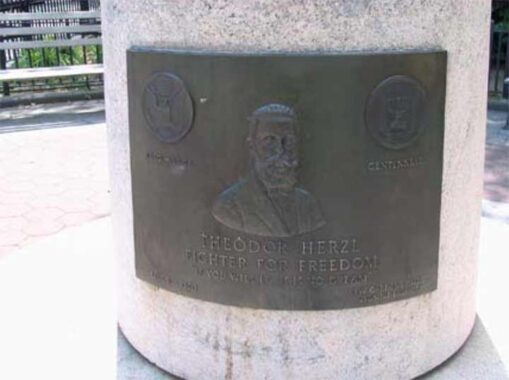
Theodor Herzl Memorial at Freedom Square in Kew Gardens Hills is a plaque installed on a flagpole in 1960, the centenary of Herzl’s birth. The neighborhood has a sizable Jewish community evident in the many kosher stores and yeshivas on the surrounding blocks. The Hungarian-born lawyer and journalist is the founder of political zionism, which advocated for an independent Jewish state. Herzl is also honored with a street in Brownsville, Brooklyn. Kevin visited this park in 2008.
Wallenberg Square in Forest Park honors Raoul Wallenberg, the Swedish diplomat who saved the lives of thousands of Hungarian Jews in the last year of World War Two. When the Red Army captured Budapest, he was arrested and died in a Soviet prison. For decades, the Soviets refused to acknowledge his date of death. Wallenberg is also honored with a sculpture on 1st Ave. near the UN Secretariat building and by a public forest in Riverdale, Bronx.
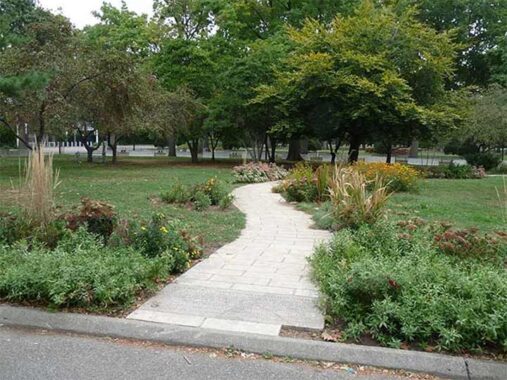
Yitzchak Rabin Walk in Flushing Meadows-Corona Park honors the Israeli Nobel Peace laureate who negotiated peace with the Palestinian Authority. He was assassinated by a Jewish extremist for daring to wage peace. The path is situated in the Yitzhak Rabin America-Israel Friendship Grove, which Kevin visited in 2024. Next to it is the Queens Museum, where the UN voted in 1947 to create the State of Israel and Palestine alongside it. The grove has a Lebanese cedar, perhaps in hope of eventual peace between Israel and its northern neighbor.
Staten Island
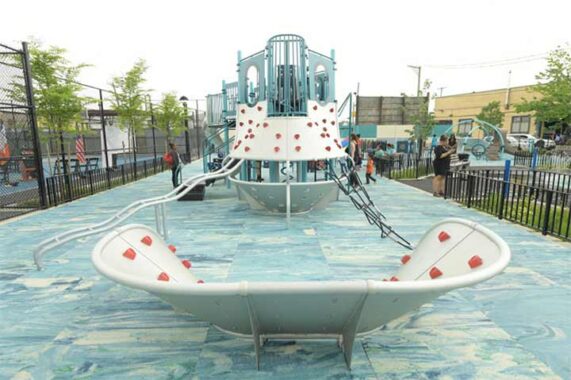
Levy Playground in Port Richmond honors a local reservist who died aboard Army Transport Ship USS Lincoln en route to Europe on October 1, 1917. He was one of many World War One casualties honored with a park name, and the only Jewish name on a park on Staten Island. His surname indicates ancestry in the tribe of Levi, which included the prophets Moses, Aaron, and Miriam.
Perhaps Worth Mentioning
Brooklyn’s Adam Yauch Park, State Street and Columbia Place in Cobble Hill, honors this local Beastie Boy who had a Jewish mother, but was a practicing Buddhist.
In Manhattan, there’s Robert Moses Playground in Turtle Bay, although he was intermarried, rarely spoke about his heritage, and had an Episcopal funeral.
In both of these boroughs, there are parks honoring Fiorello LaGuardia, whose mother was Jewish, and he spoke Yiddish, but attended an Episcopalian church. He’s on my Italian list.
Among Jewish Parks workers, currently there is no organized fraternal society to represent their culture. Their colleagues at the FDNY and NYPD have longstanding Jewish societies, NYCDOE has United Jewish Teachers, and the City Council has the Jewish Caucus that are represented every year at the Israel Day Parade.
Sergey Kadinsky is the author of Hidden Waters of New York City: A History and Guide to 101 Forgotten Lakes, Ponds, Creeks, and Streams in the Five Boroughs (2016, Countryman Press), adjunct history professor at Touro University and the webmaster of Hidden Waters Blog. This week, Sergey was blessed as he and his spouse welcomed their third child.
Check out the ForgottenBook, take a look at the gift shop. As always, “comment…as you see fit.” I earn a small payment when you click on any ad on the site.
5/16/26
4 comments
I have tried to email you privately but the email bounces back.
Impressive list! Thank you!
Being an Israeli-born Jew myself, it was good to hear about all of this.
Mazel tov on the birth of your third child! And also thanks for this wonderful entry in Forgotten NY.